Trump’s Quad meeting in Manila brought together the United States, Japan, Australia and India amid protests against a US-led technology and critical minerals initiative, growing tensions with China and preparations for a major diplomatic gathering in Shenzhen.
Trump met Indian Prime Minister Narendra Modi, Australian Prime Minister Anthony Albanese and Japanese Prime Minister Sanae Takaichi at the Solaire Resort in Manila on Tuesday, during the final day of the Association of Southeast Asian Nations (ASEAN) summit.
The meeting marked the first gathering of the four leaders since Trump returned to the White House in January 2025. The Quad partnership, which brings together the United States, Japan, India and Australia, seeks to strengthen cooperation across the Indo-Pacific and counter China’s growing regional influence.
The discussions covered maritime security, artificial intelligence, critical minerals and economic security, reflecting the strategic importance of the region to the four countries.
However, Trump’s arrival in the Philippines was accompanied by demonstrations, with protesters criticising the American-backed Pax Silica initiative and its proposed technology hub in the country.
Quad leaders discuss maritime security and emerging technologies
During the meeting, Trump described the four countries as important powers whose cooperation was essential to maintaining a stable and prosperous Indo-Pacific region.
He said the countries represented the four corners of a free, open and stable region and announced that the Quad would conduct an exercise involving US maritime patrol aircraft.
According to Trump, the exercise would help protect regional peace through military strength and closer security coordination.
Modi also highlighted the partnership’s activities since the beginning of 2025, noting that the foreign ministries of the four countries had met five times during the period.
He praised the contributions of the other leaders towards strengthening the grouping and advancing cooperation on maritime security.
The Quad leaders last met in September 2024 in Delaware, before Trump began his second presidential term.
Takaichi said the partnership would play an important role in shaping the future of the Indo-Pacific. She called for greater regional resilience and cooperation in areas including maritime security, energy, economic security and emerging technologies.
“We would like to realise a free and open Indo Pacific by strengthening resilience of countries in the region and promote their freedom to decide for themselves across a wide range of areas including maritime security, economic security, energy and critical and emerging technologies,” she said.
Albanese disclosed that the leaders would discuss critical minerals, rare earth resources and developments in artificial intelligence during their private discussions.
He also identified maritime security as an important issue on the agenda.
The Guardian reported that journalists were asked to leave the meeting room after the leaders delivered their opening remarks, allowing the four countries to continue their discussions privately.
Protests greet Trump over Pax Silica initiative
Trump’s arrival in Manila attracted demonstrations from hundreds of people who opposed his visit and the proposed Pax Silica initiative.
The protests focused particularly on plans to establish a technology hub at New Clark City in Tarlac, approximately 120 kilometres from Manila.
Pax Silica is designed to strengthen supply chains for artificial intelligence technology and critical minerals among participating governments, reducing dependence on individual suppliers, including China.
The initiative is expected to involve 25 signatory governments and is intended to improve access to the materials and technologies required by the global technology industry.
However, critics in the Philippines have raised concerns about the potential effects of the proposed development on local communities and natural resources.
Opponents argue that the technology hub could put pressure on water and electricity supplies and displace members of the Ayta Indigenous community.
Indigenous groups and other demonstrators gathered in Manila to condemn Trump’s visit and express opposition to the initiative.
The controversy highlights the challenges facing the United States as it attempts to strengthen its economic and technological partnerships in Southeast Asia while addressing local concerns about the consequences of major foreign-backed projects.
China threatens retaliation over new US chip restrictions
While Trump was holding discussions with the Quad leaders in Manila, China criticised fresh American restrictions on access to advanced artificial intelligence chips.
Beijing threatened to take what it described as necessary measures to protect its interests following Washington’s decision to tighten controls on remote access to advanced chips and computing infrastructure.
Chinese Foreign Ministry spokesperson Guo Jiakun accused the United States of using national security concerns to interfere with normal international trade and technological cooperation.
He argued that Washington had repeatedly expanded the meaning of national security and abused export controls to restrict China’s technology industry.
Guo also described the latest American measures as economic coercion, arguing that they contradicted the understanding reached between the two countries.
The new US rules restrict Chinese companies from remotely accessing advanced American artificial intelligence chips through data centres located in countries including Singapore, Thailand, Malaysia, Indonesia and Brazil.
The measures are designed to close a route that allowed Chinese businesses to obtain access to advanced American technology through facilities outside China.
The restrictions have emerged just days before Trump is expected to meet Chinese President Xi Jinping in Shenzhen on Thursday.
The dispute over technology controls is therefore likely to add another difficult issue to the relationship between the two economic powers.
Trump arrives in Manila amid political challenges
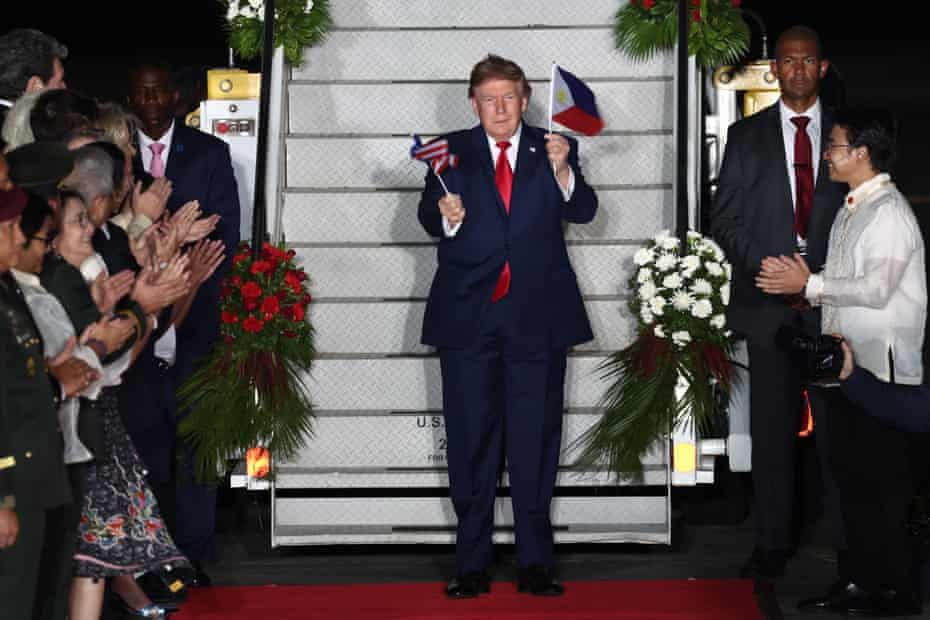
Trump arrived at Ninoy Aquino International Airport in Manila aboard a Boeing 747 aircraft gifted to him by Qatar.
He was welcomed by Philippine officials and members of the military during a red-carpet reception.
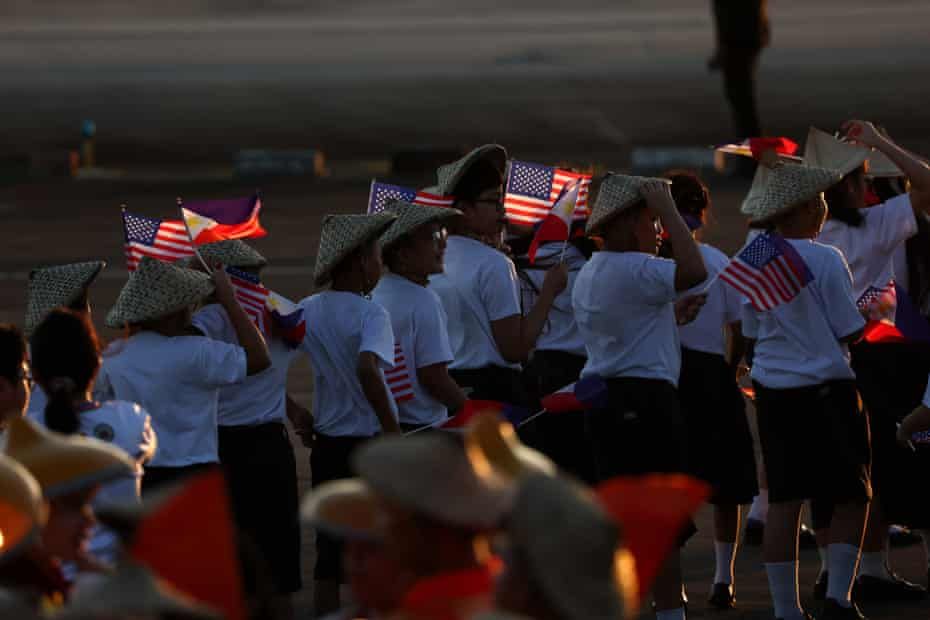
Philippine children also greeted the American president while waving US flags, as a military band played the song YMCA.
Trump’s visit comes as his domestic political position has weakened following the recent US midterm elections, with Republicans expected to lose control of Congress in January.
His arrival in Manila was also scheduled for the day the ASEAN summit was concluding, limiting the time available for extensive discussions with Southeast Asian leaders.
Philippine President Ferdinand Marcos Jr confirmed Trump’s arrival during a brief news conference after the country handed over the ASEAN chairmanship to Singapore.
Marcos said Trump was waiting for the Philippine leadership to meet him and invite him to an informal summit.
The Philippine president reportedly apologised for ending his interaction with journalists because he did not want to keep the US president waiting.
Marcos calls for protection of food and energy supplies
Before Trump’s arrival, Marcos called on Asian governments to strengthen safeguards for food and energy supplies as international conflicts continue to affect prices and trade.
He warned that disruptions occurring thousands of miles away could have direct consequences for households and businesses across East and Southeast Asia.
The Philippine president referred to the effects of the US-Israel war on Iran, which has contributed to concerns about energy costs, supply chains and the movement of essential goods.
He said regional governments needed to ensure that maritime trade and logistics remained operational while protecting access to food and energy.
Marcos stressed that international cooperation was necessary to help businesses continue operating and prevent global disruptions from placing excessive pressure on ordinary families.
His comments reflect wider concerns among Asian economies about the vulnerability of regional supply chains to geopolitical conflicts.
North Korea’s Kim Jong-un may attend APEC, Trump suggests
Trump also raised the possibility that North Korean leader Kim Jong-un could attend the APEC summit in Shenzhen.
Speaking to journalists before the Quad leaders began their formal discussions, the US president said Kim would like to attend the gathering.
His remarks came hours after Beijing said it had no information about a possible meeting between Trump and the North Korean leader.
Trump also indicated that he would be willing to hold a separate bilateral meeting with Russian President Vladimir Putin during the APEC summit if the opportunity became available.
The American president further said he intended to press Xi and Putin to become involved in efforts to end the war involving Iran.
He also told journalists that he would examine reports alleging that Iran had considered plans to detonate a so-called dirty bomb in Washington.
The possibility of Kim attending the summit would add another significant diplomatic dimension to the gathering, although no confirmed arrangement was announced in the reports.
Xi’s Shenzhen summit attracts international attention
China is hosting APEC for the third time, following previous gatherings in Shanghai in 2001 and Beijing in 2014.
The choice of Shenzhen reflects the city’s importance to China’s technology and manufacturing ambitions.
Located within the Greater Bay Area, which includes Hong Kong and Macau, Shenzhen has developed into a major centre for technology, innovation and industrial production.
The city is home to major Chinese companies such as BYD, Huawei and Tencent.
Analysts have said hosting the summit in Shenzhen allows Beijing to showcase its economic development and present the city as a centre of international trade and technological innovation.
The APEC chief executive summit concluded its activities on Tuesday, while Xi’s keynote address was expected on Wednesday. The main economic leaders’ meeting was scheduled for Wednesday and Thursday.
Meanwhile, Singapore has formally accepted the ASEAN chairmanship from the Philippines and will host the regional gathering next year.
Singaporean Prime Minister Lawrence Wong said 2027 would provide opportunities to strengthen ASEAN’s international relationships, including its partnerships with the United States, Canada and the European Union.
He also highlighted the 30th anniversary of ASEAN’s cooperation with China, Japan and South Korea.
France and Malaysia strengthen strategic partnership
Away from the main US-China diplomatic developments, French President Emmanuel Macron and Malaysian Prime Minister Anwar Ibrahim announced a series of agreements aimed at strengthening relations between their countries.
The two leaders upgraded their bilateral relationship to a strategic partnership during Macron’s two-day visit to Malaysia.
One important aspect of the agreements involves rare earth materials.
Malaysia agreed to relax export restrictions on certain raw rare earth materials to support cooperation with France in the sector.
Macron said the renewed partnership would help strengthen the independence of both countries while expanding cooperation in defence and security.
Anwar confirmed that Malaysia would supply some raw rare earth materials to France following Paris’s commitment to collaborate on processing the resources.
The agreement is significant because rare earth elements are essential to several advanced technologies, including electric vehicles, electronics and defence equipment.
About The Author