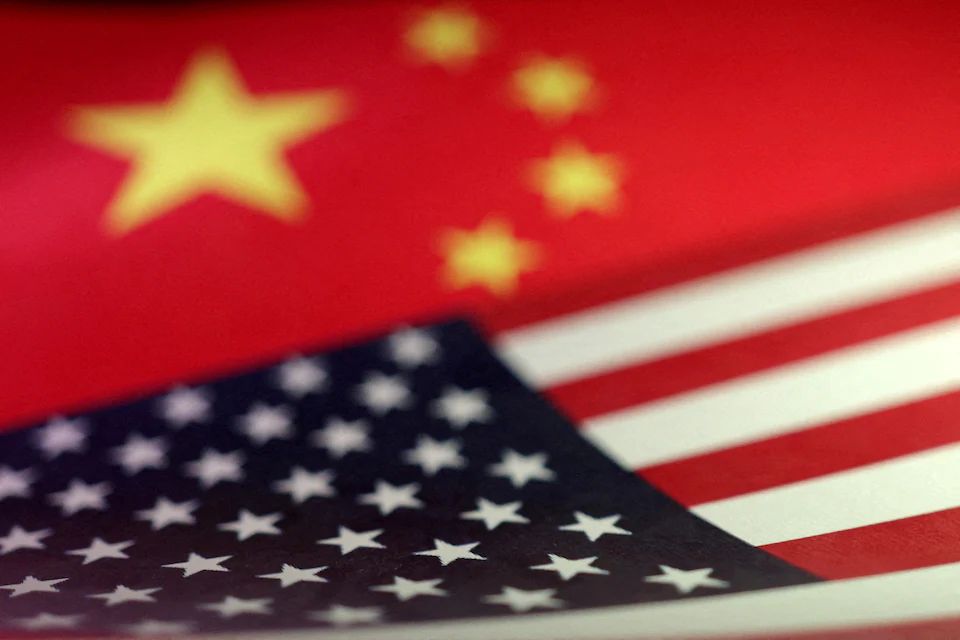
The US AI race with China is entering a decisive phase, with Washington preparing to warn dozens of countries that joining a competing Chinese artificial intelligence framework could threaten their place in a US-led technology coalition.
The planned warning is contained in a draft State Department letter reviewed by Reuters and addressed to 35 countries that signed an AI Opportunity Statement in June.
The letter signals a tougher approach from Washington as the United States seeks to protect its leadership in artificial intelligence, semiconductors and critical minerals while preventing Beijing from expanding its influence over the technologies shaping the global economy.
The message is blunt: countries may not be able to maintain close technological partnerships with Washington while simultaneously joining initiatives designed by Beijing.
“Choose deliberately,” the draft letter reportedly urges countries, warning that membership of the US-led framework represents more than simply signing up for another international initiative.
The emerging confrontation demonstrates how artificial intelligence has moved beyond a competition between technology companies. It is increasingly becoming a strategic contest involving national security, military capabilities, trade, critical minerals and global diplomatic influence.
Washington draws a line in the AI competition
The United States launched the Pax Silica initiative to strengthen cooperation with allies and partners on AI models, semiconductor technology and critical mineral supply chains.
The broader objective is to reduce dependence on countries considered strategic competitors while ensuring that Washington and its allies retain access to the resources required to develop advanced technologies.
About two dozen countries have joined the initiative, including Japan, Australia and South Korea.
Kazakhstan is particularly important because of its reserves of critical minerals and its strategic position in Central Asia.
However, Kazakhstan has also joined China’s rival AI initiative, making it the only country currently known to belong to both competing frameworks.
That development appears to have triggered concern inside Washington.
US warning puts partners under pressure
A US official involved in the discussions said Washington wanted to make the position unmistakable.
“You can’t have it both ways,” the official said, arguing that countries cannot credibly describe themselves as trusted partners of one technology ecosystem while simultaneously joining a competing Chinese initiative.
The draft letter reportedly says that membership of Pax Silica is a “commitment” rather than a simple subscription.
It further warns that the commitment cannot comfortably coexist with membership of “duplicative initiatives” whose expectations conflict with Washington’s objectives.
Although China is not specifically named in that passage, the intended target is clear.
The message could force governments that have tried to maintain balanced relationships with both Washington and Beijing to make increasingly difficult strategic choices.
China builds its own AI alliance
The pressure comes as Beijing works to establish an alternative global framework for artificial intelligence.
Chinese President Xi Jinping launched the World Artificial Intelligence Cooperation Organization in July, promoting China’s approach to AI cooperation and highlighting the country’s open-weight technology.
The initiative represents an effort to challenge what Beijing sees as excessive US influence over a rapidly developing sector.
China’s emergence as a major AI competitor has become increasingly significant because its open-weight models have made rapid advances against proprietary systems developed by leading US companies.
The competition is therefore no longer simply about who produces the most advanced chatbot.
It is increasingly about who controls the infrastructure, resources, standards and international partnerships that will underpin the next generation of artificial intelligence.
Open AI models change the balance
Chinese developers’ progress with open-weight AI models has complicated Washington’s strategy.
Open-weight systems can allow developers and organisations to inspect, adapt and deploy models with greater flexibility than many proprietary systems.
That has helped Chinese technology gain international attention while creating concerns in Washington about the possibility of China expanding its technological influence even where US companies remain dominant.
At the same time, Beijing is reportedly considering restrictions on overseas access to some of its most advanced AI models because of national security concerns.
The contradiction highlights the increasingly complicated nature of the China AI framework: Beijing wants greater international adoption of its technology while also protecting strategically important capabilities.
Critical minerals become part of the AI battle
Artificial intelligence depends on more than sophisticated algorithms and powerful computers.
The sector also requires enormous amounts of hardware, semiconductor components and critical minerals.
That is why Washington’s AI strategy is closely connected to its efforts to diversify mineral supply chains.
Kazakhstan’s importance is particularly obvious in this context.
The United States welcomed Kazakhstan into Pax Silica in June, describing it as the first Central Asian country to join the initiative and highlighting its significant reserves of minerals needed for advanced technologies.
China, meanwhile, maintains enormous influence over global critical mineral supply chains.
That influence has already become a major source of tension between Washington and Beijing.
AI, chips and minerals become strategic weapons
The US-China technology rivalry has increasingly blurred the traditional boundaries between economics and national security.
Semiconductors power advanced AI systems, while critical minerals are required for many of the technologies used to manufacture sophisticated hardware.
Control over those resources can therefore provide countries with significant leverage.
Washington’s effort to build alternative supply chains is partly designed to ensure that China cannot easily disrupt access to materials essential for US technological development.
For Beijing, maintaining its position in critical minerals provides an important economic and geopolitical advantage.
The result is a contest in which AI models, chips, minerals and international alliances are becoming interconnected.
US allies face a difficult choice
Countries caught between Washington and Beijing now face increasing pressure to decide how closely they want to align with either side.
For major US allies such as Japan, Australia and South Korea, the choice may be relatively straightforward because of their existing security and economic relationships with Washington.
For countries such as Kazakhstan, however, maintaining productive relationships with both major powers may be economically and strategically valuable.
That is why Washington’s warning could have consequences well beyond the AI industry.
If countries are forced to choose between rival technology ecosystems, the division could eventually influence trade, investment, semiconductor supply chains, mineral agreements and even diplomatic relationships.
The US-led AI coalition could become an important instrument for Washington’s broader strategy of containing China’s technological influence.
At the same time, Beijing is likely to continue presenting its own AI framework as a more open alternative to what it may portray as US-led technological exclusion.
The global AI race enters a new phase
The confrontation between Washington and Beijing is occurring as artificial intelligence capabilities advance at extraordinary speed.
AI systems are increasingly capable of performing complex tasks, while concerns are growing about their ability to conduct cyber operations, automate sophisticated activities and contribute to military applications.
The technology’s potential to reshape economies and national security has made leadership in AI a strategic priority for both powers.
Washington therefore wants its partners to share a common technological direction.
Beijing, meanwhile, is seeking to build a global network capable of reducing dependence on US technology and challenging American influence.
Kazakhstan becomes a test case
Kazakhstan’s position could become an early test of whether countries can remain active participants in both technology ecosystems.
Its membership of both initiatives has already attracted attention in Washington.
The US draft letter does not explicitly name China, but its warning against joining “duplicative initiatives” makes the strategic concern unmistakable.
Whether Kazakhstan and other countries ultimately choose one side or attempt to maintain relationships with both will help determine how fragmented the global AI landscape becomes.
Washington and Beijing prepare for a bigger technology showdown
The immediate issue is the future of Pax Silica and China’s rival AI framework, but the implications are much larger.
The US-China technology rivalry is increasingly becoming a competition over who sets the rules for the technologies that will define the next decade.
The United States has enormous advantages, including leading technology companies, advanced semiconductor capabilities and a network of powerful allies.
China, however, possesses a massive technology sector, significant manufacturing capacity and influence over critical mineral supply chains.
Both sides therefore have important strengths.
Read also: Trump cuts South Korea joint drills despite North Korea threat
The warning being prepared by Washington shows that the era when countries could comfortably cooperate with both technology superpowers may be coming under pressure.
The choice facing many governments may soon extend beyond economics.
It could become a question of which technological ecosystem they trust, which supply chains they depend on and which global vision they want to support.
As the AI race accelerates, the biggest battle may not simply be over who builds the smartest machine.
It may be over who gets to decide where the world’s artificial intelligence future is heading.
About The Author