Trump cuts South Korea joint drills despite warnings from US and South Korean military officials that North Korea is acquiring valuable battlefield experience from the Ukraine war, raising fresh questions about regional deterrence and the future of the US-South Korea alliance.
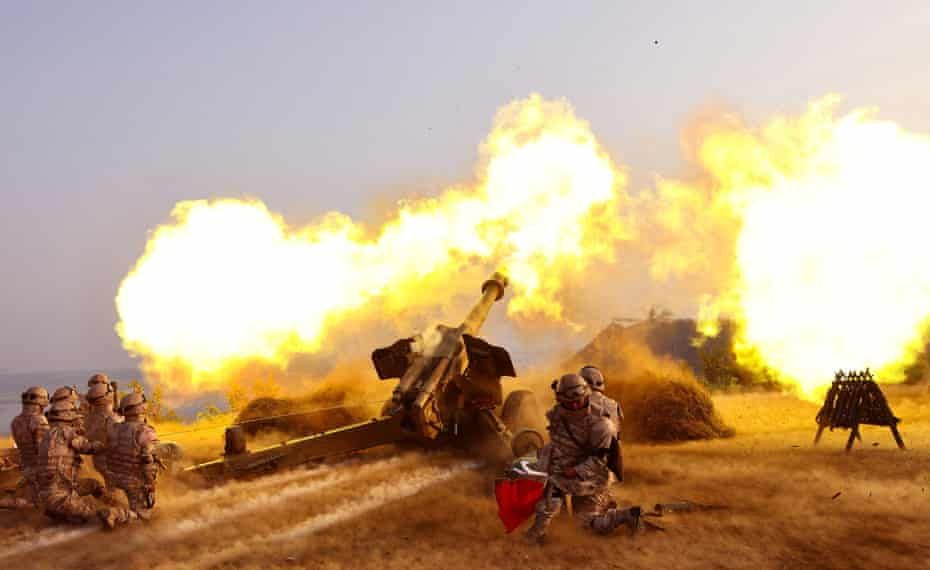
The decision comes as the annual Ulchi Freedom Shield exercises begin, with thousands of South Korean and American personnel expected to participate alongside troops and personnel from several countries under the United Nations Command.
The exercises are designed to strengthen the allies’ ability to respond to a potential North Korean attack. However, President Donald Trump has ordered the scale of the drills to be reduced, citing his relationship with North Korean leader Kim Jong-un.
Trump said he was “not happy” with the scale of US participation because of his “very good relationship with Kim Jong-un”.
He also argued that the exercises were expensive and could send an “inappropriate and hostile” signal to Pyongyang.
The announcement has created an unusual contrast between Washington’s diplomatic approach and military concerns over North Korea’s expanding capabilities.
Trump points to relationship with Kim Jong-un
Trump’s latest decision reflects his long-standing preference for direct engagement with Kim rather than relying exclusively on military pressure.
The US president has previously suspended or reduced major military exercises involving South Korea as part of efforts to create space for diplomacy with North Korea.
After Trump’s first summit with Kim in 2018, a major exercise was cancelled, while other drills were subsequently suspended or reduced before later returning in modified forms.
The latest move has therefore revived speculation that Trump could seek another meeting with Kim.
Trump recently shared an old photograph of himself with the North Korean leader on social media and again stressed that the two men “get along great”.
That statement has fuelled expectations that another Trump-Kim summit could eventually take place.
South Korea faces a difficult security calculation
For Seoul, however, reducing military exercises comes at a sensitive moment.
North Korea has strengthened its military relationship with Russia and has reportedly gained experience from its involvement in the war in Ukraine.
Military officials have warned that the experience could make North Korean forces more capable of using modern battlefield technologies.
South Korean and US officials had planned to incorporate lessons from the Ukraine conflict into this year’s exercises, including scenarios involving drones, GPS disruption and cyberattacks.
US military official Col Ryan Donald said North Korean troops had taken lessons from the battlefield and brought them back to North Korea.
“They’ve taken those lessons they learned there and brought them back to North Korea,” Donald said, arguing that the development had changed the country’s military capability.
That assessment makes Trump’s decision to reduce the drills particularly significant.
North Korea gains Ukraine battlefield experience
North Korea’s military cooperation with Russia has become one of the most important developments affecting security on the Korean Peninsula.
Pyongyang has provided Moscow with troops, artillery ammunition and ballistic missiles as part of its growing strategic partnership with Russia.
More than 14,000 North Korean troops have reportedly fought alongside Russian forces in the Kursk region, giving North Korean personnel exposure to modern warfare.
The experience reportedly includes the use of drones, electronic warfare, cyber capabilities and other technologies that are increasingly important on today’s battlefield.
US commanders warn of changing threats
Lt Gen Scott Winter, deputy commander of the United Nations Command, said the threats being addressed during the exercises reflected North Korea’s growing understanding of contemporary battlefield technology.
He said commanders were “very conscious” that North Korea had used the Ukraine conflict as an opportunity to test aspects of its military capability.
That assessment is particularly important because the purpose of the exercises is not simply to maintain traditional combat readiness.
The drills are also intended to help South Korean and US forces adapt to changing military technologies and tactics.
Officials therefore see the exercises as an opportunity to prepare for threats that could look very different from those faced during previous periods of tension.
One US military official described this year’s exercise as “bigger and better than ever” before Trump’s decision to scale back participation.
South Korea says drills will continue
Despite Trump’s announcement, South Korea’s defence ministry said the exercises would proceed according to the previously announced schedule.
That response highlights the delicate balance between Washington and Seoul.
The two countries remain treaty allies, with the US maintaining a significant military presence in South Korea as part of the broader effort to deter North Korean aggression.
However, Trump’s latest comments could intensify discussions about how much responsibility Seoul should assume for its own defence.
Cheong Seong-chang of the Sejong Institute said the alliance remained “extremely important” but argued that South Korea should gradually reduce its dependence on Washington.
He also pointed to growing domestic support for South Korea developing its own nuclear deterrent, although the government continues to reject that approach.
Other analysts have warned that reducing military cooperation could have unintended consequences.
Leif-Eric Easley of Ewha Womans University said scaling down the exercises could “weaken deterrence” against possible conflicts in Asia.
He also argued that the financial savings would be relatively small compared with the potential diplomatic and security costs.
North Korea rejects the reduced drills
Pyongyang has traditionally condemned US-South Korean military exercises, describing them as preparations for an attack.
North Korea’s foreign ministry called the latest exercise “a rehearsal for an aggressive war” and warned that it would respond to what it considers a new threat with a stronger deterrent.
The language is familiar from previous periods of heightened tension.
However, analysts believe Trump’s decision to reduce the exercises may not be enough to satisfy North Korea.
Lim Eul-chul, a North Korea expert at Kyungnam University, said Pyongyang would likely attach greater significance to a complete cancellation rather than a reduction.
“The North will only view it as meaningful if the joint exercises are cancelled in their entirety,” he said.
That creates a difficult diplomatic equation for Trump.
If Washington reduces the drills to encourage dialogue, Pyongyang may demand more concessions. If the US maintains the exercises at full strength, North Korea could use them as justification for additional weapons tests or military demonstrations.
Ballistic missile tests add to tensions
North Korea has already test-fired ballistic missiles in the period surrounding the exercises.
Analysts believe the launches were partly intended to protest the US-South Korean military activities.
The missile tests also demonstrate why military officials remain concerned about maintaining readiness.
North Korea has continued developing ballistic missile systems while deepening its relationship with Russia, creating an increasingly complicated security environment for South Korea, the United States and their regional partners.
Retired South Korean lieutenant general Chun In-bum warned that the changing threat should not be underestimated.
“This is a very serious improvement in North Korean capabilities,” he said.
His warning reflects the central dilemma surrounding Trump’s decision.
Trump faces pressure over North Korea policy
Trump’s decision to reduce the South Korea exercises could open another diplomatic channel with Kim Jong-un, particularly if the two leaders eventually meet again.
Read also: Ukrainian drone attack on Russia kills six, Moscow says
However, the move also risks creating uncertainty among allies at a time when military officials believe North Korea is becoming more experienced and technologically capable.
The challenge for Washington will be finding a balance between diplomacy and deterrence.
For Seoul, the question is equally serious: how can it preserve the benefits of its alliance with Washington while taking greater responsibility for its own security?
For now, the exercises will continue, but the debate over their future has become more intense.
Trump’s decision could ultimately become an important test of whether diplomatic engagement with Kim Jong-un can deliver meaningful security gains without weakening the military deterrence that has underpinned stability on the Korean Peninsula for decades.
About The Author