Roy Cooper’s affordability campaign is gaining momentum ahead of the November 3 US midterm elections, with the Democratic Senate candidate building a 14-point lead over Republican rival Michael Whatley in North Carolina by focusing on healthcare costs, household expenses and protecting public services.
Cooper, a former North Carolina governor, has centred his campaign on a straightforward promise to “make stuff cost less,” appealing to voters concerned about inflation, rising insurance premiums and the affordability of essential services.
The strategy appears to be working in a state that has not elected a Democrat to the US Senate in nearly two decades. An October SurveyUSA poll placed Cooper 14 percentage points ahead of Whatley, putting Republicans under pressure less than three weeks before election day.
The Republican super PAC leading Senate campaign spending has paused television advertising in North Carolina and redirected funds towards defending seats in other states, including Iowa and Kansas.
President Donald Trump is expected to campaign for Whatley in North Carolina on Tuesday, as Republicans attempt to reverse the Democratic candidate’s growing advantage.
Roy Cooper’s affordability campaign targets healthcare costs
Cooper, 69, has made healthcare affordability a central pillar of his campaign, drawing on his record as governor to argue that he can deliver practical results through bipartisan cooperation.
During his six years as governor, he fought to expand Medicaid despite resistance from North Carolina’s Republican-controlled legislature. The programme provides government-funded health insurance for eligible low-income Americans.
The expansion eventually passed in 2023, extending coverage to more than 700,000 residents, according to state health department data.
Cooper has repeatedly cited the lengthy battle as evidence that he can work across party lines to achieve policies that directly affect ordinary people.
At a September 26 rally in Raleigh, he described the financial pressures confronting families and criticised President Trump’s major tax and spending legislation.
“People should not have to make a choice between going to a doctor and putting food on the table,” Cooper said.
He added: “This ‘Big Beautiful Bill’ that gave tax cuts to billionaires has now driven healthcare premiums up more than double for people.”
The White House has defended the legislation, arguing that it cuts taxes, protects Medicaid for eligible Americans and tackles fraud and abuse.
Nevertheless, Cooper has used concerns about healthcare expenses to question whether Republican economic policies are helping working families.
Medicaid expansion strengthens Cooper’s campaign message
The Medicaid expansion remains one of Cooper’s most significant achievements as governor and an important part of his argument that his campaign is based on an established record rather than promises alone.
It took six years for him to persuade the Republican-controlled state legislature to approve the expansion under the Affordable Care Act, commonly known as Obamacare.
Following its passage, Cooper described the process as “an unnecessarily long and agonizing journey.”
The expansion extended health insurance coverage to hundreds of thousands of residents who had previously lacked access through the programme.
Cooper now argues that the gains could be undermined by federal legislation supported by Trump and congressional Republicans.
By linking his record on healthcare access with concerns about new federal cuts, the Democrat is seeking to persuade voters that the Senate election could have direct consequences for their household finances and medical coverage.

Trump-backed healthcare cuts become campaign issue
Cooper has made Trump’s sweeping tax and budget legislation a major target, arguing that its healthcare provisions threaten the progress North Carolina made under Medicaid expansion.
The Republican-led Congress passed the legislation last year. According to the nonpartisan Congressional Budget Office, it includes approximately $1 trillion in Medicaid cuts, representing the largest reduction in the programme’s history.
Cooper has framed the legislation as a decision to prioritise tax reductions for wealthy Americans while placing healthcare coverage under pressure.
The White House, however, maintains that the bill reduces taxes, protects eligible Medicaid beneficiaries and addresses fraud and abuse.
The competing arguments have placed healthcare policy at the centre of the North Carolina Senate contest, giving voters a direct comparison between the candidates’ approaches.
Cooper has also criticised congressional Republicans over their decision to curtail subsidies introduced during the COVID-19 pandemic for people purchasing health insurance through the Affordable Care Act marketplace.
According to health policy research organisation KFF, the changes caused premiums to rise and more than 200,000 North Carolina residents to lose their coverage.
The figures have provided Cooper with another opportunity to connect national Republican policy decisions with the financial concerns of voters in his state.
Prescription drug and insurance costs remain central
Rather than campaigning primarily on a proposal to replace the existing healthcare system with government-run insurance for everyone, Cooper has focused on expanding existing coverage and reducing the cost of medical care.
Some Democrats in heavily Democratic states have supported Medicare for All, a proposal intended to provide government-run health insurance to all Americans.
Cooper’s approach has instead emphasised Medicaid expansion, prescription drug prices and insurance affordability.
The strategy allows him to present himself as a moderate Democrat focused on specific household concerns rather than a candidate advancing a sweeping ideological programme.
His message could also appeal to voters who do not consistently support either major party but are concerned about the cost of living and access to healthcare.
Independent voters could decide North Carolina Senate race
North Carolina’s electorate presents an important opportunity for Cooper because a substantial proportion of registered voters do not identify with either the Democratic or Republican Party.
Approximately 40% of registered voters in the state are unaffiliated, compared with around 30% each for Republicans and Democrats.
That political balance makes independent voters particularly important in a Senate contest where a relatively small shift in support could determine the outcome.
Cooper’s campaign has sought to attract these voters by emphasising affordability, healthcare and his record of working with political opponents.
Neera Tanden, president of the Democratic-aligned Center for American Progress and a former adviser to President Joe Biden, said Cooper’s approach had helped him appeal beyond the Democratic base.
“It’s like he’s our star athlete and no one’s paying any attention,” Tanden said.
She added: “The strength of Roy Cooper’s campaign is that he’s able to attract Democrats and independents, but also even some Republicans because he’s focused on cost, but he also has a record.”
Her assessment reflects the view among some Democratic strategists that Cooper’s popularity and policy focus could offer a model for candidates campaigning in competitive states.
However, his advantage may also reflect his personal standing after years in public office rather than a strategy that every Democratic candidate could easily reproduce.
Republican rival Michael Whatley faces challenges
Whatley, a former chair of the Republican National Committee, has never held elected office, leaving him to introduce himself to voters while competing against a former governor with a long political record.
Republican strategist Paul Shumaker said Cooper entered the contest with a strong reputation built over decades of public service.
“Roy Cooper came to the US Senate race with a known brand that has been trusted by a majority of North Carolina voters election after election,” Shumaker said.
He added: “Republicans are suffering from a lack of trust on the economy right now and Whatley has failed to reestablish that trust.”
Whatley’s close association with Trump could also become a challenge if voters dissatisfied with the president’s economic record decide to support the Democratic candidate.
Trump’s approval rating stood at 32% in an October Reuters/Ipsos poll, its lowest level recorded in that polling series, according to the report.
The same poll found registered voters nationally favouring Democrats over Republicans by 44% to 37%.
Among independent voters, Democrats led by 37% to 21%, although 28% of independents remained undecided.
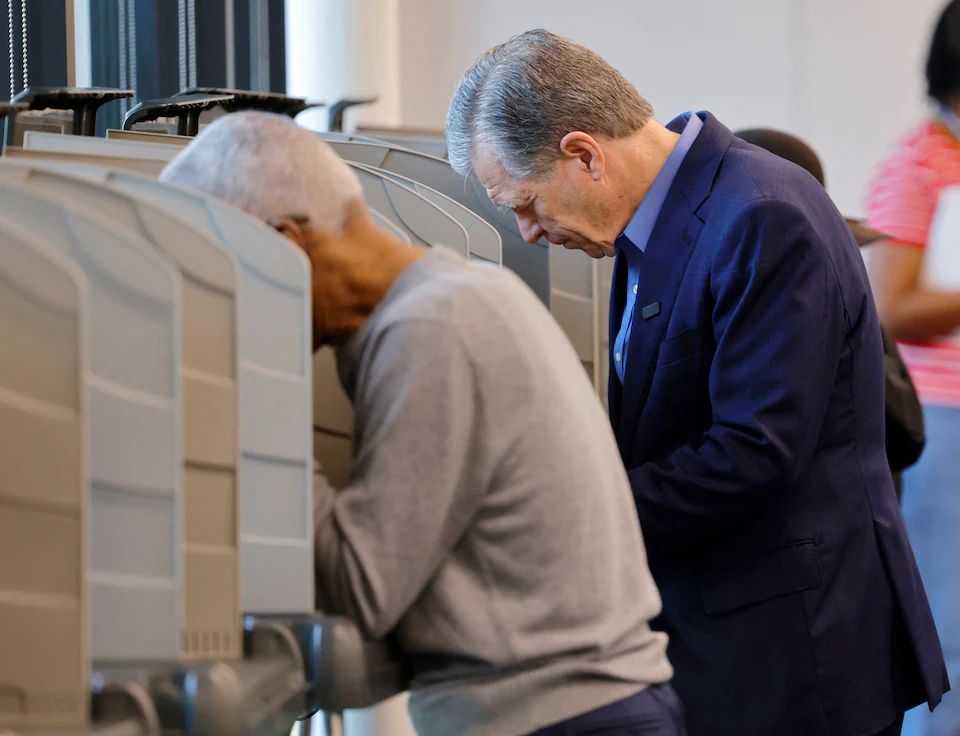
These national figures do not determine the result in North Carolina, but they indicate the wider political environment in which Republican candidates are campaigning.
Can other Democrats replicate Cooper’s strategy?
Cooper’s performance has prompted questions about whether other Democrats could use a similar approach to win voters in states where Republicans remain competitive.
His campaign combines a moderate political profile, a record of executive experience and a focus on everyday economic concerns.
Whit Ayres, a Republican pollster, suggested that other moderate Democratic governors in the South could achieve similar results, including Kentucky Governor Andy Beshear.
“The Roy Coopers of the world are not unique,” Ayres said.
He continued: “The Republicans nominated someone who’s never been elected to any public office at any level anywhere running against a reasonably moderate, popular governor.”
Ayres’s assessment highlights a key distinction in the race: Cooper is not simply campaigning on affordability but also drawing on an established record that voters have had years to evaluate.
Other Democrats may be able to adopt his emphasis on prices, healthcare and public services, but they might not enjoy the same level of recognition or popularity.
The effectiveness of the approach could depend on whether candidates can demonstrate tangible achievements while persuading voters that their opponents have failed to address economic concerns.
Senate control raises the stakes
The North Carolina contest is particularly significant because control of the US Senate is at stake in the November 3 midterm elections.
Republicans currently hold a 53–47 majority in the chamber. Democrats would need to gain four seats to take control.
That challenge makes competitive races such as North Carolina especially important for both parties.
The Republican super PAC’s decision to pause television advertising in the state and redirect campaign funds to other contests suggests that Republican strategists are reassessing where their resources could have the greatest impact.
However, the race is not over. Trump is due to campaign for Whatley, and Republicans will have opportunities to challenge Cooper’s record and present their own economic arguments before voters cast their ballots.
Cooper declined an interview request for the Reuters report, while Whatley’s campaign did not respond to a request for comment.
Cooper’s record could shape the final weeks
North Carolina’s Senate contest has become a test of whether a candidate with a moderate profile and a clear economic message can overcome the Republican Party’s traditional strength in the state.
Read more: France protests update: Police clash with thousands as demonstrations over high prices turn violent
Cooper’s emphasis on affordability has allowed him to connect healthcare policy with familiar household pressures, including insurance premiums, prescription drug costs and the choice between medical treatment and other essential expenses.
His Medicaid expansion record also gives him a concrete achievement to point to as he criticises proposed federal cuts.
For Republicans, the challenge is to convince voters that Trump’s economic and healthcare policies will benefit North Carolina residents and that Whatley can represent their interests effectively in Washington.
The result could offer Democrats lessons about campaigning in politically competitive states. However, Cooper’s personal popularity, experience and history of electoral success make it uncertain whether his approach can be reproduced elsewhere.
With election day approaching, the contest will provide an important indication of how strongly affordability concerns are influencing voters and whether those concerns can translate into a Democratic Senate victory.
About The Author