

France protests update: Police have fired tear gas and clashed with demonstrators as hundreds of thousands of people reportedly took to the streets across France, protesting high living costs, deteriorating public services, poor school conditions and growing social inequality.
The demonstrations on Saturday, October 17, escalated into violence in Paris and Marseille, where masked protesters threw fireworks and paving stones, set fires and damaged public property. French authorities detained dozens of people, with further arrests expected.
The nationwide mobilisation brought together students, teachers, workers, pensioners and farmers, reflecting growing frustration over economic hardship and the perceived weakening of France’s social welfare system.
The unrest also revived memories of the gilets jaunes, or yellow vests, movement that emerged in 2018 over economic grievances and social injustice during President Emmanuel Macron’s first term.
France protests spread as anger over living costs intensifies
The demonstrations developed from student protests that began last month in schools across the poor northern suburbs of Paris. Initially focused on teacher shortages and deteriorating school facilities, the movement has expanded into a broader challenge over inequality and public spending.
Students and their supporters have complained about absent teachers, inadequate learning environments and what they consider a lack of government attention to educational needs.
Saturday’s demonstrations sought to broaden the movement by bringing together people affected by rising prices, pressure on household budgets and concerns about public services.
According to figures released by French authorities, 140 protests involving 32,800 people had been recorded outside Paris by midday. The authorities attributed the violence to what they described as the “ultra-left”.
However, the demonstrations attracted people with different grievances, including those concerned about inflation, wages, pensions, education and the availability of essential public services.
The CGT, one of France’s largest labour unions, backed the mobilisation, calling for “higher wages and pensions, lower prices and the protection of public services that meet people’s needs”.
An October survey involving 2,000 people found that approximately 45 per cent of French respondents were worried about rising living costs and inflation.
Protesters demand affordable living and better public services
For many demonstrators, the protests represent a struggle against the increasing pressure on ordinary households as the costs of essential goods and services remain a major concern.
Fuel prices have become one of the prominent issues, echoing the grievances that helped trigger the yellow vest movement in 2018.
A 19-year-old demonstrator in Paris, identified as Lola, explained why she had joined the protest.
“We are fighting because the cost of living is too harsh, because the price of fuel is too high, because high school pupils are being violently attacked and hurt all over the country just for trying to protest and ask for more teachers and decent learning conditions,” she said.
Her comments reflected the connection between economic concerns and anger over the treatment of young demonstrators during the recent school protests.
The movement has also attracted workers, pensioners and farmers, whose participation has widened the protests beyond their original focus on schools.
Paris demonstrations turn violent as police fire tear gas
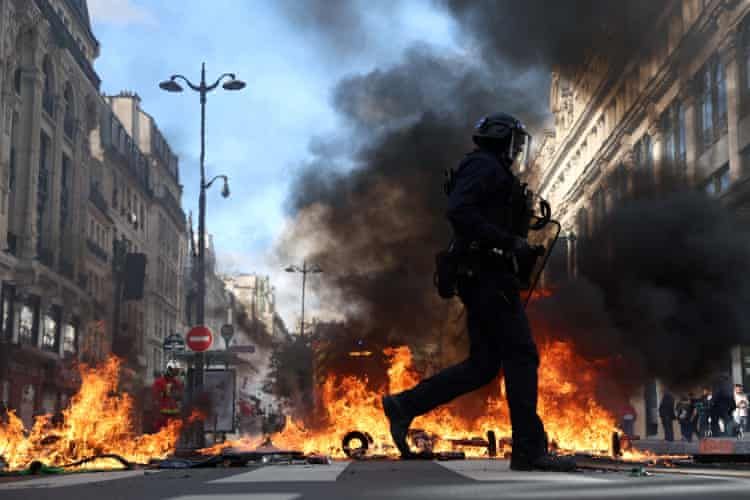
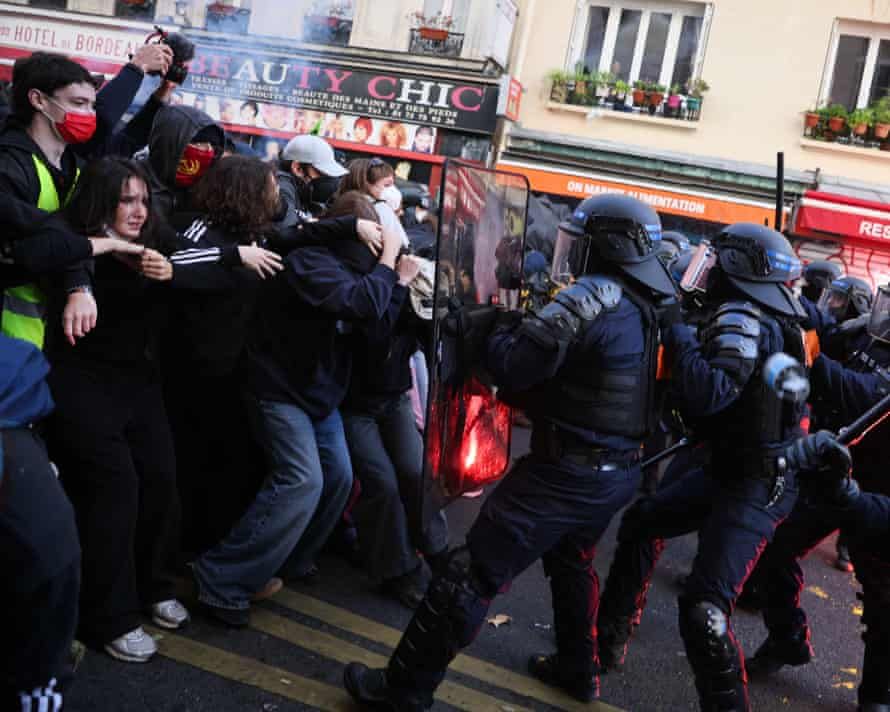
In central Paris, a march around Place de la République that had begun peacefully descended into violence as masked and black-clad demonstrators clashed with police.
Officers fired tear gas after some protesters threw fireworks and paving stones, attacked a bank and looted a sports shop.
One demonstrator shouted, “We’re taking the Bastille!” as tensions escalated.
Other protesters set wheelie bins on fire, threw firecrackers into the burning containers and overturned glass recycling bins. Some collected bottles from the broken containers and used them as projectiles.
A lorry was also set on fire, with flames spreading to a nearby building. The resulting smoke and tear gas created dangerous conditions in surrounding streets.
Residents were forced to close their windows and doors as thick clouds of tear gas rose towards the rooftops.
The violence occurred amid a substantial police presence in central Paris, particularly around prominent landmarks and government areas.
The Avenue des Champs-Élysées and the Arc de Triomphe were excluded from the routes of the two official demonstrations, while authorities imposed restrictions on some other proposed gatherings.
Approximately 100 people reportedly approached police at the beginning of one demonstration, shouting, “all cops are bastards!”
The clashes highlighted the challenges facing authorities as they attempt to manage large demonstrations while preventing violence and protecting public property.
Police detain protesters across the country
French authorities detained dozens of demonstrators across the country, and officials anticipated that the number of arrests could rise as police continued responding to unrest.
Interior Minister Laurent Nuñez had warned ahead of Saturday’s mobilisation that hundreds of protest actions and more than 80 marches were expected nationwide.
These included organised demonstrations, spontaneous gatherings and road blockades.
Police also requested the closure of numerous Métro stations in Paris, including stations around the Champs-Élysées and areas near the presidential palace, parliament and government offices.
The measures were intended to manage public movement and reduce security risks around sensitive locations.
However, the scale of the mobilisation showed that the protests had spread well beyond individual school campuses, becoming a nationwide expression of discontent.
Marseille protesters storm town hall
Marseille witnessed some of the most dramatic scenes of the day when protesters forced their way into the city’s town hall.
Demonstrators used security barriers removed from the street to ram the entrance, briefly gaining access to the municipal building.
One protester spray-painted an “A” symbol associated with anarchy on a wall before police officers intervened and removed those who had entered.
Other protesters set rubbish bins alight, damaged property and vandalised a municipal police station.
Images from the city showed riot police detaining demonstrators and protesters confronting authorities amid smoke and burning objects in the streets.
The incident underscored the growing tension between protesters and security forces as the demonstrations expanded from peaceful marches into confrontations involving vandalism and arson.
Marseille’s unrest also reflected the wider geographical spread of the mobilisation, with demonstrations and protest actions recorded in cities and towns across France.
In Nancy, northeastern France, protesters placed rubble across a road in preparation for an afternoon rally, while demonstrators elsewhere used high-visibility vests and street blockades reminiscent of the yellow vest movement.
Macron calls for calm and respect for property
President Emmanuel Macron appealed for calm on Friday, ahead of the nationwide demonstrations, urging protesters to respect people and property while defending their constitutional right to demonstrate.
“There is a constitutional right to protest and to express oneself, and I have always been vigilant and attentive that that right is fully respected,” Macron said.
He continued: “But this right comes with the need to respect. Respect for people, respect for property, and therefore a commitment not to insult or destroy.”
Macron also described as “unacceptable” the possibility that some people might attend demonstrations solely to cause damage and create unrest.
His comments came as officials warned that the planned mobilisation could lead to further confrontations between demonstrators and police.
The president is entering the final stretch of his presidency, leaving behind a deeply polarised electorate and a fragmented political landscape.
The protests have therefore emerged at a politically sensitive moment, with disputes over economic policy, public spending and the condition of public services contributing to wider dissatisfaction.
Police violence allegations deepen tensions
The latest demonstrations followed weeks of unrest involving students and security forces, with thousands of arrests and hundreds of injuries reported during the wider protest movement.
Schools have also been set on fire during the disturbances, while allegations of excessive police force have intensified public scrutiny.
The police watchdog is investigating at least two dozen allegations of police violence. France’s prime minister has said that more than 900 police officers have been injured.
Some protesters have sustained severe injuries that campaigners attribute to police riot-control weapons.
Interior Minister Nuñez suspended the use of a particular type of stun grenade against young demonstrators after a 15-year-old lost a hand. However, he said the devices could be used during Saturday’s demonstrations.
The allegations have become an important part of the wider dispute, with protesters arguing that young people should not face serious injuries for demanding better educational conditions.
Authorities, meanwhile, have stressed the need to maintain public order and prevent violence against officers and other members of the public.
On Tuesday, climate and social justice activist Greta Thunberg joined students at a school in Saint-Denis, a suburb north of Paris, demonstrating the international attention the school protests have attracted.
Political parties seek to capitalise on the unrest
France’s political divisions have become increasingly visible as parties on both the far left and far right seek to benefit from the growing protest movement.
The left has positioned itself in support of demonstrators, highlighting concerns about inequality, public spending and the treatment of students.
Jean-Luc Mélenchon, leader of the far-left France Unbowed party, joined a demonstration on Tuesday and has publicly expressed support for the student protesters.
On the right, political voices have backed the police and emphasised the importance of public order.
The competing responses reflect the difficulty of turning a broad protest movement into a unified political programme.
Although many demonstrators share concerns about living costs and public services, their political affiliations and preferred solutions may differ considerably.
The revival of yellow vest-style protests nevertheless signals that economic grievances remain politically significant in France, particularly when they converge with anger over education, policing and social inequality.
France protests raise questions about the country’s direction
Saturday’s demonstrations have exposed the scale of public frustration over the cost of living, education and the condition of social services.
What began as protests over teacher shortages and inadequate school facilities has developed into a broader mobilisation involving several sections of French society.
The participation of labour unions, pensioners, farmers and other groups has widened the movement, while violent incidents in Paris and Marseille have placed public order at the centre of the national debate.
Read also: Trump refuses to blame Putin in Ukraine war update as he suspends new sanctions
For the government, the challenge is to address legitimate concerns about household expenses and public services while preventing demonstrations from descending into violence.
For protesters, the central demand is for a response to rising costs, improved educational conditions and stronger protection for essential services.
With Macron approaching the final stage of his presidency, the demonstrations could further influence political debate over economic priorities, social policy and the future direction of France.
The extent to which the movement can maintain its momentum, secure concrete concessions and avoid further violent confrontations remains uncertain.
About The Author


