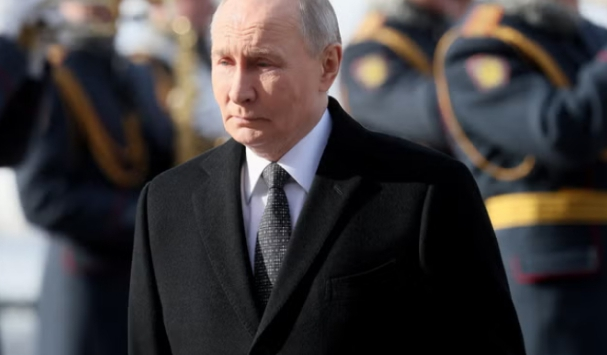
Russia-Ukraine war live coverage on Monday was shaped by a stark warning from Russian President Vladimir Putin, who said Ukraine’s Western allies were “pushing themselves to the edge” and would “regret” their continued political, military and financial support for Kyiv, as the conflict entered its fifth year with no clear path to a negotiated settlement.
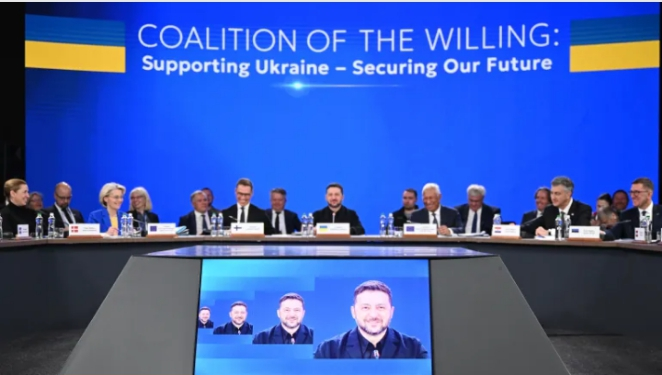
Putin’s remarks came as European leaders gathered in Kyiv to mark four years since Russia launched its full-scale invasion of Ukraine, a milestone that has renewed diplomatic pressure on both sides while exposing deep divisions over how the war should end.
Speaking amid anniversary events, the Russian leader framed Western backing for Ukraine not as solidarity with a sovereign state, but as a deliberate strategy to weaken Russia and prolong the fighting.
According to Putin, Ukraine’s allies are ignoring what he described as Moscow’s repeated warnings about security red lines, choosing instead to expand weapons deliveries, intelligence sharing and economic assistance.
He argued that these actions were escalating the conflict beyond Ukraine’s borders and increasing the risk of wider confrontation, language that echoes earlier Kremlin statements linking Western involvement to global instability.
The warning was interpreted by analysts as another attempt by Moscow to pressure European governments at a moment of symbolic importance, as leaders from Britain, France and Germany reaffirmed long-term commitments to Ukraine’s defence.
For the Kremlin, the anniversary served as an opportunity to restate its narrative that Russia is not fighting Ukraine alone, but a coalition of Western states intent on reshaping the European security order.
European officials dismissed Putin’s comments as intimidation and propaganda, insisting that support for Ukraine is rooted in international law and the principle that borders cannot be changed by force.
Standing alongside Ukrainian President Volodymyr Zelenskyy, visiting leaders said continued assistance was necessary to prevent Russia from consolidating territorial gains and setting a precedent for future aggression.
Zelenskyy, addressing Ukrainians on the anniversary, emphasised that independence and territorial integrity remain non-negotiable, particularly as diplomatic discussions continue behind closed doors.
He acknowledged growing international fatigue but said Ukraine could not accept peace at the cost of sovereignty, especially in contested eastern regions where fighting has left towns devastated and communities displaced.
Putin’s warning to Ukraine’s allies also came amid intensified economic pressure on Russia. The United Kingdom announced nearly 300 new sanctions targeting Russian energy revenues and suppliers of military equipment, describing the measures as the largest package since the early months of the invasion.
Australia followed with restrictions on imports of Russian-origin petroleum and gas products, saying the aim was to reduce Moscow’s ability to finance its war effort.
Moscow has repeatedly downplayed the impact of sanctions, but economists say the cumulative effect has reshaped Russia’s economy, forcing a shift towards military production at the expense of civilian sectors. Rising inflation, higher taxes and reduced consumer spending have added to domestic strain, even as the Kremlin continues to prioritise defence spending and battlefield logistics.
The financial burden of the war is even more pronounced in Ukraine. The World Bank recently raised its estimate for rebuilding the country to $588bn, citing extensive damage to housing, transport networks and energy infrastructure. The revised figure highlights the long-term cost of a conflict that has displaced millions and destroyed entire communities.
Despite these mounting costs, Putin maintained that Western governments were acting irresponsibly by encouraging Ukraine to resist rather than compromise.
Russian officials have repeatedly argued that peace could be achieved if Kyiv accepted territorial concessions, a proposal Ukrainian leaders say would reward aggression and undermine future security.
Human rights organisations have warned that the war’s legacy will extend far beyond territorial disputes. Human Rights Watch said documented abuses over four years of fighting demonstrate a pattern of disregard for civilian life and international humanitarian law.
The group has called on Ukraine’s allies to support accountability measures, including investigations at the International Criminal Court, a demand Russia rejects.
Putin’s remarks also revived concerns about nuclear rhetoric, which has surfaced repeatedly during the conflict. While stopping short of explicit threats, the Russian president reminded audiences that Moscow’s adversaries understand how any attack involving a nuclear element could end, reinforcing a message of deterrence aimed at Western capitals as much as at Kyiv.
Diplomatic efforts to de-escalate the conflict have so far failed to produce tangible results. Talks held earlier this month in Geneva were the latest in a series of mediation attempts that have stalled over fundamental disagreements on territory, security guarantees and sanctions relief.
Observers say Putin’s latest warning suggests the Kremlin sees continued Western involvement as an obstacle rather than a pathway to peace.
At the same time, Europe faces its own challenges as the war drags on. Defence analysts warn of capability shortfalls and ammunition shortages, prompting NATO members to pledge significant increases in military spending over the coming decade.
Read also: Russia’s invasion of Ukraine: Kremlin admits goals not yet achieved
For many European governments, Putin’s language reinforces the view that Russia remains a long-term security threat requiring sustained deterrence.
As the Russia-Ukraine war live conflict enters another year, the gap between Moscow and Kyiv, and between Russia and the West, appears as wide as ever.
Putin’s warning to Ukraine’s allies underscores a strategy built on pressure and deterrence, while Europe’s response signals a determination to stand firm despite the risks.
With front lines largely frozen and diplomatic channels strained, the anniversary has served less as a moment of reflection than as a reminder that the war’s most dangerous phase may still lie ahead.