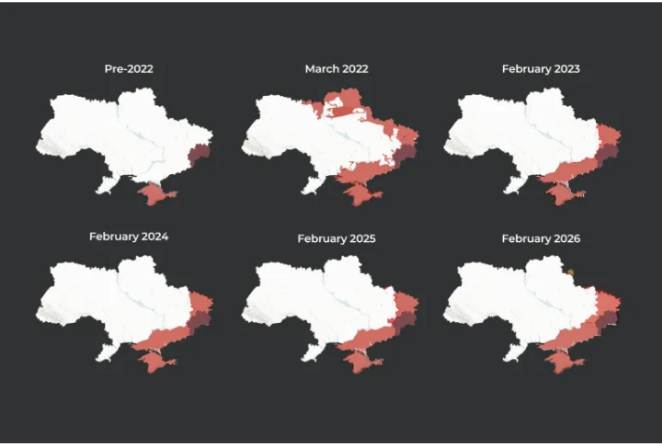
Mapping Russian attacks and territorial gains across Ukraine reveals a war that has devastated cities, displaced millions, and transformed the country into Europe’s largest conflict since 1945.
The war began on February 24, 2022, when Russian forces invaded from multiple directions, targeting Kyiv, the Donbas, and southern regions, following the recognition of separatist territories.
Initially, Moscow’s troops advanced rapidly, seizing roughly 27 percent of Ukraine, but Ukrainian counteroffensives gradually pushed back, demonstrating that initial momentum could not overcome determined resistance.

Ukraine’s defense slowed Russian advances near Kyiv and Kharkiv, forcing withdrawals and reshaping the front line, highlighting the resilience of local forces and strategic planning across multiple regions.
In the Donbas, Russia intensified operations, capturing cities such as Bakhmut and Avdiivka after months of brutal fighting, with casualties mounting on both sides during grinding battles.
Ukraine retaliated with counteroffensives, reclaiming key towns and infrastructure, showing that persistent strategy and coordinated military efforts can gradually erode Russian territorial gains over time.
Mapping Russian attacks and territorial gains across Ukraine also underscores the dramatic expansion of drone warfare in Ukraine, which has become central to Moscow’s operational strategy.
Drone strikes have escalated, rising from thousands in 2023 to tens of thousands by 2025, including repeated attacks on civilian areas, infrastructure, and densely populated urban centers.
Russia primarily uses Shahed-type drones, originally supplied by Iran, but now manufactured domestically in regions such as Tatarstan, allowing sustained daily assaults across multiple front lines.
Ukraine has countered drone attacks with layered air defenses, mobile teams, and electronic warfare systems, yet waves of drones and missiles continue to overwhelm protective measures.
The relentless campaign has included more than 1,900 attacks on Ukraine’s energy infrastructure, targeting power plants, distribution networks, and substations, leaving millions facing rolling blackouts.
Winter months have amplified the human cost, as temperatures drop below minus 20 degrees Celsius, leaving civilians exposed to freezing conditions after repeated energy attacks.
President Volodymyr Zelenskyy declared a nationwide emergency for the energy sector in January 2026, warning that electricity generation met only 60 percent of demand.
Strategic attacks on cities including Kyiv, Kharkiv, and Odesa demonstrate how Russia has targeted civilian populations, attempting to undermine morale and disrupt essential services.
Mapping Russian attacks and territorial gains across Ukraine also highlights the incremental nature of front-line changes, with towns sometimes captured after daily advances of mere tens of meters.
Pokrovsk and Kostiantynivka in Donetsk have been focal points, serving as gateways for Moscow to secure larger cities such as Kramatorsk and Sloviansk, often at tremendous human cost.
Despite severe losses, Russian advances slowed significantly in 2025, as Ukraine strengthened positions and leveraged intelligence, artillery, and coordinated counterattacks to limit territorial expansion.
Air and drone attacks now surpass artillery strikes in frequency, reflecting the modernization of Russia’s offensive strategy and the growing importance of unmanned weapons in shaping the battlefield.
Ukraine has responded with counter-drone tactics and electronic warfare, while simultaneously coordinating conventional artillery, tank, and infantry movements to safeguard reclaimed territories.
The war has also strained logistics, with energy infrastructure attacks disrupting industrial production, civilian services, and military supply lines, affecting both urban centers and rural communities.
Mapping Russian attacks and territorial gains across Ukraine reveals how these disruptions have forced Ukraine to adopt flexible emergency protocols, including localized energy rationing and rapid repair operations.
Diplomatic efforts have repeatedly failed to halt the conflict, with more than a dozen rounds of peace talks yielding no substantial results and often collapsing after civilian atrocities.
Early negotiations in Belarus and Turkiye, including the March 2022 Istanbul talks, sought to outline a settlement, but proposals were rejected as Russia demanded control over the Donbas region.
Multilateral summits excluding Moscow produced minimal progress, leaving Ukraine’s leadership reliant on military resilience and international support to protect sovereignty and maintain defensive positions.
Recent trilateral talks facilitated by the Donald Trump administration in Abu Dhabi and Geneva marked renewed diplomatic engagement, yet a comprehensive peace deal remains elusive.
Russia continues to insist on territorial concessions and a permanent denial of NATO membership for Ukraine, while Kyiv maintains that no land will be surrendered without binding security guarantees.
Mapping Russian attacks and territorial gains across Ukraine underscores the war’s human toll, including civilian deaths, displacement of millions, and widespread trauma across affected regions.
Drone warfare in Ukraine, energy infrastructure attacks, and prolonged battles have reshaped civilian life, forcing adaptations to blackouts, disrupted heating, and constant air raid alerts.
Ukraine counteroffensives have demonstrated the country’s determination, slowly reclaiming territory, protecting key cities, and maintaining morale under extreme hardship and continuous Russian assaults.
The Donbas conflict remains central, with high-intensity operations and strategic targeting of logistical hubs continuing to define the war’s trajectory and the distribution of Russian and Ukrainian forces.
Mapping Russian attacks and territorial gains across Ukraine illustrates a conflict defined by endurance, technological adaptation, and the interplay of diplomacy, strategy, and sheer human resilience.
While the front line shifts slowly, the combination of drone warfare in Ukraine, targeted energy attacks, and persistent Ukrainian counteroffensives ensures the conflict’s consequences resonate far beyond the battlefield.
Even as peace talks falter, the war continues to shape regional security, influence global alliances, and challenge conventional military doctrines, revealing both vulnerabilities and strengths on both sides.
Four years on, mapping Russian attacks and territorial gains across Ukraine provides a stark record of a protracted war, highlighting incremental territorial changes, strategic innovations, and ongoing humanitarian crises.
As the war enters its fifth year, Moscow’s ambitions remain partially realized, Ukraine’s resilience continues to hold, and the international community grapples with the broader consequences of prolonged conflict.
Read also: Miracle baby arrives in UK after groundbreaking deceased donor womb transplant