

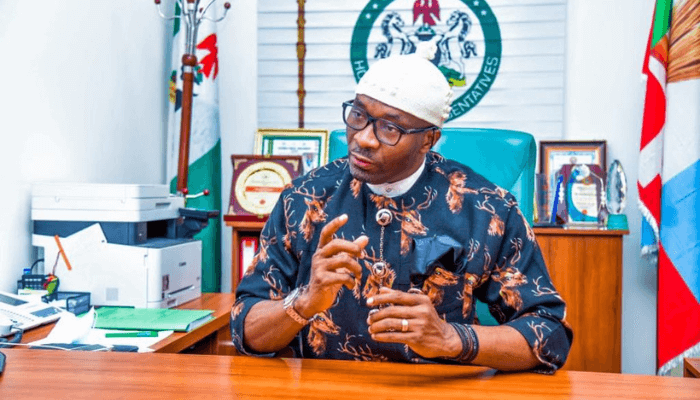
The Deputy Speaker of the House of Representatives, Benjamin Kalu, has urged the Igbo people to reconsider their political calculations ahead of future elections, insisting that the South-East should not accept a four-year presidential arrangement after waiting for nearly six decades to produce Nigeria’s President.
Kalu argued that whenever the opportunity eventually comes for the region to occupy the nation’s highest political office, the Igbo should be prepared for a complete eight-year tenure rather than settle for a single four-year term.
He made the declaration in Umuahia, Abia State, during the inauguration of the All Progressives Congress (APC) Campaign Council, where he also encouraged political leaders and residents of the South-East to strengthen their relationship with other regions through strategic alliances.
According to the Deputy Speaker, the region’s quest for political relevance cannot be achieved through isolation or emotional considerations.
Instead, he maintained that the Igbo must develop a deliberate political strategy that would enable them to participate more effectively in national decision-making.
He specifically urged the people to support President Bola Ahmed Tinubu, describing cooperation with the ruling party as an opportunity for the South-East to strengthen its position within the country’s political structure.
Kalu, who represents Bende Federal Constituency in the House of Representatives, said the Igbo had demonstrated considerable intelligence and foresight in business, particularly in overcoming the economic difficulties that followed the Nigerian Civil War.
He explained that the ability of the people to rebuild their commercial activities, establish businesses and develop economic networks after the conflict was largely connected to their willingness to think strategically and identify opportunities.
However, he expressed concern that the same approach had not been consistently applied to their political engagements.
In a statement issued by his Chief Press Secretary, Levinus Nwabughiogu, the Deputy Speaker argued that sentiment had prevented the South-East from making certain political decisions capable of advancing its collective interests.
He maintained that political progress required more than emotional attachment to particular positions or individuals, stressing that negotiations, partnerships and calculated alliances were essential to achieving meaningful representation.
Kalu said the South-East should learn from its economic experiences and adopt similar principles in pursuing its political aspirations.
He stated: “Over the years, we have been very successful in our business as a people in the South-East, and we have been able to achieve what we achieved post-civil war, rebuilding the South-East without the intervention of the government, only because we are strategic in our thinking.
“But I want to tell you that where we have gotten it wrong in our political growth is that rather than apply that formula that had helped us in our businesses, in our economic life, the Igbo have been sentimental.
“Sentiment does not drive political growth, participation, engagement and advancement. It does not drive the dividends of democracy. It is about time that we dropped sentiment and picked up strategy.”
The lawmaker further called for stronger political relationships between the South-East and other geopolitical zones, arguing that the region could not secure its desired place in national politics by operating independently.
He described political cooperation across regional boundaries as a necessary step towards building influence, adding that the Igbo should be willing to establish partnerships with political stakeholders outside their immediate environment.
According to him, there is little advantage in remaining politically isolated when the country’s democratic system requires negotiations and broad-based support to secure important positions.
Kalu also referred to the experiences of previous Nigerian political leaders who, according to him, struggled to advance the interests of their communities until they established wider political partnerships.
He warned that the South-East could lose valuable political opportunities if its leaders continued to make decisions without properly considering the long-term consequences.
The Deputy Speaker consequently urged the people to view their votes as an important political asset that must be deployed carefully rather than wasted on arrangements that might not produce meaningful results.
He identified Tinubu as the political leader the Igbo should support, describing the President as someone whose approach to governance, in his assessment, transcends ethnic and cultural boundaries.
Kalu explained that his support for the President was not simply because Tinubu currently occupies the nation’s highest political office but because he identified with his political philosophy and leadership principles.
He said the President’s approach to governance was based on building structures and institutions capable of outliving the individual in power.
He added that the President’s political outlook provided an opportunity for Nigerians from different backgrounds to participate in national development without being restricted by their ethnic identities.
“There is no pride in waste. What is strategic is to invest our votes. And as Igbo, we have always made investments that yielded dividends. And that is why we are prosperous.
“I can assure you that in politics, there will be a paradigm shift in which the Igbo will cast their votes into a rewarding investment platform. That platform is none other than President Bola Ahmed Tinubu,” he said.
Kalu further declared that the Igbo should take a more active position in determining the country’s political direction, insisting that electoral participation remained one of the strongest instruments available to the region.
On the performance of the Tinubu administration, the Deputy Speaker expressed confidence that the Federal Government’s policies and ongoing interventions would gradually produce more visible outcomes.
He argued that the administration had spent its first three and a half years establishing the foundations for national development, adding that Nigerians would begin to appreciate the results as the various initiatives progressed.
Using the construction of a building as an illustration, he explained that the foundation represented the initial stage of development, while the bricks, walls and roofing symbolised the subsequent benefits expected from the government’s policies.
He maintained that the President had invested the period in office in laying the groundwork for a country that future generations could be proud of.
The Abia lawmaker also drew attention to what he described as major achievements of the Tinubu administration in the South-East, noting that government interventions had covered different sectors of the regional economy.
Although he did not provide a detailed breakdown of the projects during the remarks contained in the statement, he urged the people to recognise the administration’s activities and consider their implications when making political decisions.
Meanwhile, Kalu charged members of the newly inaugurated Abia APC Campaign Council to intensify mobilisation efforts across the state.
The council, which comprises more than 500 members, was tasked with taking the message of the Federal Government’s Renewed Hope Agenda to communities and grassroots political structures throughout Abia.
He urged the campaign officials to engage residents, communicate the party’s programmes and strengthen its presence at the local level.
The Deputy Speaker maintained that the South-East’s political future would depend significantly on its willingness to build lasting alliances, make calculated electoral decisions and participate actively in the country’s democratic process.
He reiterated that while the aspiration for an Igbo presidency remained important, the region must first establish the political relationships and influence required to turn that ambition into reality.160-Character SEO Snippet
Benjamin Kalu urges the Igbo to reject a four-year presidency deal, seek eight years and build political alliances while backing President Tinubu.
About The Author
