European peacekeepers deployed to Ukraine after a possible ceasefire would be authorised to defend themselves against Russian attacks, with British and French forces preparing for a potential mission that could expose them to renewed confrontation with Moscow.
Western officials said the proposed multinational force would be permitted to respond if Russian troops or drones attacked its personnel. However, any military response would remain defensive rather than involve offensive operations against Russian forces.
The planned deployment, led by Britain and France, would also operate without depending on American military technology, including Elon Musk’s Starlink satellite communications system.
One official familiar with the arrangements said: “Clearly we will protect our forces against any aggression,” while emphasising that the response by European troops would be “defensive in nature”.
Although the deployment remains conditional on an agreement to end the war, preparations are advancing as European governments consider how to guarantee Ukraine’s security after hostilities.
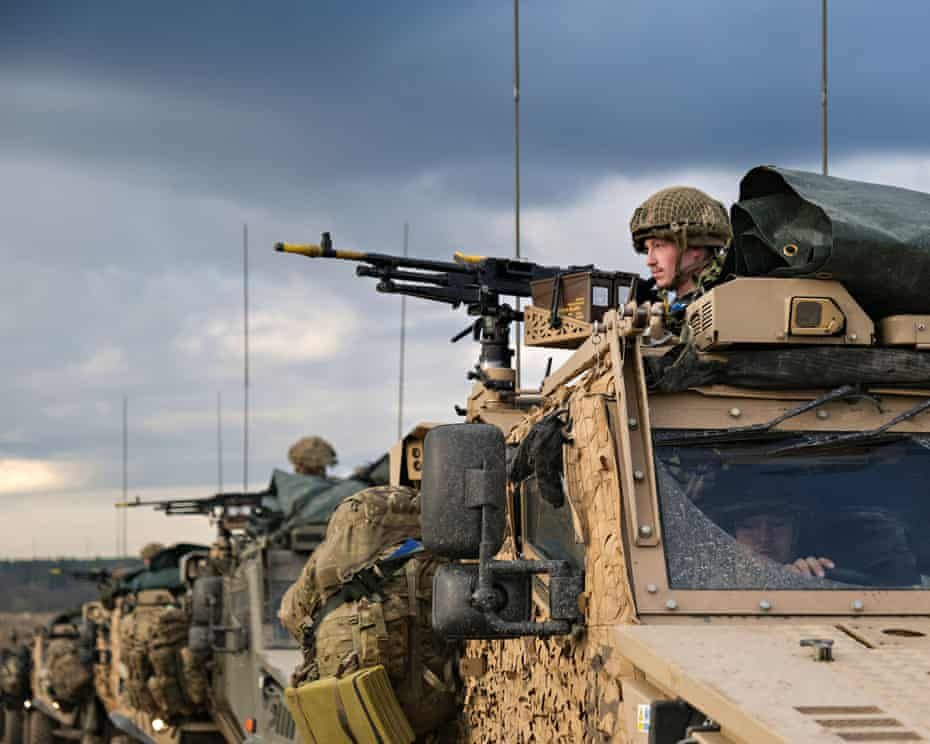
Eleven countries prepare for military deployment exercise
Britain and France have announced Exercise Koalicja, a multinational military rehearsal scheduled to take place in Poland later this month.
The exercise will involve 11 countries and test how European military forces could be deployed rapidly into Ukraine if a ceasefire brings the conflict to an end.
Approximately 2,800 soldiers, sailors and air personnel are expected to participate. France will contribute 1,500 troops from its 1st Division, while Britain will provide 300 personnel from the 7th Light Mechanised Brigade.
Other participating countries include Poland, Germany, Belgium, Estonia, Lithuania, the Netherlands, Spain, Sweden and Turkey.
The exercise is intended to assess the participating militaries’ ability to coordinate operations, move personnel and equipment quickly and maintain an effective multinational presence.
Lieutenant General Tom Bateman, commander of the proposed force, said Britain, France and their European partners remained committed to providing Ukraine with security assurances after a cessation of hostilities.
He explained that the exercise would demonstrate their “military preparedness, rapid deployment capabilities and ability to operate effectively”.
Planning for the operation has reportedly been underway for more than a year.
European force will operate independently of NATO
Despite the involvement of several countries that belong to the North Atlantic Treaty Organization, the proposed stabilisation mission would operate outside the alliance’s formal command structure.
Bateman described the force as “non-Nato”, indicating that it would function independently of NATO as a multinational European-led operation.
The mission is also expected to receive little or no American military support if deployed.
This has influenced preparations, particularly concerning communications and operational technology.
Western officials said the force was being organised to avoid dependence on American systems, including Starlink, which has become important to Ukraine’s military communications during the war.
“We are not dependent on US systems,” one official said when asked whether the proposed deployment would rely on Starlink satellite technology.
The decision reflects wider European concerns about the reliability of American support, particularly following recent disagreements over Washington’s military assistance to Kyiv.
Last month, the United States temporarily restricted Ukraine’s access to Starshield, the military version of Starlink, for approximately 10 days.
The restriction affected some medium-range drone operations, highlighting the potential consequences of relying heavily on technology controlled by another country.
Peacekeepers could face renewed confrontation with Russia
Although the proposed deployment would follow a ceasefire, European governments recognise that the presence of foreign troops could create fresh security risks.
Russia has a history of low-level attacks during the earlier ceasefire period in eastern Ukraine between 2014 and 2022.
Consequently, the possibility of renewed hostilities cannot be completely dismissed even if a new agreement formally ends the current war.
The proposed rules of engagement would allow European personnel to defend themselves against Russian drone attacks and other forms of aggression.
However, any incident involving armed European troops and Russian forces could create serious diplomatic and military consequences.
The distinction between defensive action and direct involvement in a wider conflict could become particularly sensitive if Moscow interprets a response by peacekeepers as an act of aggression.
The proposed force is therefore expected to concentrate on stabilisation and security activities rather than operations close to the front line.
Mission would help rebuild Ukraine’s military capabilities
Beyond providing a security presence, the multinational force is expected to support efforts to restore and strengthen Ukraine’s armed forces after the fighting ends.
Bateman described one of the mission’s objectives as “regenerating and strengthening” Ukraine’s military.
The intention is to help Kyiv rebuild its defence capabilities while ensuring that European personnel operate well away from active combat zones.
European fighter aircraft could also play a role in helping Ukraine reopen its commercial airports by conducting patrols to improve security.
Another proposed operation involves clearing mines from the Black Sea to restore safe maritime movement.
Turkey is expected to lead the mine-clearance effort, which would help reopen shipping routes used for Ukrainian grain exports and other commercial activities.
Restoring maritime access would be particularly important for Ukraine’s economy, which has faced significant disruption since Russia launched its full-scale invasion.
The combination of military support, air security and maritime operations is intended to provide a broader framework for stabilising the country after a ceasefire.
US unwillingness to send troops shapes European plans
The proposed European mission comes amid uncertainty over the level of American involvement in guaranteeing Ukraine’s postwar security.
Although President Donald Trump has repeatedly sought to lead diplomatic negotiations between Russia and Ukraine, he has said the United States would not commit its own troops to a peacekeeping mission in the country.
This position has encouraged European governments to consider arrangements that could operate without direct American military participation.
Fresh diplomatic efforts during the autumn have so far produced limited progress, although plans are reportedly being considered for another round of three-way talks brokered by Washington later this month.
Meanwhile, Russia and Ukraine have continued attacking each other’s energy infrastructure.
The security situation was further complicated on Sunday and Monday when air-raid alert applications in both countries were hacked.
Ukraine’s warning application briefly issued false alerts about nuclear and chemical threats, as well as reports of street fighting.
These developments underline the difficulties facing any proposed ceasefire and the challenges involved in maintaining security after an agreement is reached.
Britain expands military commitments beyond Europe
Britain’s preparations for a possible Ukraine deployment are also taking place alongside its wider military commitments in the Middle East.
The UK has pledged assistance to several countries seeking protection against attacks from Iran and Yemen’s Houthi rebels.
During the spring, Royal Air Force Typhoon fighter jets conducted dozens of sorties from Qatar to help defend Gulf countries.
Last month, Britain also committed to supporting Saudi Arabia against Houthi missile and drone attacks.
Read also: Supreme Court rejects Trump administration’s attempt to block California ballots
These commitments demonstrate the expanding responsibilities facing the British military as European governments prepare for possible security operations in Ukraine.
For the proposed peacekeeping mission, however, the immediate priority remains establishing a force capable of protecting its personnel, supporting Ukraine’s recovery and operating independently of American military systems.
The central challenge will be maintaining that defensive role without allowing any confrontation with Russian forces to trigger a wider conflict.
About The Author