The Trump Ukraine envoy mission intensified on Tuesday as Washington pushed urgently for progress, even while Russian missile strikes on Kyiv underscored the violent reality shaping negotiations and expectations.
Diplomatic momentum surged following meetings in Geneva, where US and Ukrainian officials attempted to bridge long-standing disagreements on sovereignty, territorial concessions, NATO aspirations and security guarantees crucial for Kyiv’s survival.
President Donald Trump announced that negotiations were “moving faster than expected,” though he admitted the path forward required “tough conversations” with both Ukrainian leaders and Russian officials wary of concessions.
Central to the Trump Ukraine envoy mission was Trump’s decision to dispatch special envoy Steve Witkoff to Moscow, with instructions to clarify remaining disputes directly with President Vladimir Putin.
Trump asserted that sending Witkoff “cuts through unnecessary noise,” saying face-to-face talks were essential to resolve lingering disagreements that had slowed progress in previous rounds of back-channel discussions.
Ukrainian officials expressed guarded optimism, saying they supported “the framework’s essence,” noting that the revised proposal abandoned earlier demands viewed in Kyiv as heavily tilted toward Russian geopolitical ambitions.
A senior Ukrainian negotiator said updated provisions better aligned with Ukrainian red lines, especially concerning territorial integrity, future military strength and guarantees against future Russian aggression.
Andriy Yermak, Ukraine’s chief of staff and lead negotiator, said Ukraine’s preferred security guarantees were “very solid,” adding that “for the first time, we see a viable pathway forward.”
President Volodymyr Zelenskyy told coalition leaders that Ukraine was ready to “move forward,” although he warned that unresolved issues remained “politically sensitive and emotionally charged for millions of Ukrainians.”
Trump acknowledged similar challenges, stating the Trump Ukraine envoy mission sought to balance “the desire for peace with the need for fairness,” recognising neither side could accept humiliating compromises.
He hinted he was prepared to meet both Putin and Zelenskyy “when the deal is final or very close,” stressing such a meeting would only occur at a decisive moment.
Russian officials remained cautious, indicating they had not seen the revised framework and warning that significant deviations from the Alaska summit understandings could jeopardise Moscow’s willingness to proceed.
Foreign Minister Sergey Lavrov reiterated that “the spirit and letter of Anchorage must be maintained,” suggesting revisions altering core principles would be unacceptable to the Kremlin’s negotiating team.
Correspondents in Moscow described a climate of “uncertainty,” though they noted ongoing informal contacts between Russian envoy Kirill Dmitriev and US envoy Steve Witkoff during the negotiation’s early stages.
Russian media reports indicated dissatisfaction with parts of the revised plan, especially changes regarding Ukrainian military limitations, NATO eligibility and withdrawal requirements in contested eastern regions.
Analysts observed that the new proposal removed earlier American provisions demanding Ukrainian force reductions and mandatory withdrawals from key zones, reflecting pressure from European and Ukrainian officials.
A US Army representative expressed confidence after meetings with Russian officials in Abu Dhabi, saying, “Talks are going well and we remain optimistic,” hinting at previously unpublicised diplomatic progress.
White House Press Secretary Karoline Leavitt told reporters that only “delicate but not insurmountable details” remained, predicting further exchanges between Ukraine, Russia and the United States in the coming days.
Washington-based analysts noted uncertainty surrounding the next negotiation round due to the American Thanksgiving holiday, which could delay final high-level talks until the following week.
Meanwhile, European leaders accelerated work on security guarantees for Ukraine, describing them as indispensable in sustaining any ceasefire, given Russia’s continued offensive operations.
French President Emmanuel Macron and British Prime Minister Keir Starmer co-chaired a coalition meeting where leaders agreed to create a joint US-European task force to finalise security commitments.
The plan envisioned European-led training programs, continuous military support and a multinational reassurance force, although effectiveness depended on US backing that Trump had not yet formally confirmed.
Macron stressed that Ukraine must face no military limitations, declaring that “Geneva made this clear,” and signalling European resistance to earlier proposals restricting Ukrainian troop levels.
He also confirmed Europe was nearing a decision on using frozen Russian assets for reconstruction, saying, “We expect this to be finalised in the coming days with the Commission.”
Europe froze approximately $300 billion in Russian assets in 2022, but disagreements persisted, with some states favouring direct seizure while others expressed legal concerns about setting precedent.
Reports suggested Trump proposed splitting the assets between Ukrainian reconstruction and US-Russia investment programs, an arrangement drawing mixed reactions from European officials and legal advisors.
Macron criticised Russia’s attacks on Kyiv, calling for “continued pressure” on Moscow, noting that “on the ground, the reality contradicts any claim of a true willingness for peace.”
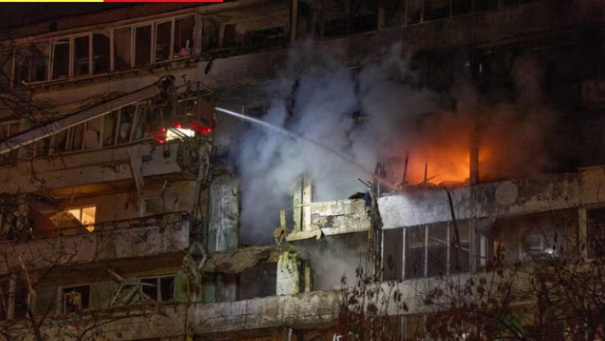
Ukraine reported seven deaths from the latest barrage on Kyiv, highlighting Russia’s intensified campaign targeting infrastructure, energy networks and residential districts despite ongoing diplomatic exchanges.
Zelenskyy condemned the strikes as “especially cynical,” stressing they occurred “while talks are underway on how to end the war,” reinforcing concerns Moscow used violence for leverage.
Ukrainian energy authorities said overnight attacks disrupted power and heating systems across Kyiv, warning of renewed winter hardship as temperatures fall and targeted infrastructure becomes increasingly fragile.
Residents described scenes of destruction across several districts, with one survivor saying, “Everything shook. We heard the explosion, and then we saw smoke everywhere. It felt like the city exhaled fear.”
European leaders argued such attacks demonstrated why firm guarantees were needed, insisting Russia must not be allowed to exploit any ceasefire or diplomatic process to regroup militarily.
Meanwhile, analysts noted that the Trump Ukraine envoy mission placed Washington at the centre of the conflict’s diplomatic future, creating expectations that the United States could deliver a workable settlement.
Experts in Washington argued that while Trump’s approach departed from previous US policy, it aimed to produce “visible results,” relying on direct negotiation rather than collective pressure alone.
Ukrainian officials emphasised the importance of maintaining Western unity, warning that any appearance of division could encourage Moscow to harden its stance or demand more favourable terms.
A European diplomat said, “We must stay aligned. This is the moment when unity either pays off or collapses and takes the peace effort with it.”
US officials highlighted strong bipartisan interest in stabilising the region, even though questions remained about long-term American commitments under shifting political dynamics.
Despite guarded hopes, several analysts warned that deep mistrust between Ukraine and Russia could still derail progress, especially if Moscow perceived the revised framework as limiting its strategic priorities.
Ukrainian civil society groups urged caution, cautioning that “a rushed agreement could lock Ukraine into vulnerability,” particularly if guarantees failed to prevent future Russian aggression.
Russian commentators suggested the Kremlin sought assurances that Ukraine’s military expansion, NATO cooperation and security agreements would not threaten Russia’s perception of its strategic environment.
As debates continued, both sides braced for renewed military escalation, recognising that battlefield developments could heavily influence negotiation leverage in the coming weeks.
International monitors observed troop movements along several front lines, suggesting Russia might intensify its operations to strengthen its bargaining position before major decisions were finalised.
Military analysts warned that prolonged escalation risked undermining political momentum, noting that “every missile strike reduces public trust in diplomacy and complicates leaders’ willingness to compromise.”
Even so, US officials insisted the Trump Ukraine envoy mission remained on track, expressing confidence that direct engagement in Moscow could clarify misunderstandings and accelerate final-stage discussions.
Ukrainian leaders reiterated their commitment to a “just and durable peace,” emphasising that no agreement would be acceptable if it compromised sovereignty, territorial rights or national security.
European officials echoed that message, affirming support for Ukraine while urging Russia to demonstrate genuine willingness to end the conflict through verifiable and transparent commitments.
Despite uncertainty, diplomats across multiple capitals described an emerging sense of “cautious possibility,” reflecting the belief that the coming weeks might determine the war’s long-term trajectory.
Observers agreed high-level meetings in Moscow would be decisive, potentially marking the moment when diplomatic patience either delivers a breakthrough or collapses under geopolitical tensions.

For citizens in Kyiv recovering from fresh strikes, the hope remained that diplomacy could ease the suffering, even as they braced for another unpredictable winter of conflict and hardship.
As preparations for further talks continued, world leaders watched closely, aware that the coming diplomatic steps could redefine Europe’s security landscape for years to come.
If successful, the Trump Ukraine envoy mission could reshape regional stability, yet if it falters, the consequences could reverberate far beyond Ukraine’s borders.
About The Author