India signs critical minerals deal with Brazil– India has taken a decisive step to reduce its reliance on China by signing a landmark agreement on critical minerals with Brazil.
The pact, which focuses on rare earths and other vital minerals, was hailed by Indian Prime Minister Narendra Modi as a “major step towards building resilient supply chains.”
The agreement underscores the growing importance of securing diversified sources of strategic resources amid rising global competition and geopolitical tensions.
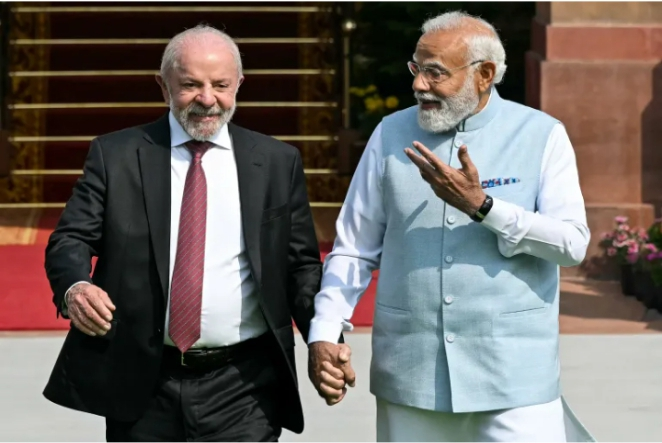
The deal was signed during a high-profile meeting in New Delhi, where Brazilian President Luiz Inacio Lula da Silva met with Modi to discuss trade, investment, and long-term strategic partnerships.
“Increasing investments and cooperation in matters of renewable energies and critical minerals is at the core of the pioneering agreement that we have signed today,” Lula said, highlighting Brazil’s commitment to supporting India’s resource security.
China currently dominates the mining and processing of rare-earth elements and other critical minerals, controlling much of the global supply.
Recent months have seen China tighten its grip on exports, even as the United States and other major economies attempt to diversify supply chains. India’s new agreement with Brazil, the second-largest holder of critical minerals worldwide, is seen as a key move to counterbalance China’s influence in this strategic sector.
Brazil’s minerals are essential across a wide spectrum of industries, including electric vehicles, solar panels, smartphones, jet engines, and guided missiles.
Analysts say that India’s growing demand for these minerals, especially iron ore, is being driven by rapid industrial expansion and infrastructure development.
According to Rishabh Jain of the Council on Energy, Environment and Water, “Global South alliances are critical for securing diversified, on-ground resource access and shaping emerging rules of global trade.”
Modi emphasized the broader implications of the India-Brazil partnership. “We are committed to taking our bilateral trade beyond $20 billion in the coming five years,” he said, adding that “our trade is not just a figure, but a reflection of trust. When India and Brazil work together, the voice of the Global South becomes stronger and more confident.”
This statement highlights the strategic dimension of the agreement, positioning India and Brazil as leaders among emerging economies seeking greater economic independence from established powers.
Alongside the critical minerals deal, nine other agreements were signed between the two countries, covering areas such as digital cooperation, healthcare, and innovation.
Subrahmanyam Jaishankar described the talks as a turning point for India-Brazil relations, expressing confidence that the new agreements “will impart a new momentum to our ties.”
Trade between India and Brazil has steadily increased over the years. In 2024, Indian exports to Brazil amounted to $7.23 billion, led by refined petroleum, while Brazilian exports to India totaled $5.38 billion, primarily consisting of raw sugar.
The new deals are expected to accelerate trade growth, particularly in high-tech and strategic sectors such as rare earths and critical minerals.
Experts note that India’s engagement with Brazil complements its ongoing supply chain diversification efforts with other global partners, including the United States, France, and the European Union.
By fostering ties with Brazil, India strengthens its access to key resources outside of traditional suppliers. Jain explained, “Collaborations with resource-rich nations like Brazil are vital for securing materials that underpin technology, energy, and defense sectors.”
The critical minerals agreement also signals India’s commitment to supporting renewable energy development. Both countries have emphasized investment in green technologies, including electric vehicles and solar energy, which rely heavily on rare earths and related materials.
Lula remarked, “Our cooperation is not only economic but also strategic, contributing to global sustainability goals and technological advancement.”
This deal aligns with broader global efforts to reduce dependence on a single dominant supplier. China’s control over rare earths has long been a concern for major economies, particularly given the minerals’ importance in defense, energy, and advanced technology.
By partnering with Brazil, India positions itself as a proactive player in reshaping supply chains and securing critical resources for its growing industrial and technological base.
Trade experts also point to the potential economic benefits for Brazil. With India as its largest trading partner in Latin America, Brazil stands to gain from increased exports of critical minerals, technology transfers, and expanded investment in infrastructure and renewable energy sectors.
“India’s market offers Brazil a long-term partnership that goes beyond raw material exports,” said trade analyst Rishabh Jain, emphasizing the strategic and economic significance of the agreement.
The timing of the India-Brazil deal is particularly significant as global demand for critical minerals continues to rise.
Analysts predict that rare earth elements will play an increasingly central role in technological innovation, clean energy deployment, and defense applications. By securing access to these resources, India aims to ensure its industrial and technological growth while mitigating risks associated with over-reliance on a single supplier.
Moreover, the deal reflects a broader trend of South-South cooperation, where developing nations actively collaborate to strengthen economic and technological resilience.
By diversifying partnerships, countries like India and Brazil are better positioned to navigate global economic uncertainties and geopolitical pressures. Modi stated, “Our partnership is a testament to the fact that emerging economies can set the agenda for equitable trade and sustainable growth.”
As details of the critical minerals agreement continue to emerge, industry observers expect increased investment in mining operations, joint research initiatives, and enhanced supply chain infrastructure.
Both governments have indicated that they will establish frameworks to facilitate collaboration in exploration, processing, and technological development related to rare earths and other strategic materials.
In conclusion, the India-Brazil critical minerals deal marks a significant step in reshaping global supply chains, reducing dependence on China, and fostering strategic cooperation between two of the world’s most influential emerging economies.
Read also:Palace signals no resistance as pressure mounts to remove Andrew Mountbatten-Windsor from royal succession
With trade agreements spanning minerals, technology, and renewable energy, the partnership promises to strengthen economic growth, enhance industrial capabilities, and support global sustainability goals. As Modi and Lula affirmed, this collaboration reflects a new era of mutual trust, resilience, and shared strategic vision.
Meta Description: India signs critical minerals deal with Brazil to curb dependence on China, aiming to strengthen supply chains, boost trade, and secure rare earth resources.
Keyphrases: India signs critical minerals deal with Brazil, rare earth cooperation India Brazil, Modi Lula trade agreement, Brazil critical minerals exports, India supply chain diversification
About The Author