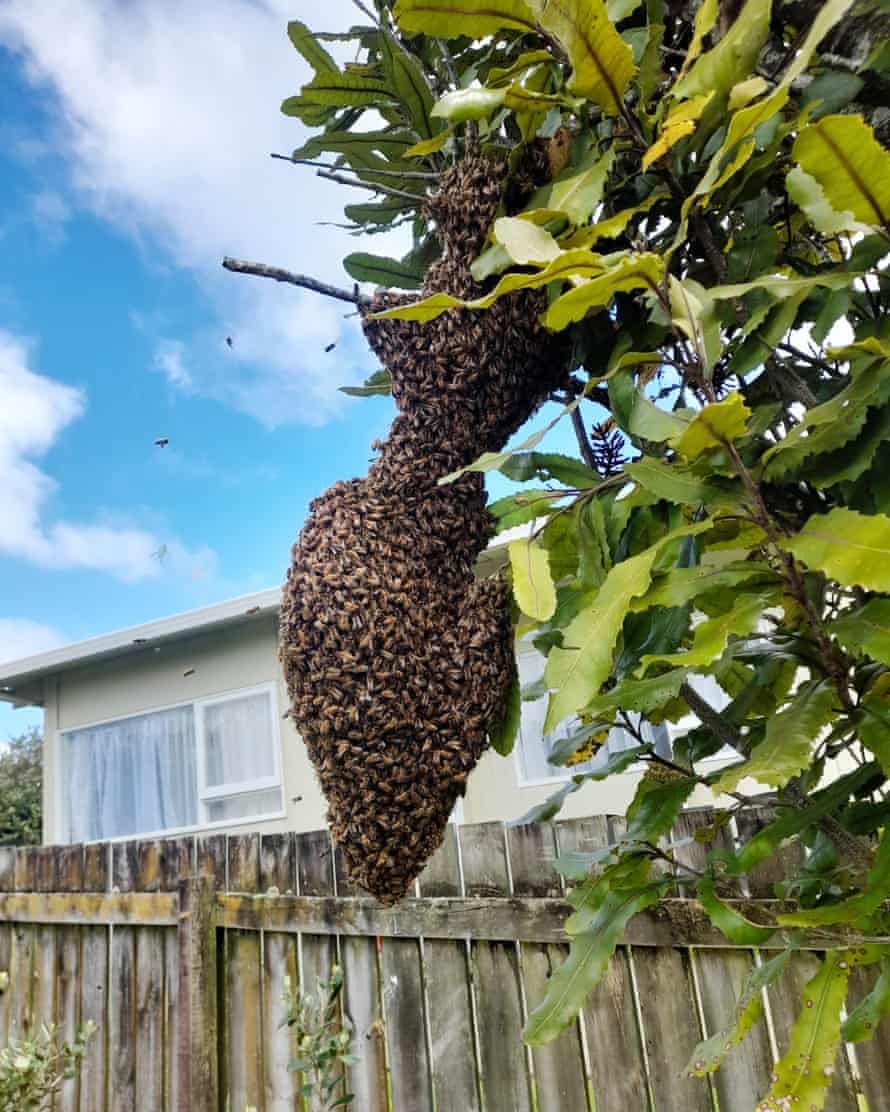

Auckland bee swarms have become an increasingly common sight across New Zealand‘s largest city, where unusually warm winter conditions and an early start to spring are believed to have triggered an exceptional rise in honeybee colonies splitting from their hives.
From parked cars covered in thousands of insects to street signs engulfed by buzzing colonies, the unusual activity has created challenges for residents and beekeepers, with the number of requests for swarm removal reaching unprecedented levels.
The Auckland Beekeepers Association says it is receiving between five and 10 calls daily from people seeking assistance, compared with fewer than five requests on a typical day in previous years.
Bryan Lang, the association’s swarm control coordinator, said the organisation had already attended at least 100 incidents, while individual members were also receiving direct requests from residents.
The increase has been linked to a milder-than-usual winter, which experts believe allowed bee colonies to develop faster and begin swarming several weeks earlier than expected.
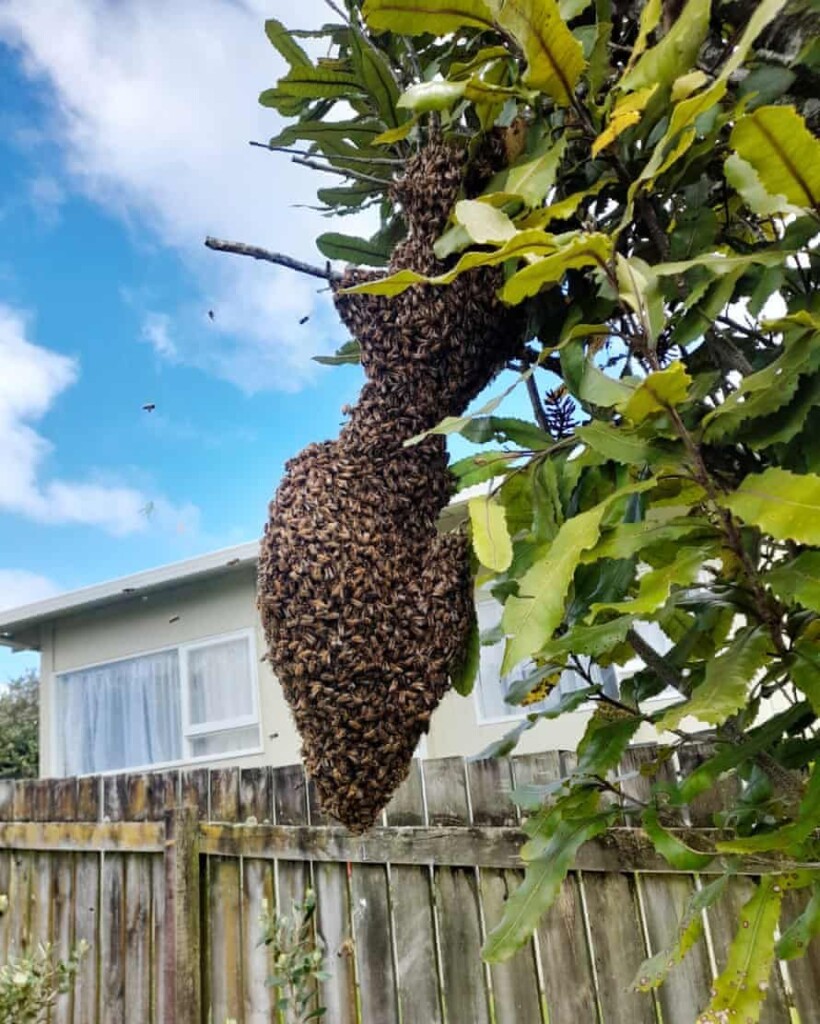
Thousands of bees descend on Auckland neighbourhoods
Some of the incidents have attracted considerable attention because of the unusual places where the insects have gathered.
In October, a large swarm covered the rear of a parked vehicle in Birkenhead, remaining there for about two hours.
A woman was reportedly sleeping inside the car while the bees surrounded it. Lang said he understood that she had not noticed the unusual activity outside.
“I’m surprised she didn’t hear them because they’re pretty loud,” he said.
Another incident occurred a month earlier when a swarm occupied a sign at a busy intersection along Queen Street, Auckland’s major commercial thoroughfare.
The gathering forced pedestrians to change their routes to avoid walking through the concentration of insects.
The incidents have highlighted how seasonal bee activity can become a public concern when colonies settle in densely populated urban environments.
For beekeepers, the increase has meant responding to more calls from residents who are uncertain about how to handle large groups of bees appearing around their properties.
What causes honeybees to swarm?
Swarming is a natural reproductive process through which a honeybee colony divides to establish another colony.
It commonly occurs during spring and early summer when a hive becomes sufficiently populated for part of its workforce to leave with a queen and search for a new home.
The departing bees usually gather temporarily on a tree, vehicle, building or another suitable surface while scout bees search for a permanent location.
Although the sight of thousands of bees moving together can frighten people, experts say a swarming colony is generally less aggressive than a colony defending its established hive.
Ken Brown, president of the Auckland Beekeepers Association, said people in rural communities were often more accustomed to seeing the phenomenon.
“When bees swarm in the countryside, no one really notices,” he said.
Urban residents, however, may have little experience with large colonies gathering in public spaces.
“If you don’t know about bees – how they’re only defensive – then you might be intimidated with thousands of venomous insects flying around,” Brown said.
He explained that bees are generally at their most placid when swarming, although people should still avoid disturbing them.
The phenomenon also creates difficulties for commercial beekeepers because a substantial part of a colony can leave its original hive.
“As a beekeeper, you don’t want them to swarm because you’re losing two-thirds of your bees, and right at the time when they should be bringing honey in for you,” Lang said.
“And it’s not great for your neighbours either.”
New Zealand’s unusually warm winter linked to early swarming
Experts believe the weather has played a significant role in the exceptional activity recorded around Auckland.
Brown said the unusually mild winter and warmer beginning to spring had encouraged colonies to develop more rapidly, allowing larger numbers of bees to leave their hives earlier than normal.
New Zealand recorded its third-warmest winter on record in 2026, according to Earth Sciences New Zealand.
The warmer conditions may have enabled colonies to produce larger broods containing eggs, larvae and pupae, providing the foundation for stronger populations.
Brown explained that colonies surviving the threat of the varroa mite could emerge from winter with particularly strong numbers and become ready to swarm sooner.
Varroa mites are tiny parasites that attach themselves to honeybees and their developing brood, weakening colonies and threatening their survival.
The combination of favourable temperatures and the survival of healthy colonies could therefore help explain the unusually early and widespread swarming activity.
Brown said changing weather conditions were making the business of keeping bees increasingly difficult to predict.
“Beekeeping is much more unpredictable nowadays because you do have the extremes of weather and the different patterns. Every year is slightly different, but it’s actually even more different in recent times,” he said.
Similar changes reported beyond New Zealand
The unusual behaviour is not restricted to Auckland.
Other parts of the world, including North America, have also experienced changes in bee swarming patterns as warmer winters and earlier spring conditions influence seasonal activity.
The developments have raised questions about how changing climate conditions are affecting insects whose reproductive cycles and colony development are closely connected to temperature and seasonal patterns.
For beekeepers, unpredictable weather can make it more difficult to anticipate when colonies will expand, swarm or become ready for honey production.
The Auckland experience provides another example of how relatively small changes in seasonal conditions can produce noticeable effects on wildlife and human communities.
Uncaptured swarms could threaten other bee colonies
While the increased number of swarms may indicate strong colony development, experts have warned that unmanaged groups can create problems.
Professor Phil Lester, an entomologist and ecologist at Victoria University, said beekeepers had been actively capturing swarms in different parts of the country, including Wellington.
However, colonies that cannot be captured may pose a risk to other honeybees and native bee populations if they carry the varroa mite.
The parasite can spread between colonies and cause serious damage, making the management of abandoned or unmanaged swarms important for protecting bee populations.
Lester also acknowledged the economic implications for beekeepers who lose large numbers of bees just as their colonies are preparing for honey production.
Nevertheless, he said the current activity could also represent encouraging news for bee numbers.
“It means they have been able to build up numbers and populations, earlier than perhaps they normally would do … its probably a good indication that it is a good bee year.”
His assessment highlights the mixed implications of the unusual season: stronger populations may be beneficial, but parasite transmission and unpredictable weather remain important concerns.
Beekeepers face growing demand for swarm removal
With large colonies appearing in residential and commercial areas, more Auckland residents are turning to local beekeeping organisations for assistance.
Lang said public awareness was improving, with people increasingly using social media groups and contacting beekeeping clubs to find help when swarms appeared.
The association’s growing workload demonstrates the pressure that an unusually active season can place on volunteers and professional beekeepers.
Read also: Russia-Ukraine peace talks open in Abu Dhabi as Trump pushes new European security deal
Although swarming is a normal part of honeybee reproduction, its appearance in busy neighbourhoods can create anxiety among people who mistake the temporary gathering for an aggressive attack.
Experts say understanding the behaviour of swarming bees is important, particularly because disturbing a colony unnecessarily can create avoidable risks.
For Auckland, the unusually mild winter has produced a striking seasonal development: more bees are leaving their hives, more residents are encountering them, and beekeepers are receiving more requests for help.
Whether the increased activity ultimately translates into a particularly productive year for New Zealand’s bees will depend partly on the colonies’ ability to survive parasites and changing environmental conditions.
About The Author