China flying cars could become a reality for recreational users and emergency services from the second half of 2027, according to XPeng, the Chinese technology company developing a two-seat aircraft that can take off and land vertically.
The vehicle, priced at approximately $300,000 (£225,000), is designed for low-altitude travel and has received approval from Chinese civil aviation authorities for limited use after nearly a decade of development and testing.
XPeng chief executive Deli Zhao announced the projected launch timeline at the Web Summit in Lisbon on Tuesday, where a prototype attracted considerable attention from visitors.
The company hopes to introduce the aircraft initially in approved rural locations, targeting recreational enthusiasts and emergency responders who need to reach areas that conventional vehicles cannot easily access.
The development represents another step in China’s ambition to establish a commercial market for personal flying vehicles, although regulatory restrictions and the aircraft’s limited range mean widespread urban use remains some distance away.
How XPeng’s flying vehicle operates
Unlike conventional cars, the XPeng model does not have wheels. It is essentially a helicopter-style drone with a compact cockpit designed to accommodate two passengers.
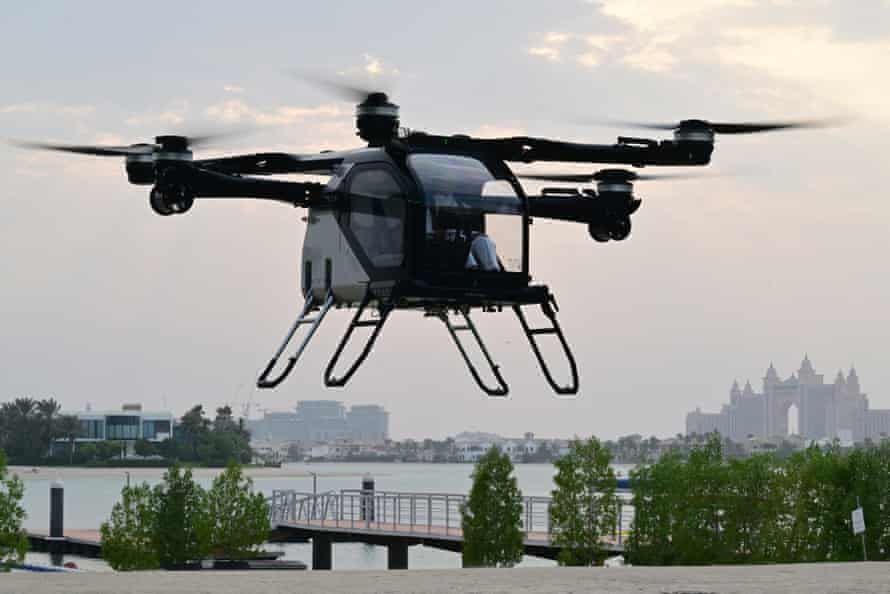
The cockpit is approximately the size of a Fiat 500, while six battery-powered propellers, resembling those used on large drones, provide the lift required to raise the aircraft into the air.
The vehicle is controlled using a simple joystick, although it also features an autonomous flight function that allows it to travel to a programmed destination.
Zhao, who is a trained pilot, claimed that operating the aircraft could be surprisingly straightforward, suggesting that he could teach an ordinary person how to fly it in just five minutes.
He presented the technology as an opportunity to make personal aviation more accessible, rather than something reserved exclusively for professionally trained pilots.
“The world where everyone can be a captain is about to arrive,” Zhao said during his presentation in Lisbon.
Despite its car-like branding, the aircraft is more accurately described as a personal electric vertical take-off and landing vehicle, with its design relying on drone technology rather than traditional road transportation.
A flying aircraft that unfolds from a van
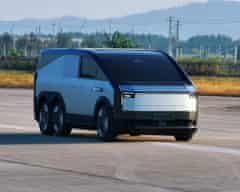
The $300,000 price includes more than the two-seat flying vehicle itself. Buyers will also receive a six-wheel carrier van approximately the size of a Ford Transit.
The aircraft is transported inside the van and can unfold from its rear compartment when required, a process Zhao compared to the transformation of vehicles in the science-fiction franchise Transformers.
The combined package is intended to make transportation and storage more practical, particularly for customers who want to use the aircraft for recreational activities away from conventional airports.
Zhao said his interest in flying vehicles had developed over almost ten years, with inspiration coming partly from fictional flying creatures in the Harry Potter stories and the Green Goblin’s airborne skateboard in Spider-Man comics.
The company has conducted development work and trials, including experiments involving flying motorbikes at its base in Guangzhou.
XPeng targets recreational users and emergency services
The initial market for the aircraft will focus on people interested in outdoor activities and organisations requiring access to difficult-to-reach locations.
Zhao identified enthusiasts involved in “diving, surfing, off-roading and flying” as potential customers for the technology.
Emergency services are another important target market, particularly where conventional vehicles face difficulties reaching remote or inaccessible locations.
However, the aircraft will not initially be available for unrestricted flights across Chinese cities. Its approved use will be limited to designated park areas and authorised emergency operations.
The restrictions underline the challenges facing manufacturers attempting to turn personal flying vehicles into an everyday means of transportation.
Although the aircraft has received regulatory approval for limited operations, wider commercial adoption will depend on aviation rules, safety requirements and the development of suitable operating infrastructure.
Flight range remains a major limitation
One of the most significant restrictions is the aircraft’s current flight range of approximately 30 kilometres, equivalent to 18.6 miles.
That distance may be sufficient for recreational flights and certain emergency operations, but it limits the vehicle’s usefulness for longer journeys.
XPeng is working to improve battery performance, with plans to double the range by increasing battery energy density to 400 kilowatts per kilogram, according to Zhao.
If achieved, the improvement would give the aircraft greater operational flexibility and potentially make it more attractive to customers.
The vehicle can reportedly cruise at altitudes of up to one kilometre above ground level, although this remains considerably below the typical operating altitude of an unpressurised light aircraft such as a Cessna.
The company has also said that no one has yet been injured or hurt while using the vehicle, although its limited operational history means broader safety performance will need to be established as usage expands.
XPeng challenges Elon Musk’s flying Tesla concept
The development of personal flying vehicles is becoming another area of competition between technology companies in China and the United States.
Tesla chief executive Elon Musk showcased his own flying-car concept last month, demonstrating a vehicle that uses powerful bursts of gas to twist and flip in the air.
However, Zhao questioned whether Musk’s demonstration represented genuine flight, drawing a distinction between the Tesla concept and XPeng’s aircraft.
He described Musk‘s prototype as “really hopping or jumping and not really flying”.
Zhao also agreed when asked whether the demonstration had the characteristics of a circus performance.
“I’m looking forward to seeing a potential future generation that can actually fly,” he said.
The exchange highlights competing approaches to the emerging market, with XPeng focusing on a battery-powered aircraft capable of sustained low-altitude travel.
The broader rivalry also reflects the growing overlap between electric vehicle manufacturing, autonomous technology and drone development.
China expands its low-altitude economy ambitions
XPeng’s plans form part of a wider Chinese government strategy to develop what Beijing calls the low-altitude economy.
The initiative covers commercial drones, flying vehicles and other forms of aviation operating at relatively low altitudes.
China’s development strategy is expected to progress from cargo transportation towards passenger services, with early applications concentrated in rural areas before any potential expansion into major cities.
Zhao said XPeng was among approximately 20 companies in China working on flying vehicles, indicating that the sector is attracting growing interest from manufacturers.
The company is also looking beyond its domestic market as it prepares for the possibility of international expansion.
Zhao disclosed that XPeng had signed agreements with the United Arab Emirates and countries in south-east Asia to develop potential applications for its flying vehicle.
He said the company hoped to enter the European market as soon as possible.
Expressing his vision for the future of transportation, Zhao said: “All cars in the future will grow wings and all transportation will move from two dimensions to three dimensions,”
Commercial launch still faces regulatory challenges
Although XPeng is targeting the second half of 2027 for initial use, the aircraft’s launch should not be confused with the immediate arrival of flying cars on ordinary roads or unrestricted urban air travel.
Its current approval covers limited operations, while its range, passenger capacity and operating restrictions make it a specialised aircraft rather than a direct replacement for conventional cars.
The company must also demonstrate that its technology can operate safely and reliably as the number of users increases.
Nevertheless, the planned introduction of the two-seat model represents a significant commercial ambition for China’s emerging low-altitude aviation industry.
If XPeng meets its proposed timetable, recreational customers and emergency services could become among the first groups to experience this new form of personal air transportation.
About The Author