

What the MPC’s rate cut really signals for Nigeria’s economy
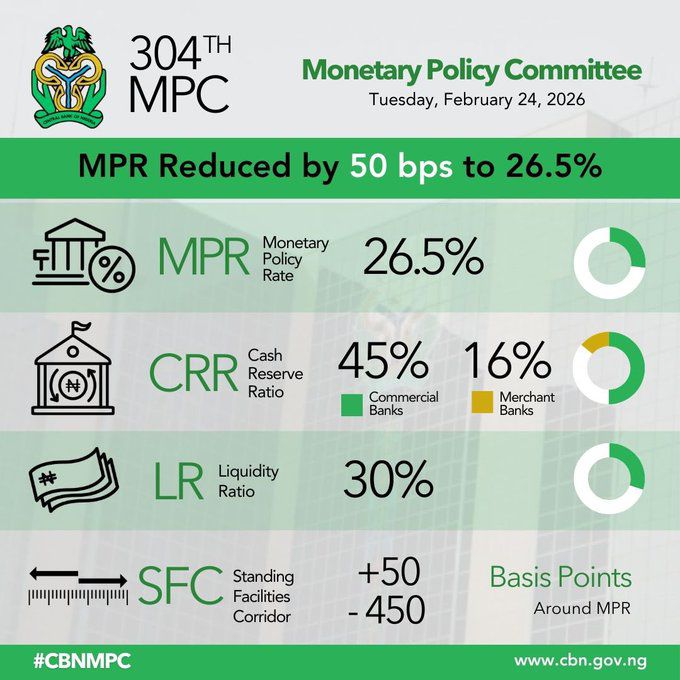
The decision by the Central Bank of Nigeria to lower its benchmark interest rate at the 304th meeting of the Monetary Policy Committee marks a subtle but important shift in Nigeria’s monetary policy trajectory. While the headline action — a 50 basis point reduction in the Monetary Policy Rate (MPR) to 26.5 percent — appears modest, the broader configuration of policy tools reveals a far more nuanced message.
To understand what the MPC’s rate cut really signals, it is necessary to look beyond the MPR and assess the full spectrum of decisions taken.
A cautious retreat from aggressive tightening
For much of the past year, the CBN has pursued an aggressive tightening cycle aimed at taming inflation, stabilising the naira and anchoring investor confidence.
The reduction of the MPR from 27.0 percent to 26.5 percent represents the first calibrated step away from that restrictive stance.
In practical terms, the MPR functions as the anchor for lending and deposit rates across the banking system. A lower benchmark rate can, over time, translate into cheaper borrowing costs for businesses and households.
However, transmission in Nigeria’s financial system is rarely immediate. Commercial banks adjust lending rates gradually, depending on liquidity conditions, risk perception and balance sheet constraints.
The key word here is “gradual.” The rate cut does not signal a dramatic pivot to monetary easing. Rather, it suggests that policymakers see early evidence of moderating inflationary pressures and are testing the waters without abandoning caution.
Tight liquidity conditions remain firmly in place
If the MPC intended to unleash liquidity, it had other levers at its disposal. It chose not to pull them.
The Cash Reserve Ratio (CRR) for commercial banks remains at a steep 45 percent. This means nearly half of customer deposits are sterilised at the central bank and cannot be deployed for lending. Such a high CRR acts as a powerful liquidity constraint, limiting banks’ capacity to aggressively expand credit even when benchmark rates decline.
Similarly, the Liquidity Ratio has been retained at 30 percent. Banks must continue holding a significant share of assets in liquid instruments to guard against systemic risk and sudden withdrawals. Together, these measures reinforce financial stability and curb excess money supply growth.
The asymmetric corridor around the MPR — set at +50 and -450 basis points — was also left unchanged. This framework discourages banks from parking idle funds at the central bank for easy returns while ensuring borrowing from the apex bank remains slightly above the policy rate.
By maintaining this structure, the MPC underscores its intention to preserve discipline within the interbank market.
Taken collectively, these decisions show that while the MPR was trimmed, monetary conditions remain structurally tight.
Inflation and credibility considerations
The MPC’s rate cut really signals a balancing act between supporting growth and maintaining anti-inflation credibility. Inflation in Nigeria has placed sustained pressure on households and eroded purchasing power. Yet premature easing could risk reversing hard-won gains in price stability.
By opting for a measured 50 basis point reduction rather than a more aggressive cut, policymakers appear to be signalling confidence — but not complacency. The CBN is effectively communicating that inflationary momentum may be softening, but structural risks remain.
Maintaining high reserve requirements alongside a modest rate cut sends a dual message to investors: growth support is emerging, but monetary discipline remains intact. This signalling is critical in an economy sensitive to capital flows and exchange rate volatility.
Implications for businesses and households
For businesses, especially manufacturers and SMEs reliant on bank credit, the move may offer cautious optimism. Lower benchmark rates can ease financing costs at the margin, potentially supporting investment decisions over the medium term.
However, the elevated CRR suggests that credit expansion will likely remain selective. Banks, constrained by liquidity requirements, may prioritise low-risk borrowers and sectors aligned with regulatory incentives.
Households should not expect immediate relief on loan repayments. Retail lending rates often incorporate risk premiums far above the MPR. While the policy shift is symbolically important, its impact on consumer credit conditions will unfold gradually.
From an investor standpoint, the MPC’s rate cut really signals continuity in strategic direction rather than abrupt change. Fixed-income markets may interpret the move as the beginning of a slow easing cycle, potentially affecting bond yields and portfolio allocation decisions.
The broader macroeconomic context
Monetary policy does not operate in isolation. Fiscal dynamics, external reserves, oil price movements and exchange rate stability all influence the effectiveness of rate adjustments.
The CBN’s calibrated approach suggests awareness of election-related liquidity risks, global monetary trends and domestic structural bottlenecks. By easing one instrument while holding others steady, the central bank preserves room for manoeuvre should inflation reaccelerate or capital flows weaken.
In essence, the MPC is neither slamming the brakes nor stepping hard on the accelerator. It is fine-tuning.
Strategic messaging to the market
Central banking is as much about communication as it is about arithmetic. The MPC’s rate cut really signals that policymakers are willing to pivot — but only incrementally and conditionally.
The message to markets is deliberate: inflation risks are moderating, but vigilance remains paramount. Liquidity will not be unleashed recklessly. Financial stability remains the anchor objective.
For Nigeria’s economy, this moment represents a potential inflection point. If inflation continues to trend downward and exchange rate pressures stabilise, further gradual easing could follow.
If not, the existing tight structural controls provide a buffer against renewed volatility.
Ultimately, the latest decision reflects a central bank seeking equilibrium — encouraging productive investment while safeguarding macroeconomic stability. The brake has been eased slightly, but the steering remains firm.
About The Author