Myanmar military air strike in Rakhine has killed at least 17 civilians and wounded more than a dozen others after bombs struck a busy village market in the country’s conflict-scarred western state, according to local media and armed group statements.
The attack took place in Yoengu village in Ponnagyun township, located about 33 kilometres northeast of Sittwe, the capital of Rakhine State. Reports from the Democratic Voice of Burma (DVB) said women and children were among those killed when military aircraft targeted the area on Tuesday.
The village has been under the control of the Arakan Army (AA), an ethnic Rakhine armed group that has been fighting the military for control of the state. The AA said 17 “innocent civilians”, including three children, died in the bombing and that at least 15 others were injured.
The strike marks another deadly episode in Myanmar’s widening civil war, which has intensified since the military seized power in 2021. The coup ousted the elected government and plunged the Southeast Asian nation into prolonged instability, sparking mass protests that were met with a violent crackdown.
Since then, resistance movements made up of pro-democracy activists and long-established ethnic armed organisations have battled the military across multiple regions. Myanmar, also known as Burma, has seen thousands killed and millions displaced as conflict spreads into urban centres and remote borderlands alike.
According to United Nations estimates, about 3.6 million people have been forced from their homes since the coup. Air strikes have become a central tactic of the military’s campaign to regain territory lost to armed groups, especially in areas where ground operations face stiff resistance.
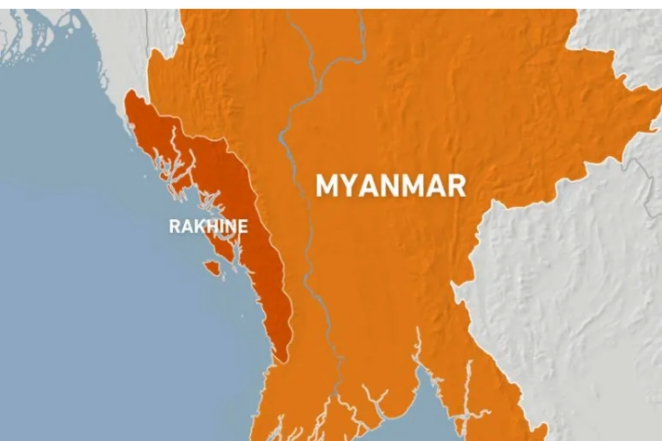
Rakhine State has emerged as one of the worst-affected regions. Once the epicentre of violence against the Rohingya Muslim minority, it is now largely under the control of the Arakan Army, which has steadily expanded its territorial hold since late 2023.
The military has responded with a blockade and repeated aerial bombardments, targeting infrastructure, towns and villages believed to be under AA administration. Humanitarian agencies have warned that restricted access and aid cuts are worsening conditions for civilians trapped in the fighting.
Pyae Phyo Naing, chairman of the Ponnagyun Youths Association, described the aftermath of Tuesday’s strike as chaotic and devastating. He said several buildings were engulfed in flames and that residents arrived to find bodies scattered across the market area.
“Some people were crying, while many dead bodies were scattered over the area,” he told the AFP news agency, recounting scenes of panic as survivors attempted to flee while homes continued to burn.
Local sources said the market was active at the time of the strike, increasing the number of casualties. Markets in rural townships often serve as central gathering points where residents buy food, medicine and other essentials, particularly in regions already struggling under shortages.
The attack comes weeks after a controversial election organised by the military-backed governing party. The vote was widely criticised by international observers and rights groups, who dismissed it as lacking credibility amid ongoing conflict and restrictions on opposition parties.
Despite claims by military authorities that the election was free and fair, critics argue that large swaths of the country were unable to participate due to fighting and displacement. In Rakhine, where the Arakan Army exercises significant control, polling was limited or absent in many areas.
Analysts say the timing of intensified air strikes may reflect the military’s efforts to assert dominance following the political process. By targeting areas controlled by resistance groups, the junta appears intent on demonstrating its continued military reach.
Rakhine’s strategic importance adds another layer to the conflict. The coastal state is home to key infrastructure projects, including ports and transport corridors linked to China-backed investments. Control over the region carries both political and economic weight.
Human rights organisations have repeatedly accused the military of indiscriminate attacks and of failing to distinguish between combatants and civilians. The military, for its part, often claims that armed groups use civilian areas for cover, a charge that opposition forces deny.
In past incidents, the military has said it targeted positions used by armed groups, including hospitals or schools allegedly repurposed for military activity. Such claims are difficult to verify independently due to restricted media access and communication blackouts in conflict zones.
The humanitarian situation in Rakhine has deteriorated sharply over the past year. The World Food Programme warned previously of a dramatic rise in hunger and malnutrition in the state, driven by conflict, trade disruptions and cuts to international aid.
Entire communities have been isolated by fighting and road closures, limiting the delivery of food and medical supplies. In some townships, residents rely on local networks and informal aid channels to survive.
The Arakan Army has gained ground not only militarily but also administratively, establishing parallel governance structures in territories under its control. This includes local courts, tax systems and social services, challenging the authority of the central government.
For civilians caught between the warring sides, daily life has become increasingly precarious. Air raid fears, displacement and economic hardship have reshaped routines, with many families forced to seek shelter in forests or makeshift camps when fighting intensifies.
International diplomatic efforts to resolve the crisis have yielded limited progress. Regional blocs such as ASEAN have struggled to enforce peace plans, while global powers remain divided in their approaches to engaging with Myanmar’s military rulers.
As violence persists, accountability remains elusive. Investigations into alleged abuses have been hampered by lack of access and cooperation from authorities. Survivors and victims’ families often have little recourse to justice.
The latest air strike in Ponnagyun township underscores the human toll of a conflict now entering its fifth year. With no comprehensive ceasefire in sight and hostilities continuing across multiple fronts, communities in Rakhine and beyond remain at grave risk.
Read also: Tommy Schaefer deported from Bali after 11 years in prison for ‘suitcase murder’
Observers warn that unless meaningful dialogue and humanitarian access are prioritised, civilian casualties are likely to mount further.
For residents of Yoengu village, the immediate concern is burying the dead and caring for the wounded, even as uncertainty looms over what may come next.
About The Author