Manchester United face £44m black hole after the club confirmed a significant decline in commercial income in their latest quarterly financial results, highlighting the impact of expiring sponsorship agreements and uncertainty over future renewals.
Manchester United FC released their second-quarter financial update on Wednesday, revealing commercial revenue of £78.5 million for the period. That figure represents a drop of £6.6 million compared to the same quarter last year, underlining mounting pressure on one of the club’s key income streams.
Within that total, sponsorship revenue stood at £37.2 million, marking a decrease of £5.8 million year-on-year. The fall reflects the expiry of major commercial partnerships that have yet to be replaced at equivalent value.
A central factor behind the downturn is the conclusion of the club’s training kit partnership with Tezos. The agreement expired at the end of June and has not been renewed, leaving United without a training kit sponsor this season for the first time since the 2021/22 campaign.
The Tezos deal had reportedly been worth around £24 million per season. Its absence has created a notable revenue gap in the current financial year, contributing directly to the projected shortfall.
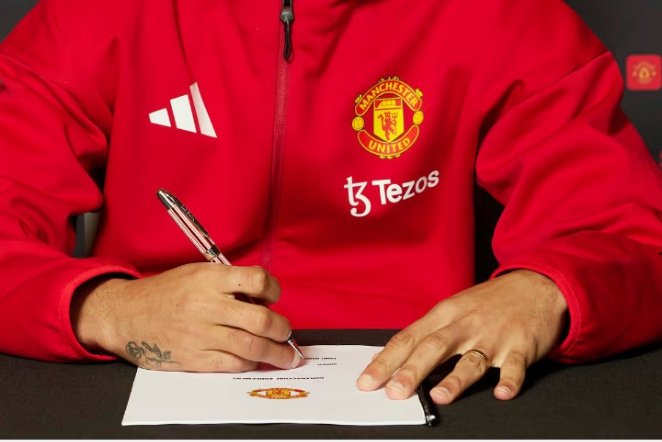
While some unveiling images of new signings earlier in the summer featured Tezos branding, the commercial agreement itself had already lapsed by that stage. Since then, United have operated without a replacement sponsor in that category.
The club had already warned of commercial softness in its December financial release, when executives acknowledged a decline in sponsorship revenue. The latest results confirm that the expected drop has materialised.
Further financial uncertainty surrounds the sleeve sponsorship agreement with DXC Technology. That partnership, believed to be worth approximately £20 million per season, is due to expire at the end of the current campaign.
For the past four seasons, DXC branding has appeared on United’s home, away and third kits. The partnership also extended beyond shirt placement, with DXC contributing digital expertise aimed at enhancing fan engagement across the club’s platforms.
If a renewal is not secured — or if a replacement sponsor is not found at comparable value — the financial impact could deepen next season. Combined with the loss of the Tezos agreement, the cumulative exposure contributes to what is being described as a potential £44 million revenue gap.
Sleeve sponsorship became permissible in the Premier League from the 2017/18 season. United were among the early adopters of the commercial opportunity, initially partnering with Kohler before DXC assumed the role in 2022.
Read also: Osimhen’s all-round influence: Osimhen drives Galatasaray confidence before Turin showdown
Commercial revenue is one of three primary income streams for elite clubs, alongside matchday and broadcasting revenue. While broadcasting income is influenced by league position and European participation, commercial earnings depend heavily on global brand strength and corporate partnerships.
United remain one of the most recognisable football brands worldwide. However, the latest figures illustrate how quickly revenue can fluctuate when high-value agreements conclude without immediate renewal.
The broader sponsorship landscape has also evolved. Cryptocurrency and blockchain firms, including Tezos, were particularly active investors in sports partnerships during recent years.
Market corrections in that sector have since led to reduced spending and renegotiated agreements across European football.
Off the pitch, the club continues to navigate structural and strategic adjustments aimed at long-term sustainability. Investment in the playing squad, infrastructure upgrades and ongoing discussions about the future of Old Trafford all depend in part on maintaining robust commercial performance.
Although supporters may not immediately feel the consequences of quarterly revenue dips, sustained commercial decline can influence transfer budgets, wage planning and overall competitive flexibility.
Securing a new training kit sponsor will likely be a priority before the next financial reporting period. Likewise, clarity over the DXC sleeve deal will be crucial in determining whether the projected shortfall widens or stabilises.
The current figures serve as a reminder that modern football economics extend far beyond match results. Brand partnerships, global reach and commercial negotiations now play a central role in shaping a club’s financial health.
For now, Manchester United face £44m black hole driven by expiring sponsorship agreements and softer commercial returns, placing renewed emphasis on the club’s ability to convert its global stature into sustained revenue growth.
About The Author