MI5 director general Sir Ken McCallum has intensified pressure on Prime Minister Keir Starmer, warning of China’s “daily threats” to Britain’s national security and democratic institutions.
In an extraordinary statement, McCallum expressed frustration over the collapse of a major espionage case involving two men accused of passing parliamentary intelligence to Beijing’s agents operating within the United Kingdom.
He revealed that Britain’s security agencies recently thwarted an attempted cyberattack linked to Chinese state-backed hackers, underscoring the growing sophistication and persistence of China’s espionage operations against Western democracies.
The MI5 chief described the decision not to prosecute the suspects as “deeply disappointing,” saying it represented a missed opportunity to defend the country’s core security interests.
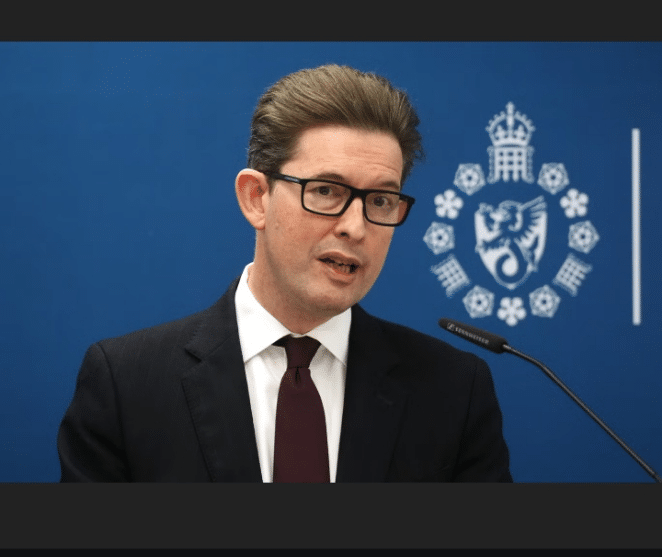
Speaking at MI5 headquarters in London, McCallum said the agency’s role was clear — to “detect, disrupt, and defeat” hostile activity that undermines British national integrity and stability.
He warned that China continues to engage in “cyber espionage, clandestine technology transfer, and covert interference” designed to influence UK public life and compromise parliamentary processes.
“The United Kingdom must defend itself resolutely against China’s actions while seizing opportunities that benefit our nation,” McCallum said, emphasizing the dual challenge of risk management and cooperation.
His remarks come amid fierce criticism of the Starmer administration, accused of downplaying Chinese aggression to preserve trade relations and maintain a stable diplomatic partnership with Beijing.
The collapse of the spy case has fueled opposition accusations that Labour’s security stance is dangerously soft, placing political convenience above the national interest of the United Kingdom.
Prosecutors unexpectedly dropped charges against Christopher Cash and Christopher Berry, who had been accused of gathering and sharing sensitive government information on behalf of Chinese intelligence.
McCallum said he was “frustrated” the prosecution failed, adding that “every unprosecuted threat leaves Britain more vulnerable and emboldens hostile actors seeking to exploit democratic openness.”
The incident has sparked renewed scrutiny of the government’s China policy, particularly after it emerged that Downing Street refused to officially label Beijing a national security threat.
Documents later released showed Deputy National Security Adviser Matt Collins privately warned that Chinese intelligence operations “threaten Britain’s prosperity, resilience, and democratic integrity” through aggressive espionage campaigns.
His statements contradicted the government’s public tone, which sought to balance national security vigilance with maintaining economic access to China’s markets and global manufacturing infrastructure.
Housing Secretary Steve Reed has since delayed approval of a planned Chinese “super embassy” near the Tower of London, amid warnings it could facilitate future espionage.
Critics claim the proposed compound would serve as a sophisticated intelligence hub, enabling Beijing to expand surveillance capabilities across London’s political and business districts undetected.
McCallum urged ministers to listen to intelligence advice and not allow “short-term economic interests” to overshadow the strategic necessity of safeguarding British sovereignty and internal security.
He said MI5 had repeatedly disrupted Chinese networks engaged in digital espionage, intimidation of dissidents, and covert recruitment of political insiders with access to sensitive data.
“When opportunities to prosecute those threatening Britain’s security are lost, frustration is inevitable,” he said. “Our duty is to identify and neutralise hostile activity quickly.”
The political fallout has placed Keir Starmer under significant strain, with opposition figures demanding transparency over his government’s handling of the high-profile China espionage investigation.
Starmer’s spokesperson defended the prime minister, insisting it would have been “absurd” for him to intervene in the judicial process or pressure the Crown Prosecution Service.
The CPS, facing mounting criticism, said it dropped the case due to “insufficient evidence” but maintained it remained committed to protecting Britain from state-backed interference.
Christopher Berry, one of the men previously accused, told the BBC he felt “unfairly subjected to trial by media” despite his full acquittal by the courts.
He said he had shared “open-source economic reports” with a private company seeking to expand trade, denying any deliberate involvement with Chinese intelligence or espionage activities.
“I did not provide information prejudicial to Britain’s safety or interests,” Berry said. “I simply wish to rebuild my life free from public suspicion.”
Former parliamentary researcher Christopher Cash also denied wrongdoing, saying the case’s collapse had left him in an “impossible position” without the chance to publicly defend his reputation.
Experts warn that the fallout risks damaging Britain’s credibility in counterintelligence cooperation with allies, including the United States and Australia, within the Five Eyes alliance.
Ben Bland, director of Chatham House’s Asia-Pacific programme, said Britain must view relations with China through a “strategic lens” and not through short-term political controversies.
“When shaping policy, the UK must recognise espionage as one dimension of a much broader bilateral relationship requiring long-term consistency and strategic clarity,” Bland told The Independent.
He cautioned that the scandal should not singlehandedly determine future diplomatic engagement, though it underscores the gravity of ongoing Chinese interference in domestic politics.
Meanwhile, Labour’s internal divisions on China policy have widened, with senior figures urging Starmer to adopt firmer rhetoric while maintaining channels for limited economic cooperation.
Tory leader Kemi Badenoch wrote to the prime minister accusing his government of “negligence” and “weakness,” saying Britain must not appear “intimidated by Beijing’s influence.”
In response, Starmer said he “would not stand for anyone being unfairly blamed” and insisted his administration acted “within the constraints inherited from previous Conservative policy.”
The prime minister added that “national security remains paramount,” but warned that isolating China entirely would damage the UK’s ability to engage on global trade and climate.
McCallum’s intervention reflects growing concern within the intelligence community that political leaders underestimate the scale and urgency of Chinese influence operations.
He reiterated MI5’s readiness to continue identifying, monitoring, and neutralising threats from foreign actors, stressing that “democracy depends on the ability to confront hidden dangers.”
Publicly, the agency continues to expand digital counterespionage programmes and strengthen cooperation with Western partners to block cyber intrusions targeting British government systems.
The controversy has reignited public debate about how far economic pragmatism should shape national security decisions in an increasingly adversarial international environment.
As McCallum warned, “China’s challenge to open societies will not vanish overnight — only vigilance, transparency, and resilience will preserve Britain’s democratic independence.
“Keir Starmer China policy,”
About The Author