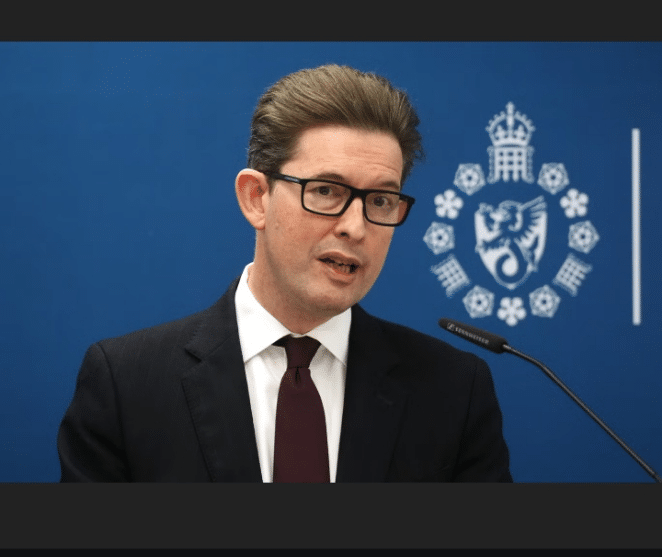
Mongolian Prime Minister Gombojav Zandanshatar has resigned after losing a no-confidence vote in parliament, ending his brief four-month tenure and plunging the nation into renewed political uncertainty.
The 126-seat State Great Khural voted decisively on Friday, with 71 members supporting Zandanshatar’s dismissal and 40 opposing, according to an official statement from the parliamentary secretariat released after the session.
The motion to remove Zandanshatar was filed on October 10 by more than 50 lawmakers accusing him of violating the constitution, abusing executive powers, and ignoring parliamentary oversight on key appointments.
At the heart of the dispute was his controversial decision to appoint a new minister of justice and home affairs without parliament’s approval, a move opponents said breached Mongolia’s separation of powers.
Lawmakers said in their statement that Zandanshatar’s unilateral action “encroached on the powers of the President and the State Great Khural, undermining constitutional principles and the rule of law.”

Zandanshatar’s government, formed in June 2025, had pledged economic stability and anti-corruption reform but quickly became mired in internal disputes and public criticism of its governance style.
Another major complaint cited by parliamentarians was that the prime minister publicly commented on an ongoing investigation, allegedly interfering with judicial independence and compromising the presumption of innocence.
Critics also accused him of altering mineral export pricing rules that benefited select companies, distorting Mongolia’s mining sector competition and weakening transparency in one of its most vital industries.
The no-confidence motion gained momentum as lawmakers across political lines argued that Zandanshatar’s leadership threatened institutional balance and weakened public confidence in Mongolia’s democratic governance.
For the landlocked country, wedged strategically between China and Russia, the political upheaval marks another setback in its struggle to build a stable democratic system since the 1990s.
Zandanshatar, a 55-year-old economist educated in Russia, had been seen initially as a pragmatic technocrat capable of restoring investor trust after months of political turbulence earlier this year.
His rise came after the resignation of former Prime Minister Oyun-Erdene Luvsannamsrai, who was ousted following weeks of public protests and corruption scandals involving members of his administration.
Protesters earlier accused Mongolia’s political elites of hoarding the profits of the country’s lucrative coal and copper exports, fueling widespread anger over deepening inequality and elite privilege.
Zandanshatar’s promises to “restore accountability” and “put the people first” were welcomed by citizens initially, but soon soured as controversies mounted and reforms stalled amid internal rivalries.
The opposition said his administration became overly centralized, failing to consult parliament or the president on critical decisions while alienating key political factions and business stakeholders.
Following the vote, Zandanshatar accepted the outcome, saying he respected “the democratic process and the will of parliament,” while urging unity to avoid further political fragmentation.
Analysts say his resignation now raises serious questions about Mongolia’s political stability and its ability to maintain investor confidence in its natural resource-dependent economy.
Mongolia’s economic growth, driven by mineral exports to China, has slowed sharply in recent months amid falling commodity prices and weakening global demand for coal and copper.
Foreign investors have expressed growing concern over frequent government changes, inconsistent mining policies, and regulatory unpredictability, which they say deter long-term development projects.
“Each leadership change delays key reforms and deters investment,” said an analyst with the Ulaanbaatar-based Economic Policy Research Center in an interview following the parliamentary vote.
The president must now nominate a new prime minister within 14 days, subject to parliamentary approval, setting the stage for fresh negotiations among Mongolia’s political factions.
The ruling Mongolian People’s Party (MPP) still holds a majority, but internal divisions and rival ambitions are expected to complicate the selection of Zandanshatar’s replacement.
Observers believe whoever succeeds him will inherit the same structural challenges: widespread corruption, weak party discipline, and growing public disillusionment with democratic institutions.
The recent political turbulence also threatens Mongolia’s delicate diplomatic balance between China and Russia, its two powerful neighbors, and its “third neighbor” policy with the West.
Frequent changes in leadership risk undermining Mongolia’s international credibility and its ability to attract partnerships in energy, infrastructure, and mining development projects.
“The instability sends a negative signal to foreign partners who value consistency and institutional predictability,” said political scientist Tserendorj Batmunkh from the National University of Mongolia.
Zandanshatar’s downfall also illustrates deeper institutional weaknesses that have plagued Mongolia since its democratic transition three decades ago, with frequent leadership turnovers and factional battles.
Public frustration with corruption, weak governance, and economic inequality has repeatedly spilled into the streets, fueling mass protests and prompting repeated parliamentary crises.
Civil society groups have urged the incoming government to prioritize transparency, accountability, and judicial independence to restore public confidence and stabilize the political environment.
Many Mongolians expressed little surprise at the resignation, saying the pattern of leaders falling from power every few months has become depressingly familiar.
“Every new prime minister promises reform, but nothing changes,” said 29-year-old university lecturer Tuvshinjargal in Ulaanbaatar. “Ordinary people still struggle while politicians fight for control.”
The loss of two prime ministers in less than six months has deepened fears of a governance vacuum and raised doubts about the country’s democratic resilience.
Former Prime Minister Luvsannamsrai had warned in June that political instability could “push Mongolia’s parliamentary democracy toward collapse” if parties failed to build consensus.
His warning appears increasingly prophetic as the nation now faces yet another leadership transition, further delaying reforms aimed at addressing corruption and economic stagnation.
Zandanshatar’s resignation speech struck a conciliatory tone, calling for “national unity, democratic integrity, and respect for constitutional order” amid a visibly divided legislature and public skepticism.
Analysts believe the repeated downfall of prime ministers reflects more than personal failures — it points to deep systemic flaws in Mongolia’s young parliamentary system.
These include vague constitutional limits on executive power, weak party cohesion, and the dominance of entrenched political elites resistant to meaningful reform or decentralization.
Economically, Mongolia’s challenges remain acute. Falling global coal demand, declining foreign reserves, and slow diversification have exposed the country’s vulnerability to external shocks.
Without political stability, economists warn, Mongolia’s ability to attract investment into renewable energy, logistics, and digital infrastructure will remain severely constrained.
International observers, including the United Nations and regional partners, have urged Mongolian leaders to safeguard democratic institutions and prevent political infighting from undermining governance.
The United States and the European Union, key “third neighbor” partners, have previously expressed concern over corruption and instability threatening the rule of law and investment security.
As the political crisis deepens, Mongolians are watching anxiously to see if their leaders can forge consensus and prevent another cycle of resignations and unrest.
For now, the government’s immediate priority is maintaining continuity of essential services and reassuring investors that Mongolia remains committed to stability and constitutional democracy.
Whether the next administration succeeds in restoring trust and delivering on reform promises will determine the trajectory of Mongolia’s fragile democracy in the coming years.
Political analysts agree that only genuine institutional reform and transparency can break the cycle of instability and ensure Mongolia’s democracy survives its current turbulence.
Mongolian Prime Minister resignation
About The Author