MI5 chief Sir Ken McCallum has warned that Britain faces greater danger than on 9/11, as the country confronts a more complex security landscape involving terrorism alongside growing threats from Russia and China.
Writing exclusively for The Independent on the 25th anniversary of the September 11 attacks, McCallum issued an unusually stark warning that Britain can no longer treat national security as the responsibility of intelligence agencies and the armed forces alone.
The director general of MI5 said the threat facing Britain in 2026 is fundamentally different from the one confronting the country and its allies when al-Qaeda carried out the attacks on New York and Washington in 2001.
“The MI5 I lead in 2026 contends with a threat landscape markedly different to 2001’s,” McCallum wrote.
“Sadly, mass-casualty terrorist ambition endures… but the terrorist threat now sits alongside strategic national security threats posed by capable States.”

MI5 warns of a ‘worst of both worlds’ threat
McCallum described the current security environment as a combination of persistent terrorism and increasingly capable state threats.
He cited former CIA director James Woolsey, who once described the post-Cold War challenge as the West having slain a “large dragon”, before warning that the situation has now changed dramatically.
“We now face the worst of both worlds: dragons are back, but snakes persist,” McCallum wrote.
The “dragons”, he explained, are principally Russia and China, while the “snakes” represent continuing threats from radical Islamic extremists.
The warning comes as the UK terror threat level remains at severe, the second-highest category, meaning an attack is considered highly likely.
Russia and China add new dimensions
According to McCallum, Britain terror threat 2026 concerns far more than the possibility of a conventional terrorist attack.
The UK and its allies now face sabotage, covert interference, cyberattacks and other forms of state-backed aggression that can target critical infrastructure and democratic institutions.
“Contending with rising State-backed aggression – whether sabotage subcontracted to criminals, or covert interference in our democracy, or destructive cyber attacks on power stations – demands new laws as well as new tradecraft,” he wrote.
Russia has previously been accused of employing a broad range of hostile activities against Britain, including cyber operations, interference and state-sponsored violence.
China, meanwhile, is increasingly viewed through the lens of strategic competition involving technology, minerals, trade routes and other areas critical to national security.
McCallum argued that these threats require Britain to rethink how it prepares for crises.
“We cannot wait for the next shock to discover who owns the vulnerability, who has the authority to act, or who was supposed to pick up the phone,” he warned.
Lessons from the 9/11 attacks
The MI5 chief also defended the enormous international effort that followed the September 11 attacks, arguing that the campaign against al-Qaeda was necessary to prevent further mass-casualty attacks.
“Al-Qaeda had to be not just taken on, but taken down,” McCallum wrote.
He said a multinational effort led by the United States developed new capabilities to dismantle the organisation’s core structure in Pakistan’s federally administered tribal areas, following the Afghan campaign.
“It worked,” he wrote.
“Al-Qaeda remains a threat today, but its capabilities are a fraction of 2001’s. That rolling back was not inevitable; it was forced.”
However, McCallum warned that the success against al-Qaeda should not encourage complacency.
Instead, he said Britain must continue adapting its security arrangements to confront threats that did not exist, or were not as prominent, in 2001.
“We must resist the temptation to admire the defences we built yesterday and instead build the ones we will need tomorrow.”
McCallum calls for a national security ‘call to arms’
McCallum’s intervention goes beyond traditional intelligence and counter-terrorism policy.
He called on government, businesses, universities and members of the public to recognise that protecting the country is a shared responsibility.
“This is my call to arms after 25 years: government, business, academia, and the public must treat national security not as the specialist concern of a handful of agencies, but as a shared national endeavour,” he wrote.
The warning reflects growing concern among security experts that modern threats can exploit vulnerabilities outside traditional government structures.
Unlike the terrorist networks that carried out the September 11 attacks, many of today’s potential targets and critical systems are controlled or operated by private companies.
Businesses will have a bigger role in national security
McCallum highlighted the changing ownership of Britain’s most important infrastructure and services.
“In 2026, unlike 2001, many of the assets, systems and services under threat sit in private sector hands,” he wrote.
“This means many of the most critical decisions will be taken not in COBR but in boardrooms.”
He called for what he described as “a new team of teams”, involving government, industry and academia.
The objective, he said, should be to preserve Britain’s open economy while strengthening cooperation, closing vulnerabilities and ensuring a rapid response when crises occur.
“We need a new team of teams, preserving an open economy but cooperating across government, industry and academia, to close vulnerabilities and enable swift coherent action when crises hit.”
Britain must prepare before the next shock
McCallum’s warning comes as Britain marks 25 years since the attacks that killed 2,977 people in New York, Washington and Pennsylvania.
The anniversary has prompted renewed debate about the lessons of 9/11 and whether governments have adequately prepared for the next generation of security threats.
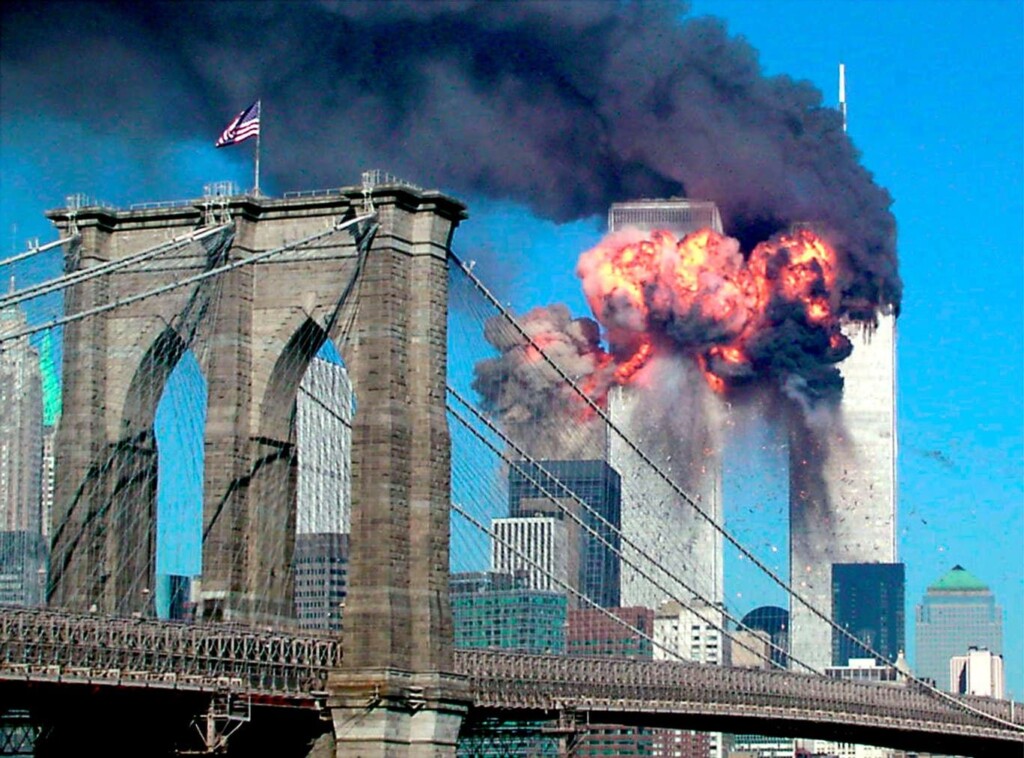
For McCallum, the central lesson is that preparation cannot wait until a crisis has already begun.
His warning is that the next major shock may not resemble 9/11, and could emerge through a combination of terrorism, cyberattacks, sabotage, political interference or attacks on critical infrastructure.
Other security experts, including former MI6 chief Sir Alex Younger and former White House adviser Fiona Hill, have similarly argued for greater national resilience in the face of external threats.
The emphasis is increasingly shifting from relying exclusively on intelligence agencies and military forces towards a broader “whole nation” approach.
McCallum ended his intervention by linking that preparation directly to the victims of September 11 and those who could become victims of future attacks.
“We owe the victims of 9/11 – and those who will otherwise become the victims of tomorrow’s attack – something more than remembrance,” he wrote.
“We owe them preparation, resilience and the courage to adapt before the next shock arrives.”
About The Author