The Palestine Action legal challenge has formally started at London’s High Court, as cofounder Huda Ammori contests the UK government ban declaring the pro-Palestinian activist group a terrorist organisation.
Ammori condemned the ban as “one of the most extreme attacks on civil liberties in recent British history,” emphasizing that the law misapplies anti-terrorism powers against nonviolent activism and public protest.
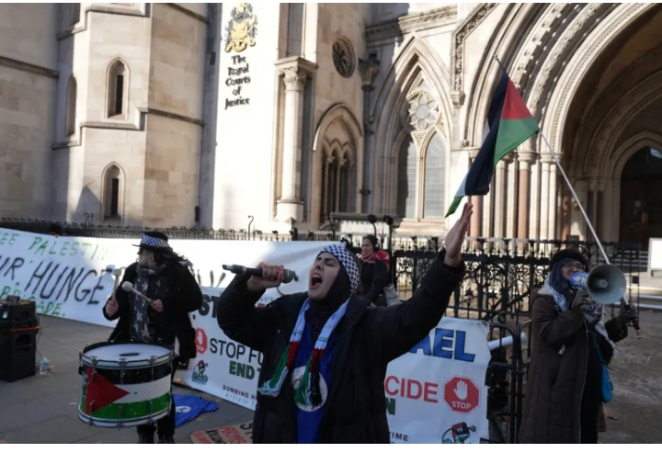
Outside the Royal Courts of Justice, protesters held placards and banners expressing solidarity with Palestine Action, some chanting slogans, demonstrating the direct impact of the UK government ban on freedom of expression.
The Home Office proscribed Palestine Action in July after activists broke into a southern England air force base, allegedly causing £7 million ($9.3m) damage to military aircraft, which prosecutors linked to civil disobedience.
Membership in Palestine Action or support for its campaigns now carries a maximum prison sentence of 14 years, while at least 2,300 people, including students, retirees, and teachers, have been arrested since the ban.
London police reported that 254 individuals have been charged with lesser offences carrying sentences of up to six months, raising questions about the proportionality of enforcement measures under anti-terrorism laws.
Critics argue the UK government equates Palestine Action with armed organisations such as al-Qaeda, ISIL, and Hezbollah, highlighting a contentious expansion of counterterrorism legislation against a group focused on pro-Palestinian activism.
Lawyers representing Huda Ammori insist the proscription misuses anti-terrorism laws, calling it disproportionate and unnecessary, with resources diverted from genuine public threats to penalise political protest and grassroots activism.
United Nations human rights chief Volker Turk described the ban as “disproportionate and unnecessary,” while the Council of Europe criticised the excessive limits it places on the right to peaceful protest in democratic societies.
The case has faced further complications due to the last-minute removal of Justice Martin Chamberlain, a judge widely respected for impartiality, raising concerns about transparency and potential bias in significant Palestine-related cases.
Replacement judges Dame Victoria Sharp and Justice Jonathan Swift have family and professional connections that critics say could represent conflicts of interest, including ties to political donors and previous work with the Home Office.
Emily Apple, spokesperson for Campaign Against Arms Trade, warned that judicial impartiality is essential, stressing that patterns of biased replacements in cases concerning Palestine may undermine public trust in UK courts.
Palestine Action, established in 2020, aimed to end global participation in Israel’s military and economic activities described by activists as genocidal and apartheid, primarily focusing on Israeli defence contractor Elbit’s weapons facilities.
Since the ban came into effect, supporters have continued holding rallies and public actions, displaying signs stating: “I oppose genocide, I support Palestine Action,” reflecting widespread grassroots commitment despite legal restrictions.
Huda Ammori argued that the UK government ban diverts resources from actual security threats and criminal networks, targeting political activism instead, while restricting civil liberties under the guise of anti-terrorism enforcement.
Outside the Royal Courts of Justice, demonstrators displayed posters and engaged in symbolic acts representing direct action tactics used by Palestine Action, with some facing immediate arrest, illustrating the tension between law and protest.
Legal experts note that the outcome of the Palestine Action legal challenge could set a precedent for future cases involving civil disobedience, protest rights, and the limits of anti-terrorism legislation in democratic societies.
Protest organisers from Defend Our Juries have emphasised that people from diverse backgrounds—including students, pensioners, and religious leaders—have faced arrests, demonstrating the wide reach and controversial nature of the UK government ban.
The Home Office maintains that Palestine Action’s campaign involved criminal damage, intimidation, and alleged injuries to individuals, framing the proscription as necessary to protect national security infrastructure and public safety.
Nevertheless, critics insist that anti-terrorism laws were misapplied, and international human rights bodies warn that such measures disproportionately limit freedom of expression and the right to protest, particularly in politically sensitive contexts.
Observers suggest that this case may influence international debates about how democratic governments handle activist groups advocating for controversial foreign policy issues, balancing security with civil liberties protections.
Supporters of Palestine Action highlight the ethical dimension of their campaigns, arguing that targeting weapons manufacturers connected to conflicts, like Elbit, constitutes moral resistance, not terrorism, challenging the UK government ban’s rationale.
The legal proceedings are expected to continue over multiple days, with further hearings to assess whether the proscription of Palestine Action aligns with established civil liberties standards and respects the principles of justice and proportionality.
The Palestine Action legal challenge represents a crucial test for UK civil liberties, potentially shaping the legal boundaries for nonviolent political activism and challenging how anti-terrorism laws are applied to peaceful protest movements.