



A groundbreaking study has intensified global debate by presenting evidence for adolescence lasting until 32, reshaping conversations about maturity, cognitive development, and the biological foundations of adult stability.
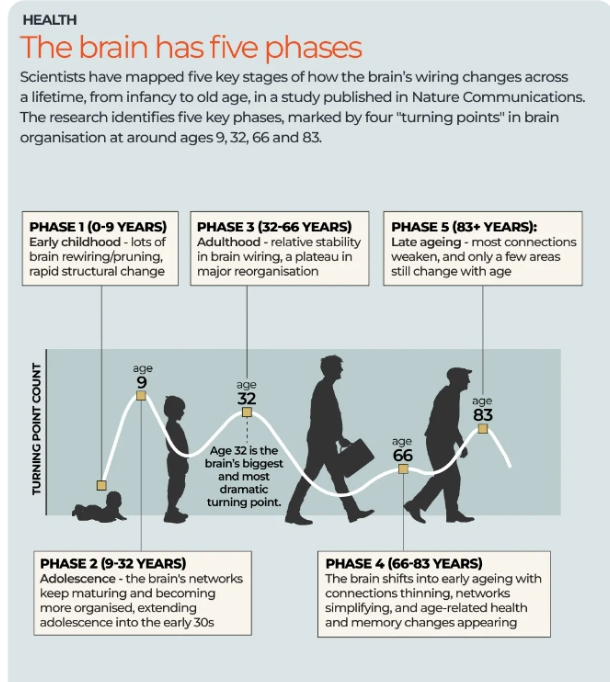
Researchers analysing nearly 4,000 brain scans discovered distinct transitions at ages nine, 32, 66, and 83, with scientists saying these ages represent “the brain’s major developmental turning points.”
The team found five identifiable structural eras in the human brain, noting the most dramatic early-life and mid-life shifts, and calling the 32-year transition a “defining neurological pivot.”
Lead authors described the transitions as “eras hidden in plain sight,” explaining that lives often feel phase-driven because “brains evolve through internal reorganisations, not just external life changes.”
Peer-reviewed in Nature Communications, the research immediately generated global attention, prompting clinicians to reconsider policies, expectations, and medical frameworks shaped by older developmental assumptions.
Neuroscientists said the extended developmental window observed in scans supports emotional and behavioural patterns previously dismissed as social trends, rather than lingering biological maturation.
They reported prolonged white-matter strengthening in participants approaching their early thirties, indicating deeper cognitive refinement that lasts longer than medical textbooks historically suggested.
Experts argue these findings challenge traditional expectations about independence, productivity, and social responsibility, especially in societies that define adulthood by age rather than neurological capacity.
The study calls this prolonged transition a “biologically grounded extension,” urging policymakers to consider the implications for education systems, social welfare, and workplace structures requiring early adult performance.
Professor Duncan Astle said, “Brains never switch from adolescence to adulthood overnight; development fades, stabilises, and recalibrates slowly,” reinforcing why many behaviours remain unstable well into emerging adulthood.
Researchers emphasised that puberty marks the clear beginning of adolescence, but not its end, which appears increasingly dependent on gradual neural integration rather than cultural milestones.
They observed that cultural definitions—such as legal adulthood at 18 or 21—rarely match biological trajectories revealed through long-term neuroimaging datasets.
The authors highlighted the importance of distinguishing cultural adulthood from biological adulthood, warning that conflating the two may misguide public health strategies and mental-health interventions.
Astle noted the research clarifies why emotional regulation, risk-taking, and identity formation often persist into the late twenties, saying, “These are neural, not moral, phenomena.”
The study further found that adolescence—traditionally capped in the teenage years—represents a far longer era of vulnerability, opportunity, and structural brain transformation than previously recognised.
Scientists identified childhood, adolescence, adulthood, early ageing, and late ageing as five neurological eras, with adolescence stretching unusually wide between ages nine and the early thirties.
They argued this extension represents natural biological pacing rather than delay, challenging stereotypes that portray younger adults as simply “maturing late” or lacking discipline.
Age nine marked the first major turning point, characterised by explosive grey-matter development and the consolidation of synapses linked to rapid cognitive expansion.
The authors described early childhood as “a neurological wildfire,” with fierce growth gradually giving way to the competitive elimination of synaptic pathways before adolescence initiates hormonal upheaval.
Puberty, according to the study, represents the first adolescence milestone, triggering major hormonal expression shifts and intensifying neural reorganisation in ways that add complexity to behavioural patterns.
Researchers said mental-health risks increase during this period because the brain’s emotional systems outpace regulatory systems, creating temporary imbalance and heightened sensitivity.
The transition from teenage years into adulthood displayed slow, steady refinement rather than abrupt closure, further supporting the hypothesis of adolescence lasting until 32 within Western populations.
The researchers noted that the age of 32 displayed the sharpest shift in directional white-matter changes, making it the clearest neurological marker of developmental stabilisation.
One author remarked, “This age stands out in the data like a bright flare,” indicating an unmistakable structural pivot that separates adolescence from full adulthood.
They observed rapid increases in white-matter volume and integrity leading up to age 32, suggesting increasingly efficient communication across brain networks.
These shifts, researchers argued, coincide with stabilisation in personality and intelligence, explaining why many adults report newfound clarity or emotional consistency around this period.
The authors stressed that this biological timing does not imply immaturity but reveals natural pacing in cognitive and emotional systems that support complex adult responsibilities.
They also emphasised that global variations may exist, noting data was drawn primarily from Western populations, leaving room for geographic or cultural differences in developmental timing.
Despite this, the authors insisted the large sample size demonstrates universal principles in structural development, though cultural environments may shape outward behaviours.
Adulthood, beginning around age 32 and lasting until the mid-sixties, presented slow, steady evolution rather than major turning points, characterised by stability rather than growth.
Scientists described this era as a “plateau phase,” shaped by the brain’s consolidated networks functioning efficiently and predictably under typical environmental conditions.
They reported subtle refinements but no dramatic reorganising events until the onset of early ageing, which begins in the late sixties.
At age 66, the study observed the next major shift, characterised by reduced white-matter integrity and decreased brain-wide synchronisation.
Researchers said the brain becomes more regionally independent during this period, functioning in specialised pockets rather than unified networks.
They warned that this era corresponds with heightened risk of cognitive decline, including dementia, and often coincides with rising health issues such as hypertension.
The authors explained that age-related changes do not represent immediate deterioration but rather gradual reorganisation reflecting new biological realities.
By age 83, the final turning point appears, though data was more limited due to fewer older participants and natural declines in scan availability.
Researchers found noticeable reductions in connectivity and overall network strength, describing this phase as a “loosening of neurological architecture.”
They cautioned that not all individuals follow identical trajectories, but the trend was consistent enough to validate a distinct late-age structural era.
Scientists said the weakening relationship between age and structural topology in late life reflects the brain’s shift into a more variable and unpredictable pattern.
They emphasised that understanding ageing phases is essential for developing targeted care, personalised medicine, and interventions to slow cognitive decline.
The study also highlighted the global significance of redefining developmental eras, particularly regarding mental-health policy and early-life interventions.
Astle commented, “We have long suspected that development is far from linear. Now we can see the architecture behind the experiences we all recognise.”
Public-health experts argue the findings should shift policy discussions around adolescent support, considering that vulnerability does not vanish upon reaching one’s twenties.
They say educational institutions, employers, and governments may need to adapt approaches acknowledging prolonged cognitive development and emotional volatility.
The research also challenges assumptions around independence, noting that financial or social dependency in early adulthood may reflect neurobiology rather than cultural shortcomings.
Clinicians suggested therapies may need to adapt timing and expectations, recognising ongoing developmental shifts until stabilisation roughly aligned with adolescence lasting until 32.
Policy groups warned that failure to integrate this science risks deepening inequalities by imposing adult burdens before neurological readiness is achieved.
Mental-health specialists described the findings as “a wake-up call,” urging societies to reconsider harsh judgments about younger adults experiencing instability or delayed milestones.
They argued that reframing youth transitions with scientific accuracy fosters empathy, improves clinical outcomes, and aligns programs with genuine biological development.

Researchers insist the study is not an excuse for behaviour but a framework enabling more realistic expectations about how humans grow, adapt, and mature.
Astle concluded, “Our phases shape our lives more than we realise. Understanding them gives us clarity, compassion, and a map through the complexity of human development.”
About The Author
