Iran’s Supreme Leader Mojtaba Khamenei has urged Basij volunteers to expand their influence across Iranian society, calling on the organisation to attract wider support and encourage more citizens to identify with its ideology.
Khamenei made the appeal on Thursday in a message marking Basij Week, asking the nationwide volunteer organisation affiliated with Iran’s Islamic Revolutionary Guard Corps (IRGC) to reach beyond its formal membership and involve people who share its principles.
The directive comes as Iran faces mounting economic difficulties, international sanctions and the consequences of the war launched by the United States and Israel in late February.
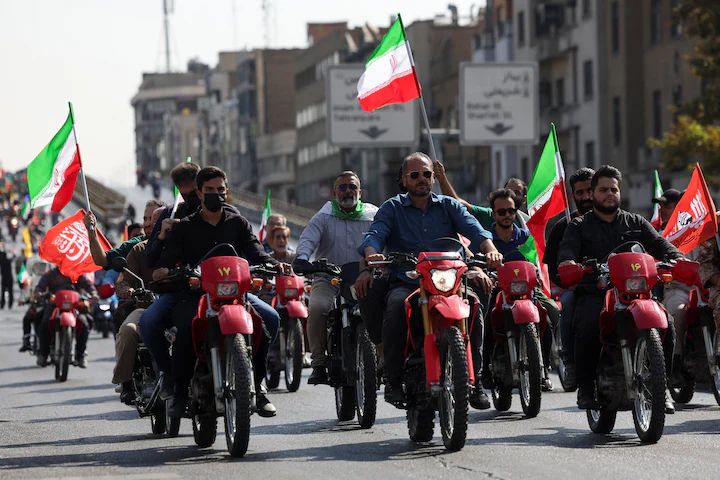
Since the conflict began, Iranian authorities have relied heavily on the Basij to organise pro-government demonstrations across the country, presenting the rallies through state media as evidence of public support for the Islamic Republic.
Khamenei calls for wider Basij participation
In his latest message, Khamenei urged the organisation to draw support from a broader section of the population, including individuals who agree with its ideological position but are not officially registered members.
State media reported that he wanted the Basij to help address the country’s challenges by expanding its social reach and encouraging greater public participation.
His appeal included the ambition of making “every Iranian, a Basiji”, suggesting that the organisation should develop a stronger presence beyond its existing network.
The message comes at a significant moment for Iran’s leadership, which is seeking to reinforce domestic support amid economic pressure and the continuing effects of the conflict.
Khamenei has remained out of public view since succeeding his father, Ali Khamenei, who was killed during the opening strikes of the war.
He has communicated through written statements rather than public appearances, while Iranian officials have attributed his absence to security concerns.
The latest statement therefore provides another indication of his priorities as the country’s new supreme leader, particularly the importance he attaches to strengthening the Basij’s position within Iranian society.
Basij remains an important part of Iran’s security structure
The Basij, formally known as the Organisation for the Mobilisation of the Oppressed, was established in 1979 by Ayatollah Ruhollah Khomeini, the founder of the Islamic Republic.
It initially developed as a nationwide volunteer force before becoming an important source of manpower during the Iran-Iraq war, which lasted from 1980 to 1988.
The organisation was incorporated into the Revolutionary Guards in 1981, strengthening its relationship with Iran’s military and security establishment.
Over the years, it has established a presence in universities, government institutions and neighbourhoods across the country.
Its responsibilities extend beyond military mobilisation to include promoting the Islamic Republic’s ideology, enforcing social regulations, organising political rallies and participating in government campaigns.
The Basij has also played a role in suppressing protests and supporting disaster-relief operations.
This extensive network gives the organisation an important position in the government’s efforts to mobilise supporters and maintain its influence throughout the country.
Role in wartime demonstrations
Since the beginning of the war, the Iranian authorities have increasingly depended on the Basij to organise repeated pro-government rallies.
State media coverage has presented these demonstrations as evidence that the Islamic Republic continues to enjoy broad popular support despite the pressures facing the country.
The authorities have also highlighted the participation of people whose appearance and behaviour do not necessarily reflect the conservative image traditionally associated with the government.
Some reports have shown women attending rallies without fully observing mandatory hijab requirements.
Such coverage appears intended to communicate a message of national unity that extends beyond the government’s traditional conservative support base.
Khamenei’s latest appeal for broader participation is consistent with these efforts to demonstrate that support for the Islamic Republic is not restricted to formal members of its ideological organisations.
Economic difficulties and US sanctions increase pressure
The call for wider Basij involvement comes as Iran confronts serious economic challenges intensified by the war and international sanctions.
The United States has maintained pressure on Tehran through sanctions designed to restrict economic activity and increase difficulties for the Iranian government.
Washington has also sought to exploit public dissatisfaction with the country’s economic conditions to increase pressure on the authorities.
Rising economic concerns have affected ordinary households, with many Iranians facing difficult decisions about spending, essential goods and their future plans.
The government therefore faces the challenge of maintaining public confidence while managing the economic consequences of the conflict.
Expanding the Basij’s social reach could help authorities strengthen their mobilisation network and encourage greater participation in initiatives designed to support the country.
However, the appeal also highlights the government’s continuing reliance on established ideological and security structures during a period of national uncertainty.
Government introduces new volunteer mobilisation programmes
The Iranian government has also introduced initiatives aimed at encouraging citizens to participate in activities connected with national defence and public services.
One such initiative is the Janfada, or self-sacrifice, programme, which calls on volunteers to register for training and assist in defending the country.
The programme reflects the authorities’ effort to broaden participation in national mobilisation as the conflict continues to shape government priorities.
Another initiative involves the Basij’s energy campaign, announced by its newly appointed head, Hossein Taeb.
Under the programme, members are trained to encourage households and businesses to reduce their consumption of electricity and gas.
The campaign comes as Iran faces the prospect of energy shortages during the winter months.
By involving volunteers in efforts to promote lower energy consumption, the authorities are seeking to use the Basij’s nationwide network to support government responses to pressure on essential services.
The initiative also demonstrates how the organisation’s responsibilities extend into everyday economic and social activities.
Iran’s leadership seeks to consolidate domestic support
Khamenei’s message reflects the importance the Iranian leadership attaches to the Basij as both a mobilisation network and an instrument for strengthening the Islamic Republic’s influence.
Its presence in communities, educational institutions and government structures gives authorities an established platform for reaching citizens across the country.
Read also: Elon Musk pledges two SpaceX shares to every child in the US
The supreme leader’s call to attract people beyond the organisation’s formal membership suggests that the government wants to widen that platform at a time when economic difficulties and wartime pressures are testing public confidence.
The Basij’s involvement in demonstrations, volunteer programmes and energy-saving initiatives also shows how the organisation is being used to support several government priorities simultaneously.
As Iran approaches another difficult period, the leadership appears determined to reinforce its domestic mobilisation capacity and present a united national front.
The latest appeal places the Basij at the centre of those efforts, with Khamenei urging its members to expand their social influence and encourage broader participation in the country’s affairs.
About The Author