

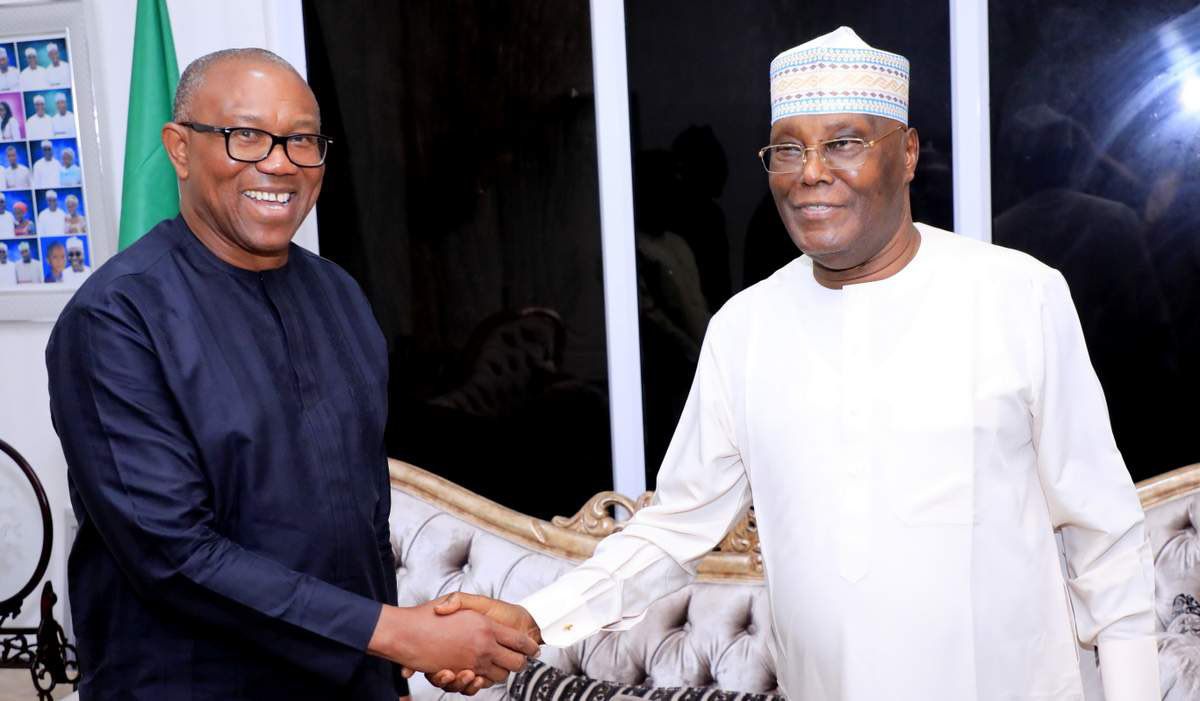
President Bola Tinubu’s Special Adviser on Policy Communication, Daniel Bwala, has questioned the electoral strength of former Vice-President Atiku Abubakar and former Anambra State Governor Peter Obi, accusing both opposition politicians of relying on political strategies that may not necessarily translate into votes.
While describing Atiku’s approach as an attempt to turn the economic hardship confronting Nigerians into a political advantage, Bwala claimed that Obi’s growing visibility was largely driven by social media activities rather than a solid nationwide political structure.
The presidential aide made the observations during an interview on the Naija Unfiltered Podcast, where he discussed the political atmosphere ahead of the forthcoming presidential election.
He was responding to questions about whether President Tinubu was becoming concerned about Atiku’s growing political activities and reported support in northern Nigeria.
Bwala, however, dismissed suggestions that the former vice-president’s growing presence at campaign events should be interpreted as evidence of a strong electoral challenge to the ruling administration.
According to him, the number of people attending political rallies does not necessarily determine a candidate’s popularity or ability to secure victory during an election.
He argued that politicians could attract impressive crowds through campaign mobilisation without necessarily enjoying the level of grassroots support required to win votes across different constituencies.
The presidential aide maintained that political parties should be more interested in identifying their actual supporters, building structures at the grassroots and ensuring that such supporters participate in the voting process.
He also claimed that Atiku had demonstrated his ability to attract large audiences during previous election campaigns, recalling the former vice-president’s contest against former President Olusegun Obasanjo.
Bwala said the enthusiasm surrounding Atiku’s campaign increased considerably in the final days before that election, creating widespread expectations that he could defeat the incumbent president.
However, he argued that the excitement generated by the rallies did not produce the expected electoral outcome.
Recalling the experience, he said Atiku’s campaign activities attracted considerable attention, with large crowds gathering wherever the former vice-president appeared.
“I remember the first time he ran on the platform provided by Asiwaju Bola Ahmed Tinubu against Obasanjo. It was within few days to election that he was sort of getting some oxygen. If you see everywhere he goes, rave, rave, rave. Everybody believed he was going to defeat Obasanjo. At the end of the day, what is it?” Bwala said.
He consequently cautioned against using attendance at political gatherings as a yardstick for measuring the popularity of presidential candidates.
Bwala disclosed that he had previously advised members of the ruling political camp not to become carried away by large crowds recorded during their own campaign activities.
He said his position was informed by his understanding of how campaign mobilisation works, stressing that the presence of thousands of people at a rally does not automatically mean that all of them would vote for the candidate.
In his assessment, the more important consideration should be whether a political movement has the organisational capacity to mobilise voters and secure their participation in an election.
The presidential aide also challenged the political structure supporting Atiku’s ambition in the North, questioning the strength of the party the former vice-president had joined.
He specifically pointed to the absence of a sitting governor in the party as a factor he believed raised questions about its political influence and organisational reach.
Bwala further dismissed descriptions of Atiku’s political movement as a major force, insisting that the ruling party had also demonstrated its ability to attract substantial crowds during campaign activities.
“But even with the crowd, we have pulled more crowds than him. So what is Atiku Tsunami? What is his structure? Because right now the party he has moved to does not have a governor,” he added.
Bwala Questions Obi’s Social Media Influence
Turning his attention to Peter Obi, Bwala questioned whether the former Anambra governor’s popularity on digital platforms reflected his actual political strength across the country.
He argued that Obi’s political visibility was heavily dependent on social media conversations, suggesting that online enthusiasm should not be confused with the kind of grassroots organisation needed to win a presidential election.
Bwala also questioned the level of support Obi currently receives from religious organisations and political associates who were prominent during his 2023 presidential campaign.
He claimed that churches played a significant role in mobilising support for Obi during the previous election but alleged that the relationship had weakened since then.
The presidential aide further suggested that some organisations and individuals who previously identified with the former governor were no longer actively supporting his political activities.
“It’s just like Peter Obi. As I talked about Atiku, he uses social media activities to gauge his election. They are nowhere in Nigeria. In 2023, the church was his structure. They are not with him. Tell me the church he has gone to lately. He has been disinvited,” he said.
Bwala also alleged that Obi’s political support network had experienced setbacks, leaving online influencers and content creators to sustain much of the attention surrounding his political activities.
He suggested that the continued conversations about Obi across social media platforms were partly influenced by the commercial opportunities available to content creators who generate engagement through political discussions.
According to him, Obi’s name and political activities attract considerable reactions online, making him an attractive subject for individuals seeking views, interactions and revenue from digital content.
He argued that such online activities could benefit content creators financially without necessarily improving the former governor’s chances at the ballot box.
“And if you are looking for revenue, you are looking for engagement, believe me, I’m telling you, the best person to pick is Peter Obi, because he’s a mixture of everything that creates engagement for you, so the guys are not losing on social media. So, Peter will lose election, but they will gain,” Bwala stated.
Rally Crowds Not Electoral Victory, Says Presidential Aide
The presidential adviser’s comments also addressed videos circulating online showing individuals allegedly demanding payment after attending political rallies, with some reports suggesting that disagreements had broken out over unpaid allowances.
Reacting to the controversy, Bwala reiterated that campaign attendance should not be used as the principal measure of a politician’s popularity.
He maintained that the credibility of a candidate’s support should be determined by the actual voting process rather than the size of gatherings or the level of attention generated on social media.
He explained that winning an election requires registered voters to participate, undergo accreditation, cast their ballots and have their votes properly counted and transmitted before the results are officially declared.
According to him, political popularity on digital platforms and the ability to organise impressive campaign events cannot replace these electoral requirements.
“I have always been an advocate of not using crowd because if you are using crowd, then that should be the new model for determining who won the election. But elections are won when registered voters, accredited voters, cast their vote, and the vote is counted, and the vote is transmitted, and the vote is collected, and it is then announced. That is the way by which people win election, not the popularity because of the management of algorithm,” he said.
Bwala eventually summarised his assessment of the two opposition politicians by drawing a distinction between what he considered their respective political mobilisation methods.
He accused Atiku of attempting to capitalise on the economic difficulties confronting Nigerians, while describing Obi’s political appeal as being sustained largely by social media engagement.
“What they are doing is that Peter Obi runs the social media algorithm, Atiku runs the weaponisation of poverty’s algorithm,” he concluded.
His comments add to the growing political exchanges surrounding the opposition and the ruling party as political actors intensify efforts to strengthen their support ahead of the next presidential contest.
While Bwala expressed confidence in the ruling party’s political mobilisation, his claims about the opposition figures’ support networks and electoral prospects remain his personal assessment.
The eventual strength of the competing political movements will be determined by voter participation and the outcome of the election.
About The Author
