

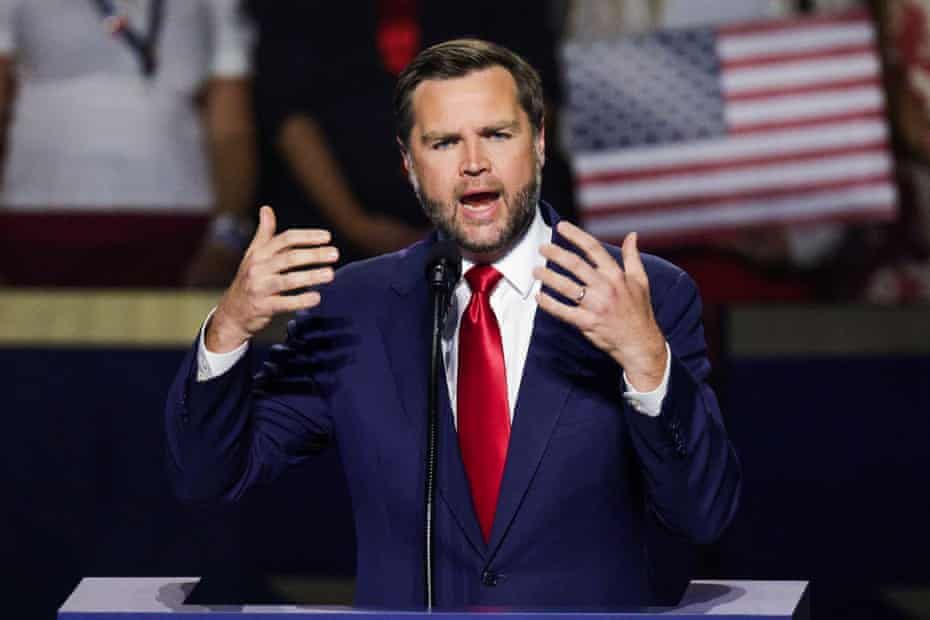
JD Vance positioned himself Trump political heir on Thursday night, delivering a combative speech at the Republican midterm convention in Dallas that closely echoed Donald Trump’s rhetoric while appearing to lay the groundwork for a possible 2028 presidential campaign.
The vice-president received enthusiastic support from the Republican base as he closed the second day of the party’s midterm convention, with some supporters openly calling for him to become the Republican nominee in 2028.
Vance, however, avoided making any direct declaration about his political future.
“We gotta take care of business this November, then we’ll worry about what comes next,” he told the crowd with a smile.
The carefully worded response allowed Vance to embrace the enthusiasm surrounding his political future without appearing to challenge Trump, whose influence over the Republican Party remains dominant.
Vance embraces Trump while building his own profile
The Dallas speech was arguably the most important address of Vance’s short political career.
He had to demonstrate that he could command the Republican base in his own right while remaining sufficiently loyal to Trump, whose approval will remain crucial to any future Republican leadership contest.
Vance repeatedly praised the president, describing Trump as “the toughest SOB in American politics”.
The audience responded with loud cheers, giving Vance one of the strongest receptions received by anyone other than Trump during the two-day convention.
The vice-president also leaned heavily into the cultural and political themes associated with Trump’s Make America Great Again movement.
He attacked illegal immigration, criticised Democratic politicians, defended religious freedom and American manufacturing, and targeted transgender rights.
Addressing what he described as Democratic “radicals”, Vance declared: “Stay the hell away from our kids.”
Vance attacks Democrats and immigration
Vance opened his speech by listing Republican grievances, using language closely resembling Trump’s political style.
He told the crowd that Republicans had previously been “tired of being called racist for noticing that our country was becoming dirtier and poorer and less safe and less prosperous”.
The line generated a strong response from the Maga supporters inside the arena.
The loudest applause of the night, however, came after a protester briefly interrupted the vice-president.
Vance claimed the demonstrator was waving a Mexican flag before responding aggressively.
“Well, my friend, if you love Mexico so much, get your ass over there I’ll buy you the plane ticket,” Vance said.
The crowd erupted in applause.
JD Vance’s 2028 ambitions become clearer
The possibility of a JD Vance 2028 presidential bid has increasingly become part of Republican political discussion.
A recent poll cited by the Guardian found Vance leading a field of potential Republican presidential contenders among likely Republican primary voters, with 43% saying they would choose him as the party’s 2028 nominee.
Secretary of State Marco Rubio was on 21%, while Donald Trump Jr had 7%.
Those figures give Vance a strong early position, although the 2028 contest remains far away and political circumstances could change substantially before then.
Vance’s challenge is therefore to build a national political identity while avoiding a premature break with Trump.
Iran war creates a potential problem
One major vulnerability for Vance could be his association with the deeply unpopular Iran war.
Foreign policy was conspicuously absent from his convention speech, despite the conflict being an increasingly important issue for the administration.
Vance has previously rejected describing the conflict as a “war” but has said he would not establish “artificial lines” regarding when it should end.
Trump’s advisers have reportedly considered the possibility that the conflict could continue through the remainder of his presidential term.
Rather than directly discussing the conflict, Vance made an indirect reference to Charlie Kirk, the far-right activist who was assassinated in Utah a year ago.
“Charlie hated war,” Vance said.
He then urged voters who disagreed with the Republican Party on particular policies not to abandon it.
“What I’m asking you to do is do what Charlie did: do not throw the baby out with the bathwater,” he said.
“Don’t don’t give the country over to a bunch of crazy people because you happen to disagree with us on a policy issue here or there.”
Vance pays tribute to Charlie Kirk
Kirk featured prominently in Vance’s speech, with the vice-president praising the activist’s political legacy and addressing Kirk’s children, who were not present at the convention.
“History will record that your father was a great man,” Vance said.
“Those of us who loved your dad, we know him as something even better than a great man – he was a good man.”
Vance’s tribute reinforced the close relationship he has developed with the Maga movement and its political activists.
It also allowed him to present himself as a defender of the movement’s broader political legacy rather than simply as Trump’s vice-president.
Other Republicans audition for the future
Vance was not the only Republican using the convention to demonstrate his appeal.
Robert F Kennedy Jr, the health secretary who switched parties to support Trump in 2024, delivered a well-received speech in which he praised the president and attacked Democrats.
Texas Senator Ted Cruz also received a strong response from his home-state audience.
“They hate Christians, they hate Jews, they hate the capitalism, they hate the constitution and they hate America,” Cruz said of Democrats, without providing evidence for the claims.
The remarks reflected the broader combative tone of the two-day gathering.
Rubio, another potential contender for future Republican leadership, did not address the convention because he was taking part in a tour of South America.
Read also: MI5 Chief warns Britain faces greater danger than on 9/11 as Russia, China and terror threats grow
Vance carefully avoids challenging Trump
The contrast between Vance and Rubio is particularly significant because both men previously competed against Trump during the 2016 Republican presidential primary.
Trump famously nicknamed Rubio “Little Marco” during that contest and engaged in bitter attacks against Cruz.
Vance, by contrast, has never publicly attracted the same level of hostility from Trump.
That relationship could prove crucial if Vance intends to become the Republican Party’s leading presidential candidate after Trump’s presidency.
For now, the vice-president appears determined to remain firmly aligned with Trump while gradually establishing his own credentials with the Republican base.
He ended his convention speech by once again praising the president, calling Trump the “greatest president” before leaving the stage for Trump to close the convention.
The performance offered a clear glimpse of Vance’s strategy: embrace Trump’s political movement, defend its core themes and build enough support to become a natural successor without openly appearing to compete with the man who brought him to the White House.
About The Author


