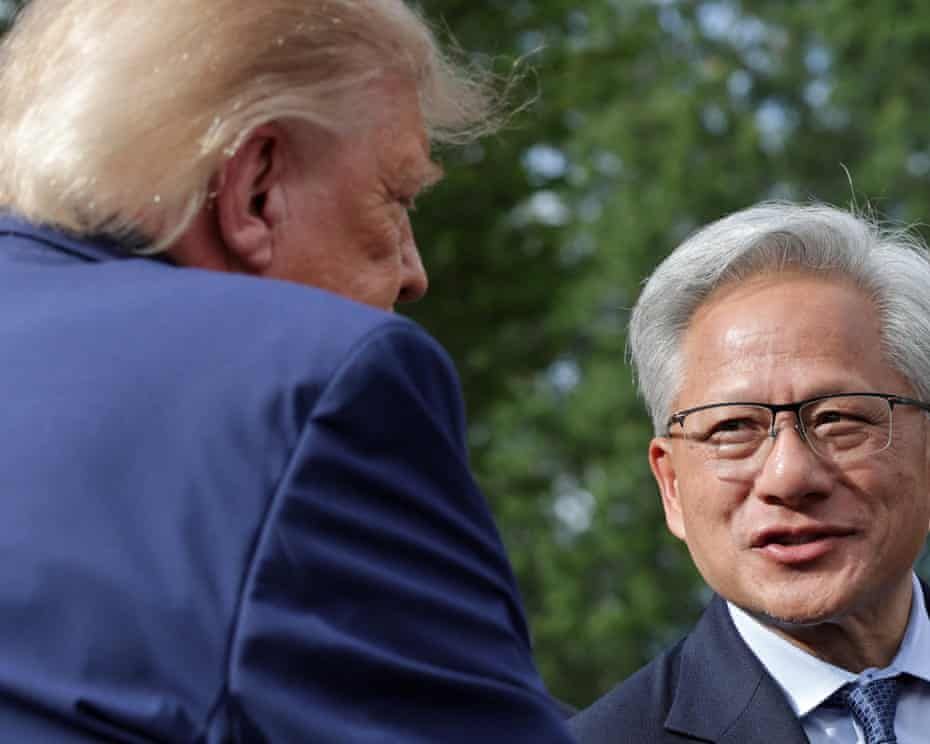
The Jensen Huang reinstatement at Nvidia has sparked fresh concerns among US lawmakers, with Democratic politicians questioning whether President Donald Trump’s intervention placed corporate interests ahead of national security.
Huang, who co-founded the artificial intelligence chipmaker in 1993, was unanimously reinstated by the company’s board after previously being removed amid allegations concerning his personal relationships and questions surrounding Nvidia’s exposure to potential Chinese intelligence operations.
The decision followed Trump’s intervention, with the president telling CNBC that he had spoken to the board and persuaded its members to bring Huang back. Trump argued that losing the technology executive’s expertise would pose a greater threat to the United States than retaining him.
However, several Democratic lawmakers have challenged that position, arguing that the circumstances surrounding the Jensen Huang reinstatement require greater scrutiny, particularly because of concerns about the possible diversion of advanced American technology to China.
Democrats question Nvidia board’s decision
Senator Ruben Gallego and Representative Ro Khanna criticised the board’s decision, suggesting that political and corporate considerations had overshadowed national security concerns.
Their criticism centres partly on allegations involving Alice Huang, a Singapore-based technology executive who has no family relationship with the Nvidia co-founder.
Alice Huang reportedly headed Megaspeed, a company suspected of purchasing billions of dollars’ worth of sensitive Nvidia artificial intelligence chips that were allegedly diverted to China despite American export restrictions.
Some intelligence officials reportedly suspected that she had links to Chinese intelligence. However, those suspicions and the allegations surrounding the chip transactions have not been established as proven facts.
The controversy also includes allegations that Jensen Huang had three affairs, including one involving Alice Huang and two others involving Nvidia employees. These allegations formed part of the circumstances surrounding his removal.
The board subsequently voted unanimously to reinstate him after Trump’s intervention, a development that has intensified questions about the company’s handling of the matter.
Lawmakers demand answers over technology transfers
House Democrat Gregory Meeks has called for a public hearing, arguing that Congress must establish whether American technology was transferred to China in violation of export restrictions.
Meeks said lawmakers would question Huang next week through hearings involving the Senate Banking Committee, House Foreign Affairs Committee, House Intelligence Committee and the House Select Committee on the Chinese Communist Party.
He expressed concern that billions of dollars’ worth of advanced technology could have reached China and questioned the Trump administration’s role in the controversy.
Senator Chris Van Hollen also condemned the development, describing it as evidence of political corruption and deterioration in the administration’s approach to big technology companies and artificial intelligence.
He accused the Trump administration of helping China advance technologically while simultaneously arguing that the United States should reduce restrictions on its artificial intelligence industry.
The lawmakers’ concerns suggest that the Jensen Huang reinstatement may become a significant issue in the wider debate over American technology exports and competition with China.
Warren proposes tighter restrictions on chip exports
Elizabeth Warren, who is expected to become chair of the Senate Banking Committee, has warned that Huang’s return does not place Nvidia beyond congressional scrutiny.
Warren is proposing three legislative measures aimed at preventing sensitive American technology from reaching China.
The proposals would prohibit the export of advanced artificial intelligence chips to China, restrict the sale of chipmaking equipment to the country and require tracking devices on every chip leaving the United States.
She has also called for an independent investigation into the allegations surrounding Nvidia and the possible movement of restricted technology to China.
Her position indicates that the political controversy will extend beyond the company’s boardroom, with lawmakers considering whether existing export controls are sufficient to protect American technological interests.
Trump intervention followed warnings about national security
The controversy has also drawn attention to earlier warnings within the American government.
Secretary of State Marco Rubio reportedly prepared a classified report in May highlighting geopolitical risks associated with the situation.
Former CIA officer Julia Curlee argued that the White House had received sufficient warnings and opportunities to address the concerns but failed to act effectively.
Trump, however, maintained that Huang’s expertise was important to American competitiveness and assured Nvidia’s board that the executive did not represent a national security risk.
Huang returned to Nvidia’s headquarters in Santa Clara on Monday, where employees reportedly welcomed him with cheers.
The company’s shares also surged by 31.5 per cent, adding approximately $950 billion to its market valuation.
Nvidia shares surge amid political controversy
The sharp increase in Nvidia’s share price has added another dimension to the debate, particularly because of Trump’s reported financial interests in the company.
Financial disclosures showed that the president held as many as 370,000 Nvidia shares as of September 30.
A BBC review reportedly found that Trump purchased Nvidia shares worth between $23 million and $86 million over the previous two years and had sold some holdings since returning to the presidency.
The latest share-price increase could have added as much as $15 million to the value of his remaining holdings.
These figures have prompted further questions about potential conflicts of interest, although the reported increase in the value of his shares does not by itself establish wrongdoing.
Mamdani criticises dependence on AI companies
New York City Mayor-elect Zohran Mamdani also criticised the influence of artificial intelligence companies on the financial markets.
Read also: Pope Francis’ private diary reveals encounters with devil and fears over abuse scandal
He argued that the retirement savings of ordinary Americans should not depend on the fortunes or personal lives of powerful technology executives.
Mamdani used the controversy surrounding Huang to question the extent to which working people’s pensions and financial security had become exposed to the performance of major technology companies.
He also referred to an unconfirmed rumour concerning a possible $81 billion divorce settlement, comparing the reported figure with the cost of providing universal childcare.
The Jensen Huang reinstatement has therefore developed into a wider political dispute involving corporate accountability, American export controls, China’s technological ambitions and the relationship between the White House and major technology companies.
With congressional hearings expected next week, Huang and Nvidia could face further questions over the alleged transfer of restricted chips, the company’s internal decisions and the administration’s handling of national security warnings.
About The Author