

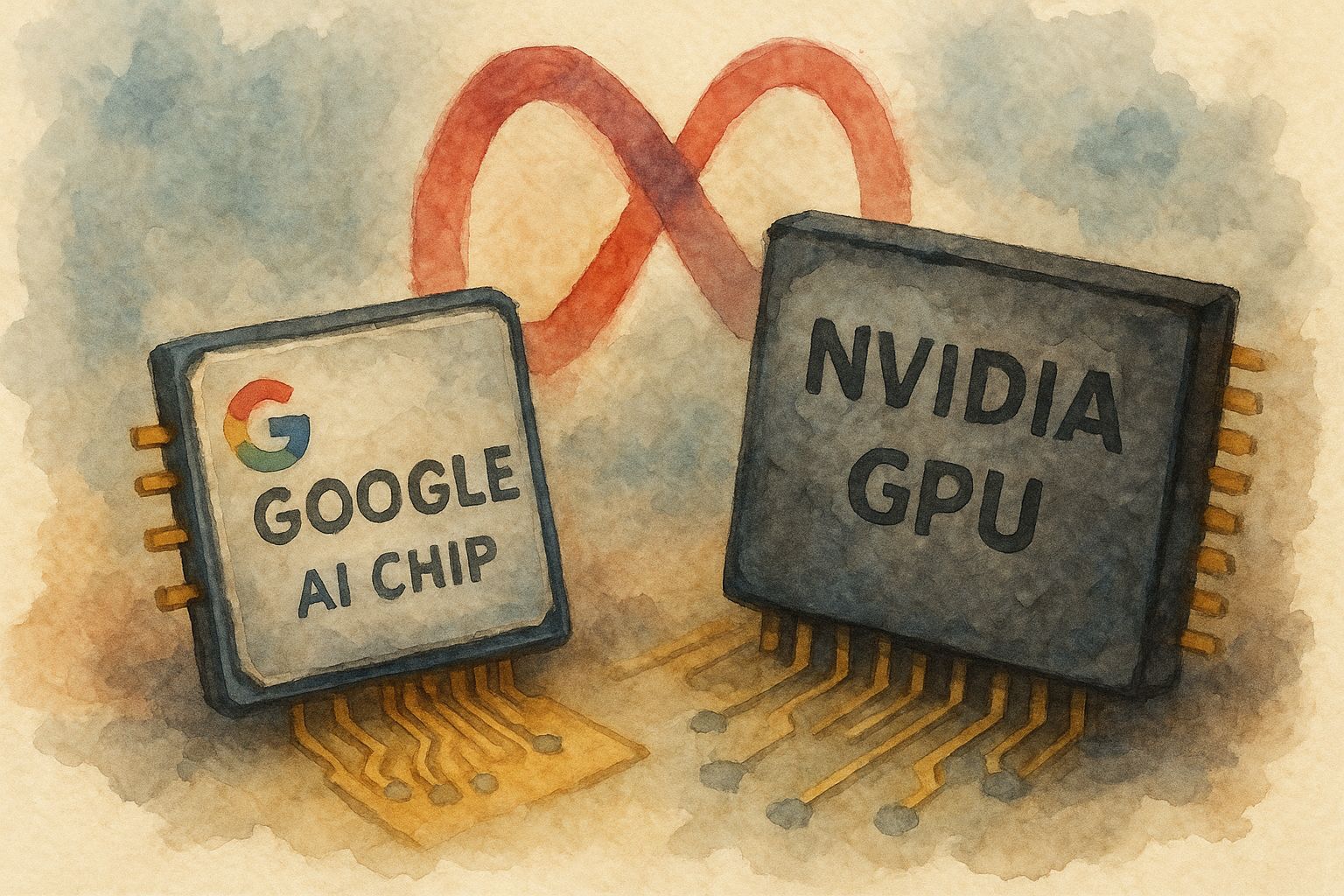
Google AI restructuring: Tech giant pivots strategy amid Nvidia-led industry shift
The global artificial intelligence race is entering a new phase as Google initiates a significant internal shake-up, reallocating talent and resources within its AI division in response to rapidly evolving industry dynamics.
The move highlights a broader recalibration across Big Tech, as companies reposition themselves to compete in what is shaping up to be the next frontier of intelligent computing.
At the centre of this transformation is the growing influence of Nvidia and its Chief Executive Officer, Jensen Huang, whose recent strategic vision for AI development is beginning to reshape priorities across the global technology ecosystem.
Strategic pivot reshapes Google’s AI direction
The ongoing Google AI restructuring reflects a deliberate shift away from experimental, browser-based AI tools toward more advanced, autonomous systems.
As part of this transition, the company has reportedly scaled back efforts on its internal project known as “Project Mariner,” which focused on developing AI agents capable of operating within web browsers.
While such tools represented an early stage of AI-driven automation, industry leaders now believe the future lies in systems that can function across multiple environments, perform complex tasks, and integrate deeply with computing infrastructure.
This reassessment underscores how quickly innovation cycles are accelerating in artificial intelligence, forcing even dominant players like Google to rethink their strategic roadmaps.
Nvidia’s influence drives industry-wide change
A key catalyst behind the Google AI restructuring is the emergence of a new conceptual framework introduced by Jensen Huang.
During a recent keynote, Huang unveiled a vision centred around advanced AI systems capable of operating with greater autonomy and flexibility.
This framework, widely discussed within industry circles, proposes a shift toward AI agents that can effectively “control” computing environments—executing tasks, navigating systems, and making decisions with minimal human intervention.
Unlike earlier AI models that were limited to narrow functions, this next-generation approach aims to create systems that behave more like digital operators, capable of handling complex workflows across platforms.
The concept has gained traction rapidly, influencing how major companies are allocating research funding and engineering resources. For Google, the implications are significant, prompting a reassessment of where long-term value in AI innovation truly lies.
From tools to autonomous systems
The Google AI restructuring signals a broader industry transition from task-specific AI tools to more generalised, autonomous systems.
This evolution is comparable to earlier shifts in computing, where foundational technologies such as operating systems redefined how software interacts with hardware.
In this emerging paradigm, AI is no longer just an assistive layer but a core component of computing architecture. Companies are now racing to build systems that can serve as intelligent intermediaries between users and digital environments.
This shift is expected to unlock new use cases across industries, from enterprise automation to consumer applications, fundamentally altering how technology is designed and deployed.
Intensifying competition among tech giants
The restructuring also highlights the intensifying rivalry among major technology firms, including Microsoft and Meta, all of which are investing heavily in artificial intelligence.
As the competitive landscape evolves, strategic agility has become critical. Companies must not only innovate but also anticipate where the industry is heading—a challenge made more complex by the rapid pace of technological advancement.
The Google AI restructuring illustrates how even established leaders are being forced to adapt in real time, balancing long-term research ambitions with immediate competitive pressures.
Implications for the future of AI
The implications of the Google AI restructuring extend beyond corporate strategy, offering insights into the future direction of artificial intelligence as a whole.
First, it signals a move toward more integrated and autonomous AI systems, capable of handling increasingly complex tasks without direct human oversight. This could transform industries ranging from healthcare and finance to logistics and manufacturing.
Second, it highlights the growing role of hardware and infrastructure in shaping AI development. As a leading provider of AI chips, Nvidia is not only powering current systems but also influencing how future architectures are designed.

Finally, the shift underscores the importance of adaptability in a rapidly changing technological landscape. Companies that fail to evolve risk falling behind, regardless of their current market position.
Broader impact on the tech ecosystem
Beyond individual companies, the Google AI restructuring reflects a broader realignment within the global tech ecosystem. Startups, investors, and research institutions are also adjusting their strategies to align with emerging trends in AI development.
The focus is increasingly shifting toward scalability, interoperability, and real-world application—key factors that will determine the success of next-generation AI systems.
For developers and engineers, this transition presents both challenges and opportunities. While the complexity of building advanced AI systems is increasing, so too is the potential for innovation and value creation.
A turning point in AI evolution
As the Google AI restructuring unfolds, it marks a pivotal moment in the evolution of artificial intelligence. The shift away from experimental projects toward more robust and scalable systems suggests that the industry is moving closer to mainstream adoption of advanced AI technologies.
For Google, the challenge will be to execute this transition effectively while maintaining its competitive edge in a rapidly changing market.
For the broader industry, the message is clear: the next phase of AI will be defined not just by incremental improvements, but by fundamental changes in how intelligent systems are conceived, built, and deployed.
TK888app sounds familiar. Decent enough, easy access through the app. Worth a download, maybe tk888app.
Yo, Jili988login is my go-to spot for some quick spins! Legit and always got the newest games. Check it out: jili988login
Apphcm66 is solid on mobile! Easy to use app and tons of games to kill time. You gotta see it: apphcm66