Iran Strait of Hormuz reopening has emerged as a possible diplomatic opening, with a senior Iranian official saying Tehran could restore access to the strategic waterway within seven days if the United States eases military pressure and lifts its blockade on Iranian ports.
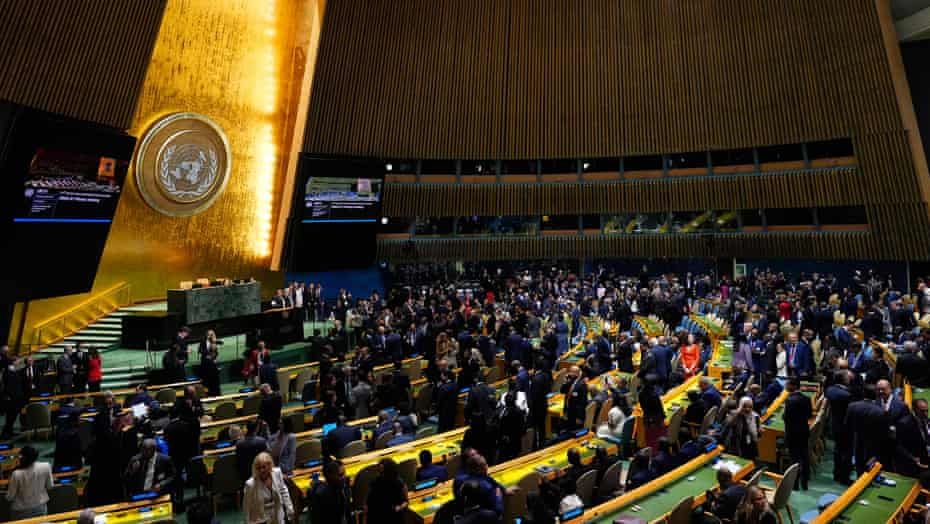
The proposal came as world leaders gathered in New York for the 81st United Nations General Assembly, where the escalating conflict involving Iran, Israel, the United States and regional actors dominated discussions.
According to Reuters, the Iranian official said Tehran’s delegation at the UN has full authority to revive diplomacy with Washington. The United States had not immediately commented on the proposal, which Reuters said it could not independently verify.
The development comes amid severe disruption to shipping through the Strait of Hormuz, one of the world’s most important energy routes. Shipping data showed that only 17 commodity vessels crossed the waterway over the weekend, compared with 37 the previous week.
Before the conflict, an estimated 120 vessels passed through the Strait of Hormuz each day, underlining the scale of the disruption and its potential consequences for international energy markets.
Iran Offers Seven-Day Strait of Hormuz Reopening
The Iranian proposal represents a significant shift from earlier conditions attached to reopening the waterway, although the precise arrangements for restoring normal commercial traffic remain unclear.
A senior Iranian official told Reuters that Iran was prepared to reopen the Strait of Hormuz within seven days if Washington took steps to reduce military pressure and ended its blockade of Iranian ports.
The official also said Iran’s representatives in New York had authority to pursue renewed negotiations with US officials, creating the possibility of diplomatic contacts during the UN General Assembly.
The proposal comes after months of confrontation over Iran’s nuclear programme, military operations and control of the strategically important waterway.
Iran had previously demanded broader concessions, including an end to military operations and other measures before agreeing to restore unrestricted passage.
Strait Remains Central to Global Energy Trade
The Strait of Hormuz connects the Persian Gulf with the Gulf of Oman and Arabian Sea, making it a crucial route for international oil and gas shipments.
The disruption has already affected energy markets, although oil prices fell for a fourth consecutive session as investors responded to signs that diplomacy could resume.
Reuters reported that Brent crude had moved lower amid expectations that the Iranian offer could improve the outlook for Gulf supplies.
The economic implications extend beyond the Middle East because prolonged disruption to the waterway can affect fuel costs, inflation, shipping and energy security across major economies.
Iran’s latest proposal therefore comes as governments and markets monitor whether diplomatic contacts can reduce the military confrontation surrounding the waterway.
UN Chief Warns of Widening Global Divisions
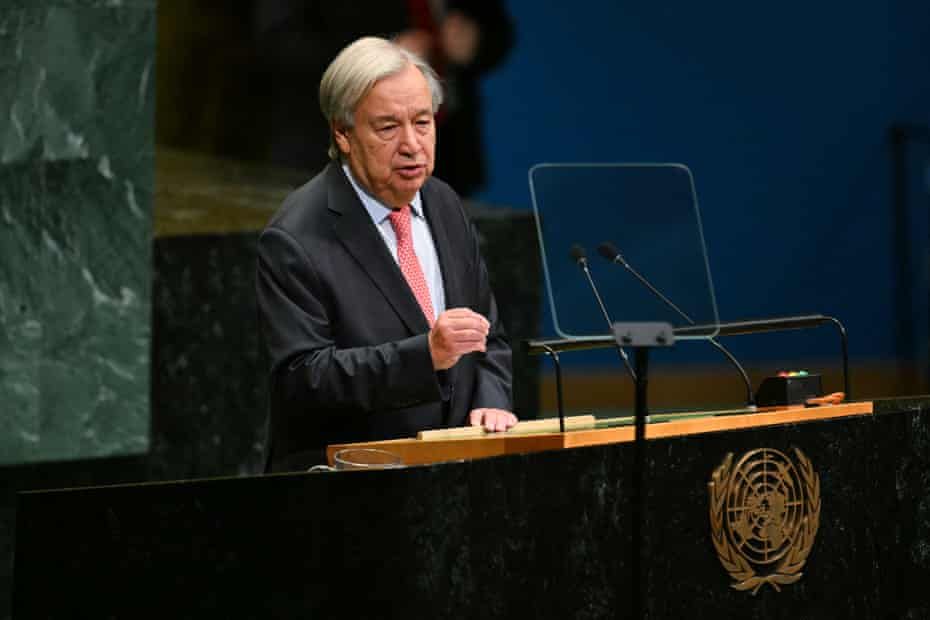
The Strait of Hormuz dispute unfolded as UN Secretary-General António Guterres opened the high-level General Assembly debate in New York with a warning about growing divisions in the international system.
Guterres said, “The fault lines in our world are widening,” pointing to geopolitical conflicts, the climate crisis and the rapid development of artificial intelligence.
He called for greater international cooperation and argued that the world should move toward “a world built on interdependence – and sustained by a dense web of economic, political, social and technological connections.”
The 81st UN General Assembly general debate is scheduled from September 22 to 26 and September 28, bringing heads of state, government leaders and senior officials together at UN headquarters in New York.
Guterres also warned about the dangers associated with artificial intelligence, particularly the possibility of autonomous weapons making decisions over life and death.
“Killer robots must have no place in our future,” he said, calling for safeguards against “technology without accountability”, “capability without oversight” and “decision making without transparency”.
US-Iran Talks Could Resume at UN
US Secretary of State Marco Rubio said Washington remained open to discussions with Iranian officials at the General Assembly, although no meeting had been scheduled at the time of his comments.
“We’re open to that,” Rubio said, while stressing that any diplomatic process would have to address Washington’s objective of preventing Iran from obtaining a nuclear weapon.
The possibility of renewed US-Iran contact comes as both countries remain locked in a wider confrontation involving military operations, sanctions, shipping restrictions and the future of the Strait of Hormuz.
President Donald Trump had also indicated that he could be open to meeting Iranian President Masoud Pezeshkian while both leaders were in New York, although reports indicated that no meeting between the two presidents had been arranged.
Pezeshkian, meanwhile, arrived in New York ahead of his address to the General Assembly, saying Iran would firmly defend its position before the international community.
“We will make the best possible use of this opportunity to convey Iran’s plight to the international community,” Pezeshkian said.
Iran, Saudi Arabia and Houthi Conflict
The diplomatic developments are taking place alongside an escalating conflict in Yemen involving Houthi forces and Saudi-backed government forces.
Fighting has intensified after the collapse of a UN-brokered ceasefire that had largely held since 2022. Military sources cited by AFP reported that 154 people had been killed during two days of fighting.
The Houthis have also attacked Saudi targets, while Saudi Arabia has carried out airstrikes against Houthi-controlled areas in Yemen.
The G7 foreign ministers called on the Houthis to end attacks against civilian shipping and return to the political process. They also called on Iran to end what they described as its arming and support of the Houthis. Iran denies supplying the group with weapons and says its support is political.
The wider regional conflict has increased pressure on the United States and its allies to address threats to shipping routes while avoiding further escalation.
G7 Calls for End to Houthi Attacks
The G7 statement said: “we call on the Houthis to immediately cease all military actions” and called for an end to “all threats and attacks against civilian shipping”.
The group also urged Iran “to end its arming of and support for the Houthis,” while Tehran has rejected allegations that it is supplying the group in violation of international restrictions.
The dispute over the Houthis has become increasingly connected to the broader confrontation involving Iran, Saudi Arabia, the United States and shipping routes around the Red Sea and Gulf.
Iran Warns Against Further US Escalation
Iran’s Islamic Revolutionary Guard Corps has separately warned that any new US attack could result in a wider geographical spread of the conflict.
IRGC spokesperson Hossein Mohebbi said Iran would “change the weapons and geography of the war” if Washington launched another attack.
“Our targets will no longer necessarily be the same as before,” he said, according to Iranian state broadcaster IRIB.
The warning came as the United States continued applying economic and military pressure on Tehran while diplomatic channels remained uncertain.
At the same time, Iran’s offer to reopen the Strait of Hormuz within seven days has introduced a new diplomatic element into the confrontation.
Whether the proposal leads to negotiations will depend on the response from Washington and the terms attached to any reopening agreement.
For now, the Strait of Hormuz remains severely disrupted, while world leaders at the United Nations face a broader set of conflicts and global challenges.
Guterres used his final major General Assembly address before leaving office at the end of 2026 to argue that cooperation remains essential despite deepening geopolitical divisions. The UN secretary-general said he would continue “championing the conviction that peace is possible” after his term ends.
The Guardian reported the developments as part of its live coverage of the Middle East conflict and the UN General Assembly in New York.