

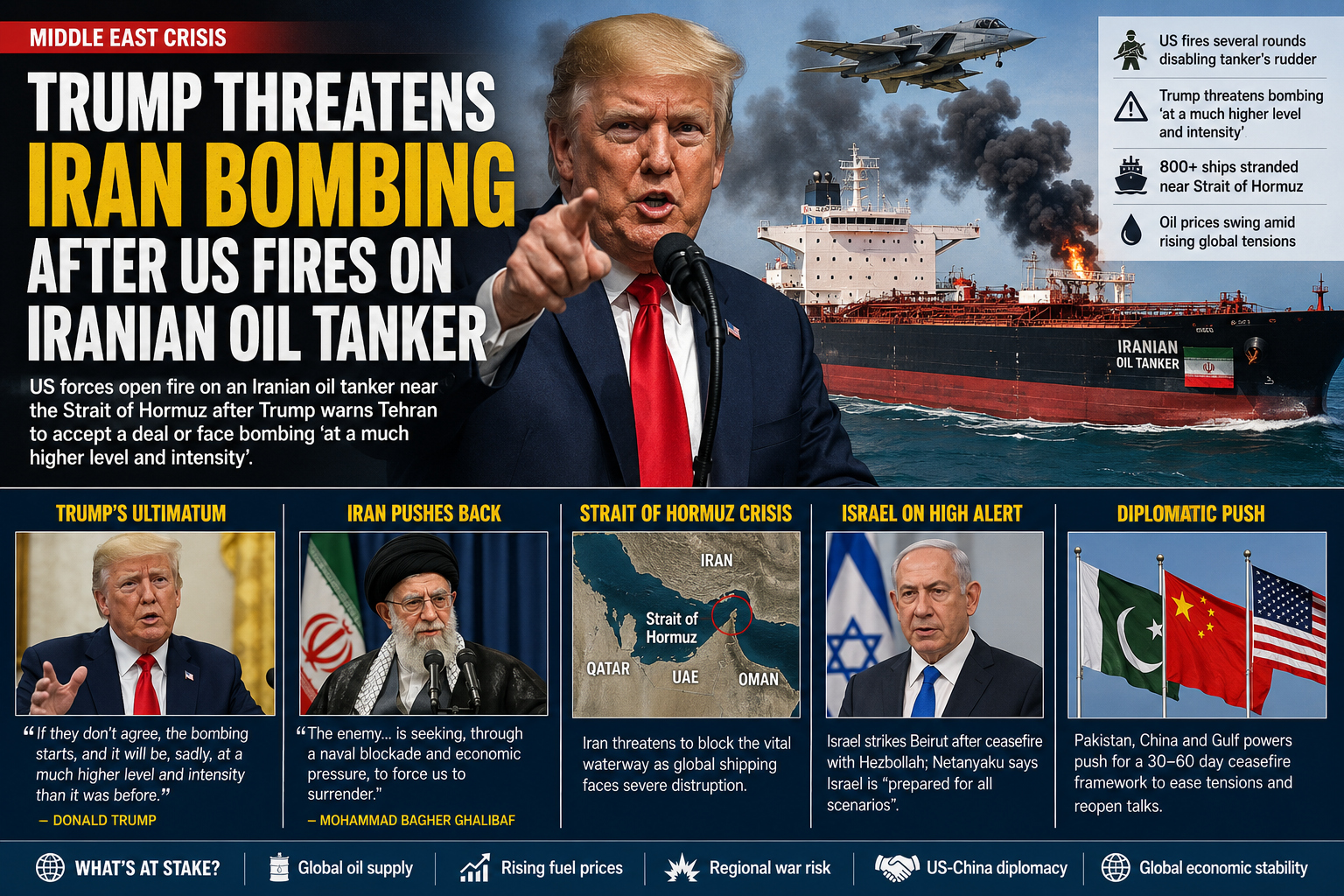
A dangerous new phase in the US-Iran conflict unfolded on Wednesday after American forces fired on an Iranian oil tanker shortly after President Donald Trump warned Tehran to accept a deal or face bombing “at a much higher level and intensity.”
The rapidly escalating Strait of Hormuz crisis has rattled global markets, raised fears of wider Middle East tensions and triggered urgent diplomatic efforts involving Pakistan, China and Gulf powers seeking to prevent a broader regional war.
Trump Threatens Iran Bombing As US Targets Tanker
The US military confirmed it fired several rounds at an Iranian-flagged oil tanker that allegedly attempted to breach Washington’s blockade of Iranian ports.
According to US Central Command, the strikes disabled the vessel’s rudder and prevented it from continuing its journey through the strategically vital Strait of Hormuz.

The incident came just moments after Trump issued a fiery warning to Tehran on his Truth Social platform.
“Assuming Iran agrees to give what has been agreed to, which is perhaps a big assumption, the already legendary Epic Fury will be at an end,” Trump wrote.
“If they don’t agree, the bombing starts, and it will be, sadly, at a much higher level and intensity than it was before.”
The comments immediately heightened fears of another large-scale military confrontation in the Middle East.
Iran Rejects Pressure As Talks Continue
Iran responded defiantly to the renewed threats, insisting it would not surrender under military or economic pressure.
Mohammad Bagher Ghalibaf, speaker of the Iranian parliament and one of Tehran’s top negotiators, accused Washington of attempting to force Iran into submission.
“The enemy, in its new design, is seeking, through a naval blockade, economic pressure and media manipulation, to destroy the country’s cohesion in order to force us to surrender,” Ghalibaf said in a message published on Telegram.
Despite the escalating rhetoric, diplomatic negotiations appear to be continuing behind closed doors.
Reports from Axios suggested Washington and Tehran may be close to reaching a one-page memorandum aimed at ending hostilities.
Pakistani officials also revealed that discussions remain active, though difficult.
“There is still ambiguity in talks and nothing is completely decided,” one official said.
“It is still 50/50 and things can go either way.”
Strait Of Hormuz Crisis Raises Global Alarm
The Strait of Hormuz crisis continues to threaten global energy supplies, with more than 800 ships reportedly stranded west of the narrow waterway.
Iran has repeatedly threatened to deploy drones, naval mines and missile systems across the route, which handles a major portion of the world’s oil shipments.
Trump recently paused a naval operation known as Project Freedom, which had been designed to escort stranded commercial vessels through the region.
According to reports, Saudi Arabia opposed the operation and warned Washington against using its airspace or military facilities for the mission.
Oil prices initially surged amid fears of supply disruptions before falling again following reports of possible ceasefire discussions.
Israel Signals Readiness For Wider Conflict
Israeli Prime Minister Benjamin Netanyahu said his government was “prepared for all scenarios” as tensions intensified across the region.
Elsewhere, Israeli forces struck Beirut for the first time since agreeing to a ceasefire with Hezbollah last month.
Lebanese authorities said multiple casualties were recorded after strikes targeted southern suburbs of the capital.
The latest escalation comes as analysts warn that the US-Iran conflict may be approaching a dangerous stalemate.
While Iran faces mounting economic pressure from the blockade, the Trump administration is also confronting international criticism and rising fuel costs at home.
Read also: Pope Leo nuclear weapons dispute: Pontiff rejects Trump accusation over Iran war
China And Pakistan Push For Ceasefire Deal
China and Pakistan are now emerging as critical players in efforts to broker a temporary ceasefire.
Trump is expected to visit Beijing next week, with observers suggesting Washington hopes China can pressure Tehran into easing the Strait of Hormuz crisis.
A senior Pakistani source said negotiators are discussing a possible 30-to-60-day framework agreement to reopen shipping routes and create room for broader talks on uranium enrichment and regional security.
“That gives a chance for both parties to talk out all important matters,” the source said.
“But nothing is finalised yet.”