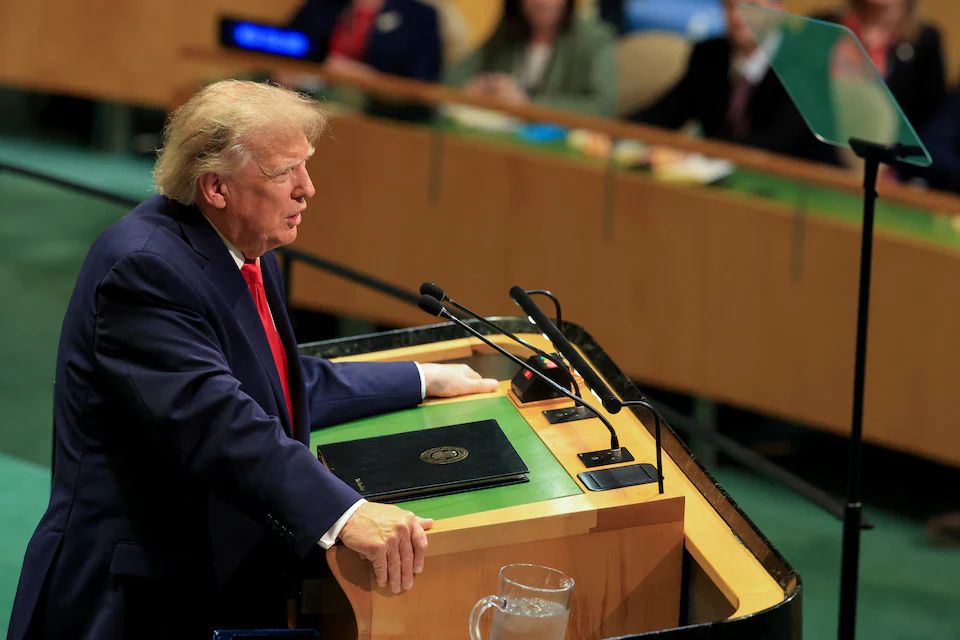
United States President, Donald Trump reportedly rejects Iran’s seven-day peace plan to reopen the Strait of Hormuz and halt fighting, as Iranian President Masoud Pezeshkian says Tehran remains ready for nuclear talks but will not accept “bullying or coercion”.
The reported US rejection comes as Iran awaits an official response from Washington to a proposal transmitted through Qatari mediators during the United Nations General Assembly in New York.
According to Reuters, the proposal could reopen the strategically important Strait of Hormuz and establish a path towards ending hostilities across the region within seven days. The report of Trump’s rejection was attributed to the Wall Street Journal, which cited unnamed US officials.
Iran’s Seven-Day Peace Plan
Iranian Foreign Minister Abbas Araghchi said Tehran had presented Washington with a concrete plan that would establish a seven-day process for reopening the Strait of Hormuz and halting fighting.
The proposal seeks to revive a framework previously agreed between Iran and the United States, while addressing the issues that led to the collapse of the earlier arrangement.
Under the reported plan, the United States would be expected to take steps including easing its military pressure, lifting its naval blockade of Iranian ports and addressing sanctions and frozen Iranian assets.
In return, Iran would reopen the Strait of Hormuz at the end of the seven-day period, while negotiations on broader issues, including the nuclear programme, would resume.
Iran Awaits Official US Response
Despite reports that Trump has rejected the proposal, Tehran says it is still waiting for an official response from Washington.
Reuters reported that Iran was awaiting the US move after the Wall Street Journal reported that Trump had rejected the plan.
The distinction is significant because no direct public statement from Trump confirming that he personally rejected the proposal has been established in the available reporting.
The Guardian similarly reported that Trump was reported to have rejected the deal, while noting that Tehran was awaiting an official American response.
Pezeshkian Says Iran Ready for Nuclear Talks
Against that backdrop, Pezeshkian said Iran remains prepared to negotiate with Washington over its nuclear programme and other outstanding issues.
Speaking to CBS’s Face the Nation, the Iranian president said Tehran would honour commitments if the United States accepted the latest proposal.
“If this message reaches the President of the United States, or the interviewers and those involved in the discussions, naturally the process will begin from the very day they accept it,” Pezeshkian said.
He also insisted that Iran was not seeking war but would defend itself against pressure and military attacks.
“Iran is not seeking war, but will defend itself against pressure, threats and attacks,” Pezeshkian said.
He added that Iran had already accepted that “we’re not supposed to develop nuclear weapons”.
Pezeshkian Rejects ‘Bullying or Coercion’
Pezeshkian said Tehran was willing to discuss its nuclear programme but would not accept negotiations conducted under threats.
“We are doing everything humanly possible, but not through bullying and coercion intended to force us into submission,” he said.
The Iranian president also pointed to what he described as an atmosphere of distrust between Tehran and Washington, particularly because military attacks had occurred around previous diplomatic efforts.
CBS reported that Pezeshkian said Iran would “abide by whatever we commit to” if Washington accepts the latest Iranian proposal.
Strait of Hormuz Remains Central to the Conflict
The Strait of Hormuz has become one of the most important pressure points in the conflict because it carries a significant share of global energy shipments.
Iran’s proposal therefore extends beyond its bilateral dispute with Washington.
The waterway connects the Persian Gulf with the Gulf of Oman and is critical to the movement of oil and other energy supplies from the region.
The ongoing disruption has already contributed to concerns over global oil prices, shipping and inflation.
Iran has said it could reopen the waterway within seven days if Washington meets the conditions outlined in its proposal.
Previous Deal Complicates New Negotiations
The latest proposal is closely connected to an earlier memorandum of understanding reached between Iran and the United States.
Pezeshkian told CBS that the two sides had previously reached an agreement but that the process was interrupted.
He argued that the latest proposal provides a framework for returning to the earlier arrangement and resolving the outstanding disagreements in stages.
The earlier agreement eventually broke down after disagreements over the operation of shipping through the Strait of Hormuz and renewed military confrontation.
Iran’s new proposal therefore represents an attempt to revive elements of that framework while setting a much shorter timetable.
Trump Has Not Publicly Confirmed Rejection
The reported rejection remains an important qualification in coverage of the diplomatic development.
The Wall Street Journal report cited by Reuters said Trump had rejected the Iranian proposal, while other reporting said the US president was sceptical that Tehran would meet his demands.
However, no direct Trump quotation confirming that he had rejected the seven-day proposal appears in the Reuters report or the Guardian report currently available.
That means the development should be described as a reported rejection, rather than presented as a confirmed public decision by Trump.
The White House has also been described as holding “positive and constructive” discussions with Iranian mediators, adding another layer of uncertainty to the conflicting signals surrounding the negotiations.
Wider Middle East Conflict Raises Stakes
The diplomatic effort is taking place against the backdrop of a wider regional war involving Iran, Israel, the United States and Iran-backed groups.
Early Saturday, a Saudi-led coalition said it had intercepted two drones launched by the Iran-backed Houthis towards Riyadh.
Iranian-aligned militias in Iraq have also been blamed for an attack on a Saudi oil pipeline that temporarily reduced oil supplies from the kingdom.
Meanwhile, Hezbollah, which is backed by Iran, remains involved in fighting with Israeli forces in Lebanon.
Read also:Russia strikes Ukraine datacentres as Kyiv fears growing threat to digital economy
These developments mean that any US-Iran agreement could have consequences extending beyond the two countries.
Seven-Day Plan Puts Pressure on Diplomacy
Iran’s proposal has introduced a specific timeframe into efforts to end the conflict.
Tehran says the process could begin immediately if Washington accepts the framework, while the United States has yet to publicly confirm whether it accepts the proposal.
Pezeshkian’s latest comments indicate that Iran wants to keep negotiations open, particularly over its nuclear programme, but considers the conditions under which talks take place to be crucial.
For now, the central question is whether the reported US rejection becomes an official position or whether Washington and Tehran can use the latest diplomatic contacts to revive negotiations.
With the Strait of Hormuz still at the centre of the confrontation, the response to Iran’s seven-day plan could have consequences for the wider Middle East conflict, global energy markets and efforts to return the two countries to negotiations.