

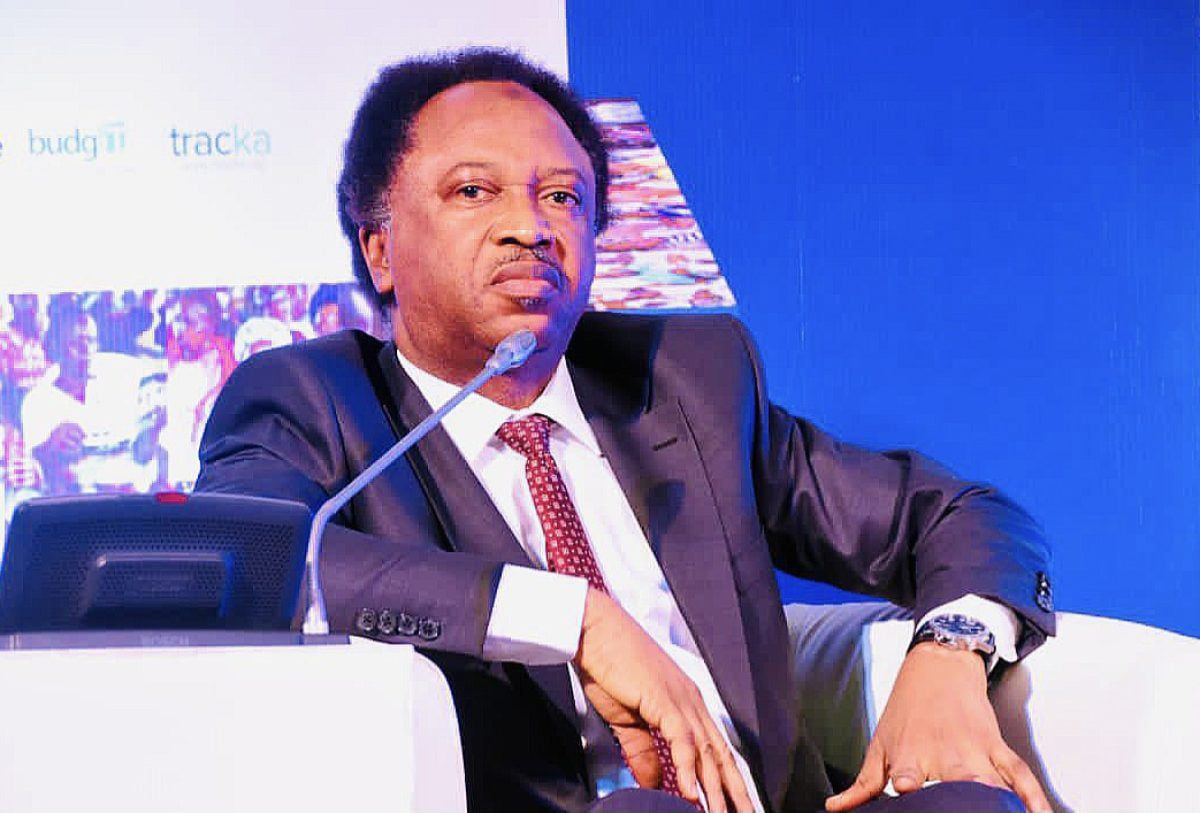
Former Kaduna Central Senator Shehu Sani has said a victory by African Democratic Congress (ADC) presidential candidate Atiku Abubakar in the 2027 election would effectively bring Nigeria’s informal rotational presidency arrangement to an end.
Shehu Sani made the statement while appearing on Channels Television’s Politics Today on Friday, September 25, 2026, as he explained his position on the regional distribution of presidential power ahead of the 2027 general election.
The former lawmaker argued that the southern part of Nigeria should be allowed to complete what he described as an eight-year presidential tenure before power returns to the North.
His position is based on the argument that the North had an eight-year opportunity to occupy the presidency between 2015 and 2023 under former President Muhammadu Buhari, and that the South should similarly complete an eight-year cycle before the presidency changes region.
Sani, however, made it clear that he was not claiming that Atiku Abubakar was constitutionally barred from contesting the 2027 election.
According to him, the former vice president has every constitutional right to seek the presidency, but political parties and leaders should also take regional balance, fairness and national stability into consideration when determining their candidates.
“I never said Atiku should not run. Constitutionally, he has the right to run for any election. But what I said was that the southern part of Nigeria should be allowed to have its eight-year tenure in office, just like the way the North has from 2015 to 2023,” Sani said.
He subsequently proposed that political parties should present southern candidates for the 2027 presidential contest and allow voters to determine who emerges victorious.
Sani specifically mentioned Peter Obi, Rotimi Amaechi and Oyo State Governor Seyi Makinde as politicians who, in his view, could represent southern interests in the election.
“The NDC should field Peter Obi, the APM should field Makinde. Let the South struggle it out and see who wins, and for four years. And when the tenure is done by 2031, the North shall have its unchallengeable opportunity to produce leadership of the country,” he said.
The former senator acknowledged that rotational presidency is not expressly provided for in Nigeria’s Constitution. However, he argued that political practices and understandings that are not written into the Constitution can still be considered when they are intended to promote equity, fairness and peaceful coexistence.
Sani said Nigeria’s political history should be taken into account when discussing how presidential power is distributed among the country’s major regions.
“There are things that are not written in our constitution, but in the interest of justice, fairness, equity, and peace, we need to consider all these things here,” he said.
His argument also extends to the question of whether population size and electoral strength should determine which region continues to control the presidency.
Sani rejected the idea that a region should be able to dominate political power simply because it has a larger population or electorate.
“You cannot say that because you have the largest electorate and population, so you should continue dominating politics,” he said.
He also referred to Buhari’s administration, which lasted from 2015 to 2023, as an example of the North having two consecutive four-year terms in the presidency.
According to Sani, the South did not mount what he described as a serious challenge to Buhari’s eight-year tenure, and he believes the same principle of allowing a region to complete an eight-year cycle should be applied to the South.
“Buhari had his eight years in office; there is no serious challenge from the southern part of Nigeria to his government,” Sani said, according to reports of the interview.
He maintained that his argument should not be interpreted as a call to prevent northern politicians from participating in the election.
Instead, he distinguished between the constitutional right to contest and the political argument over which region should produce the president at a particular point in the country’s political cycle.
“About Atiku, the constitution has not stopped him from contesting the election. He can contest the election, but for me, that is my position and I’m not backing down on it,” he said.
Sani was also asked directly about what an Atiku victory would mean for the informal principle of rotational presidency.
In response, he said an Atiku victory would effectively signal the collapse of the arrangement, while warning that such an outcome could generate resentment in parts of southern Nigeria.
“If Atiku wins, it means that is the end of rotational presidency in Nigeria,” Sani said.
He further argued that a northern candidate taking over immediately after President Bola Tinubu could encounter opposition from parts of the South because, in his view, the region would feel that it had not completed its expected eight-year period in the presidency.
Sani said the country was already dealing with political tensions and other challenges, and argued that political leaders should avoid arrangements that could deepen regional disagreements.
“I don’t think anyone will like to preside over a country full of hate, animosity, and conflict. Right now, the political system is managing a lot of crises,” he said.
He contrasted that scenario with his preferred sequence, arguing that if a southern candidate were allowed to complete an eight-year tenure by 2031, a northern candidate could subsequently take over without the same level of regional resistance.
“But if we allow the South to have their eight years, by 2031, a northerner takes over, there will be no challenge from southern Nigeria. That is my own view,” Sani said.
The debate highlights one of the political questions likely to remain prominent as parties and presidential aspirants prepare for the 2027 election: whether regional power rotation should continue to influence presidential nominations despite having no explicit constitutional basis.
While the Constitution provides the legal framework for presidential elections and does not establish a North-South rotational presidency, zoning and regional balancing have been used as political considerations by parties at different times.
Sani’s position therefore represents a political argument about how the 2027 contest should be structured, rather than a constitutional restriction on who can contest.
Atiku remains constitutionally entitled to seek the presidency, according to Sani’s own clarification, while his argument is that political parties should consider allowing southern candidates to compete for the presidency in 2027 before power potentially returns to the North in 2031.
With the 2027 presidential race already taking shape, the question of zoning, regional representation and the informal rotation of power is likely to remain part of the wider political debate as parties prepare for the election.
160-character snippet
Shehu Sani says Atiku can contest in 2027 but argues the South should complete eight years before power returns to the North in 2031.
Keywords
Shehu Sani, Atiku Abubakar, 2027 election, Nigeria presidency, 2027 presidential election,
About The Author
