The Marco Rubio Europe alliance speech delivered in Munich marked a defining moment in the Trump administration’s attempt to reset relations with the continent, offering Europe a renewed partnership while making clear that the United States expects alignment with its political and strategic worldview.
Speaking at the annual security gathering, the US secretary of state described America as “a child of Europe” but warned that any future alliance would be shaped firmly by Washington’s priorities under President Donald Trump.
Addressing delegates at the Munich Security Conference, Marco Rubio framed the transatlantic relationship as historically inseparable while insisting that sentimentality alone could no longer sustain it.
He told European leaders that the US was committed to building a new global order and added that while America was prepared to act alone if required, it preferred to do so “together with you, our friends here in Europe,” emphasising that the two sides “belong together.”
Rubio acknowledged that Washington’s tone may sound direct or urgent but argued this reflected genuine concern over Europe’s trajectory.

According to him, the destinies of Europe and the United States remain intertwined, and the stakes of political inertia have grown too high for diplomatic caution. His speech, greeted with visible relief by many in the audience, nonetheless prompted quiet unease as it became clear the partnership on offer was not one of equals.
Several delegates noted that the Marco Rubio Europe alliance speech differed sharply in tone from remarks delivered by the US vice-president a year earlier, when JD Vance launched a blistering critique of European leadership at the same forum.
Yet despite the softer language, Rubio made no attempt to soften the substance of the Trump administration’s stance, stressing that Washington would not retreat from its ideological foundations.
He rejected the idea of a Europe constrained by what he described as guilt, shame, or bureaucratic paralysis, saying the US had no interest in “being polite and orderly caretakers of the west’s managed decline.”
Instead, Rubio spoke of revitalising what he called “an old friendship” and renewing “the greatest civilisation in human history.” In his view, western societies are suffering not merely from flawed policies but from “a malaise of hopelessness and complacency.”
Throughout the Marco Rubio Europe alliance speech, the secretary of state repeatedly sought to align Europe with Trump’s political philosophy. He argued that both sides of the Atlantic had made the same strategic errors, including prioritising climate activism over national resilience, expanding welfare systems at the expense of defence spending, and embracing globalisation without sufficient regard for borders or sovereignty.
Rubio insisted that controlling national borders should not be equated with xenophobia or hatred, describing it instead as “a fundamental act of national sovereignty.”
He warned that the failure to manage migration effectively was no longer a marginal issue but a destabilising force reshaping western societies and threatening their long-term cohesion. Mass migration, he said, “was and continues to be a crisis.”
The US secretary of state also addressed the future of international institutions, arguing that the emerging global order would not require dismantling bodies such as the United Nations but rather reforming them.
He controversially claimed that it was the Trump administration, not multilateral institutions, that had driven progress in resolving conflicts in Gaza and Ukraine, a remark that drew muted reactions from European diplomats.
Despite praising Europe’s cultural and historical legacy, Rubio’s remarks implicitly questioned whether the continent possessed the political will and strategic coherence needed to join the US in reshaping the world order.
He said little about Ukraine during the speech, an omission that did not go unnoticed given ongoing tensions with Russia and the conflict’s centrality to European security debates.
Rubio confirmed that differences between Washington and European capitals over Ukraine had narrowed but conceded that the remaining points of disagreement were the most difficult.
His absence from a meeting with European leaders the previous evening, officially attributed to scheduling issues, added to speculation about the limits of US engagement.
The Marco Rubio Europe alliance speech unfolded against the backdrop of wider debates at the conference, including warnings from UK prime minister Keir Starmer that Europe must be prepared to confront growing security threats from Russia.
These discussions underscored the fragile balance between reassurance and pressure that now defines transatlantic relations under Trump’s leadership.
While Rubio’s speech was welcomed for its conciliatory tone, many European officials privately expressed concern that the offer of partnership came with a stark choice: align with Washington’s ideological framework or risk marginalisation. The emphasis on sovereignty, borders, and unilateral action suggested that cooperation would be conditional rather than collaborative.
In portraying America as both Europe’s descendant and its potential rescuer, Rubio attempted to strike an emotional chord while asserting US primacy. The message was clear that the Trump administration views the current moment as one of civilisational reckoning, requiring decisive action rather than consensus-driven diplomacy.
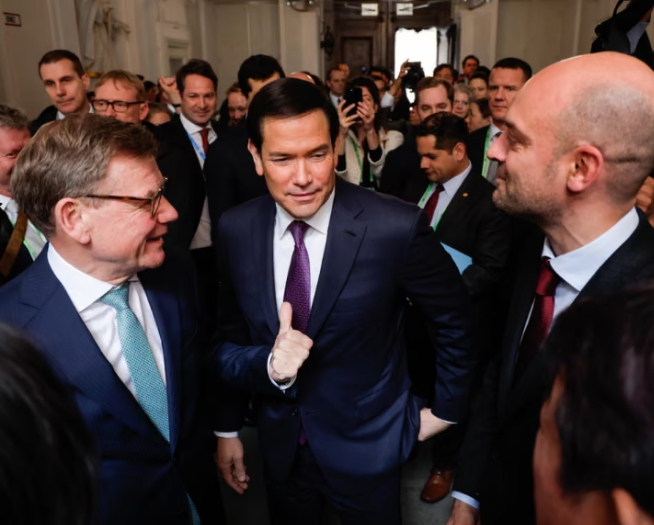
For Europe, the Marco Rubio Europe alliance speech served as both an invitation and a warning. The US remains open to renewed alliance, but only if Europe accepts a recalibrated relationship shaped by American priorities and a shared rejection of what Rubio described as the complacencies of the recent past.
The long-term impact of the Marco Rubio Europe alliance speech will depend on how European leaders respond to its underlying challenge. While many welcome renewed engagement from Washington after months of uncertainty, the conditional nature of the offer raises questions about autonomy, values, and the future balance of power within the alliance.
As debates continue at the Munich Security Conference, Rubio’s remarks are likely to resonate beyond the hall, shaping policy discussions in European capitals and Washington alike. Whether this moment marks a genuine renewal of transatlantic unity or the beginning of a more transactional era remains an open question.
Read also: UK Mandelson cooperation request in Epstein probe raises pressure on Starmer government