The moment María Corina Machado presents Trump with her Nobel peace prize medal has quickly become one of the most symbolically charged political gestures of the year, blending personal diplomacy, international controversy, and the uncertain future of Venezuela after the dramatic removal of Nicolás Maduro.
The exchange, which took place during a private meeting at the White House, was framed by Machado as a gesture of gratitude, but it has also raised serious questions about legitimacy, power, and the limits of symbolic politics in times of upheaval.
Machado, the Venezuelan opposition leader who received the Nobel peace prize for her long-running challenge to authoritarian rule in Caracas, described the act as recognition of Donald Trump’s role in what she called a decisive moment for Venezuelan freedom.
The gold medal, mounted in a large frame and later displayed by the White House, was accompanied by a dedication praising Trump’s actions toward Venezuela. Within hours, images of the medal circulated widely, drawing global attention and sharp reactions from political leaders, analysts, and the Nobel committee itself.
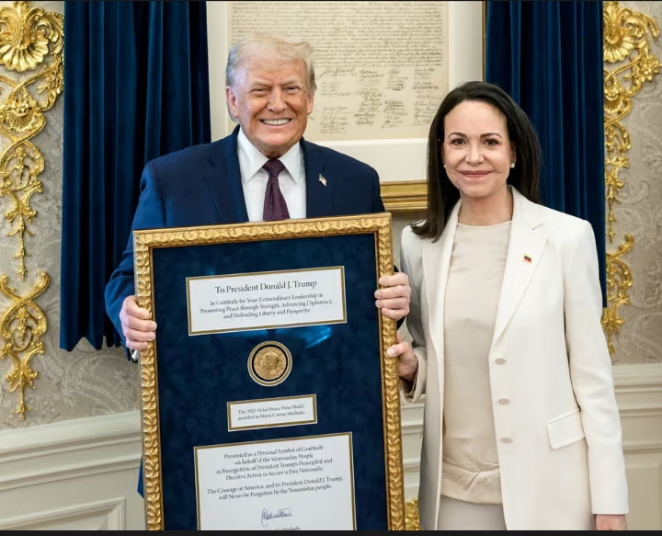
Trump responded enthusiastically, publicly thanking Machado and describing the presentation as a gesture of mutual respect.
For the US president, who has frequently complained about being overlooked by Nobel judges, the image of holding the medal carried undeniable personal and political value.
Yet the symbolism was complicated almost immediately when Nobel officials reiterated that while a medal may be physically transferred, the title and recognition of a Nobel peace prize cannot be shared, transferred, or reassigned under any circumstances.
The controversy comes against the backdrop of extraordinary developments in Venezuela. Less than two weeks earlier, US special forces had captured President Nicolás Maduro in an operation that stunned the region and dramatically altered the balance of power in Caracas.
While many opposition supporters expected Machado to emerge as the natural political beneficiary of Maduro’s removal, events unfolded very differently.
Instead of endorsing Machado, Trump’s administration recognized Maduro’s deputy, Delcy Rodríguez, as acting president, sidelining the opposition leader who had become an international symbol of resistance.
For Machado, the decision was a devastating setback. Her movement, widely believed to have won Venezuela’s disputed 2024 election, suddenly found itself without the international backing it had anticipated.
The presentation of the Nobel medal was therefore widely interpreted as an attempt to rebuild personal trust with Trump and reposition herself as an indispensable ally at a moment when Venezuela’s political future remains unresolved.
Political analysts note that the gesture reflects the increasingly transactional nature of international politics.
Machado’s action was not simply ceremonial; it was a calculated move aimed at influencing US perceptions at a time when Washington holds enormous leverage over Venezuela’s interim arrangements, sanctions regime, and prospects for future elections.
By invoking history and symbolism, she sought to frame Trump as a partner in a shared struggle against tyranny rather than as an external power imposing its will.
Trump, however, has made little effort to hide his skepticism toward Machado’s ability to govern. In public remarks following Maduro’s capture, he questioned her domestic support and suggested that stability, rather than immediate democratic transition, should be the priority.
His more favorable comments about Rodríguez underscored the administration’s preference for a controlled handover rather than a rapid shift driven by opposition forces.
The White House defended its position by pointing to security concerns and the risk of internal fragmentation. Officials emphasized that decisions were based on assessments from national security advisers and intelligence briefings, not on personal gestures or symbolic acts.
While Trump described Machado as courageous and principled, his team stressed that conditions inside Venezuela were not yet suitable for a swift return to electoral politics.
The Nobel committee’s response added another layer of tension. By publicly stating that the prize cannot be shared or transferred, the organization sought to draw a clear line between personal symbolism and institutional recognition.
The statement was widely seen as a subtle rebuke, reinforcing the idea that the Nobel peace prize is awarded to individuals for their actions, not as a transferable endorsement of others.
Historically, Nobel laureates have taken different approaches to their medals, sometimes donating or selling them for charitable causes.
Machado’s decision stands out because of its explicitly political intent. Rather than raising funds or supporting humanitarian efforts, the medal was used as a diplomatic tool, aimed at reshaping a specific political relationship at a critical juncture.
Within Venezuela, reactions were mixed. Some opposition supporters viewed the gesture as pragmatic, arguing that maintaining Trump’s goodwill is essential if there is any hope of securing future elections and international guarantees.
Others saw it as a troubling sign of dependency, suggesting that Venezuela’s democratic aspirations were being subordinated to the personal approval of a foreign leader.
Delcy Rodríguez, meanwhile, used her first major address as acting president to denounce the US operation that removed Maduro, calling it a violation of sovereignty and a stain on bilateral relations.
At the same time, she signaled openness to dialogue, insisting that Venezuela should be free to maintain relations with a wide range of global partners, including Washington.
Her remarks highlighted the contradictions at the heart of the current moment: condemnation of US actions paired with a willingness to engage diplomatically.
Trump has attempted to manage expectations about Venezuela’s future, warning that rebuilding institutions and restoring order would take time.
He has repeatedly stated that elections cannot be rushed in a country emerging from prolonged crisis, a position that frustrates opposition activists but aligns with the administration’s emphasis on stability over speed.
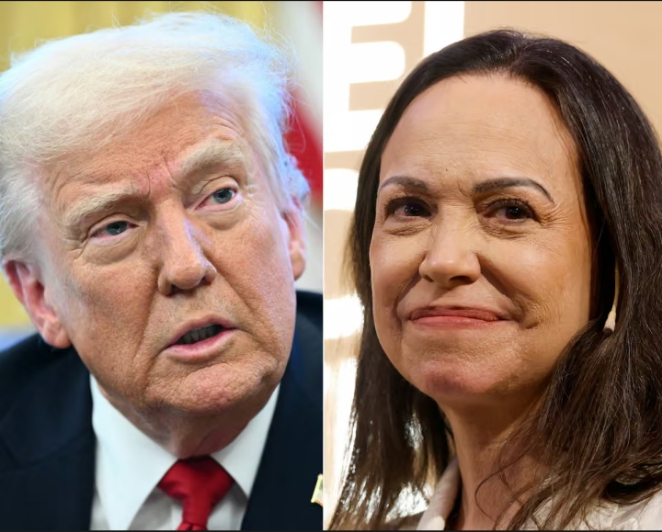
As the image of María Corina Machado presenting Trump with her Nobel peace prize medal continues to circulate, its meaning remains contested.
To supporters, it represents gratitude, recognition, and strategic outreach. To critics, it symbolizes the erosion of independent democratic movements in the face of geopolitical power.
What is clear is that the gesture has become a defining moment in Venezuela’s post-Maduro story, capturing the uneasy intersection of ideals, ambition, and realpolitik.
Whether the medal will ultimately influence US policy remains uncertain. What is undeniable is that it has drawn global attention to the fragile state of Venezuela’s transition and the personal dynamics shaping decisions at the highest levels.
Read more here:Trump set to meet Venezuelan opposition leader at White House today
In a political landscape where symbolism often carries as much weight as policy, the consequences of this moment may reverberate long after the gold frame is removed from the White House wall.
About The Author