Trump set to meet Venezuelan opposition leader at White House today, marking a significant moment in the rapidly evolving relationship between Washington and Caracas after weeks of political upheaval and unprecedented US intervention in Venezuela’s leadership crisis.
The meeting is expected to take place later today and will bring President Donald Trump face to face with María Corina Machado, one of the most prominent figures in Venezuela’s opposition movement.
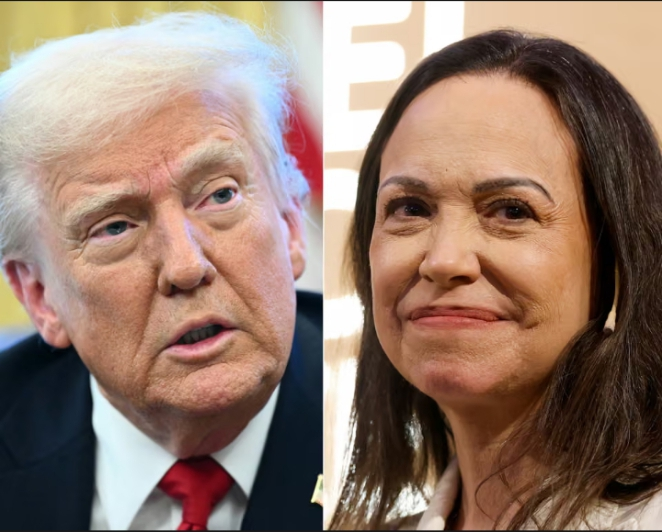
Machado has long positioned herself as a vocal critic of authoritarian rule in the country and emerged as a central symbol of opposition unity following disputed national elections held in 2024.
Those elections were widely contested both inside and outside Venezuela, with opposition groups maintaining that their coalition secured a decisive victory.
Despite these claims, the results were rejected by then-president Nicolás Maduro, deepening political paralysis and fueling international condemnation.
The crisis reached a dramatic turning point earlier this month when US forces carried out a surprise operation in Caracas that resulted in the arrest of Maduro and his wife at a heavily fortified compound.
The couple were subsequently transported to the United States, where they now face federal charges related to large-scale drug trafficking.
The operation stunned the international community and immediately reshaped the balance of power within Venezuela, leaving senior figures from Maduro’s inner circle overseeing the country’s daily administration.
Machado’s visit to Washington comes against this complex backdrop. Although she has been celebrated by supporters as the legitimate representative of democratic change, Trump has previously expressed skepticism about her political viability.
In recent remarks, the US president described her in personal terms but offered limited endorsement of her leadership ambitions, suggesting the talks would remain general rather than policy-specific.
The White House meeting is therefore being closely watched for what it may reveal about the administration’s true intentions in Venezuela.
While US officials have consistently stated their commitment to democratic principles, recent diplomatic signals suggest a more pragmatic approach may be taking shape behind the scenes.
In parallel with engaging the opposition, Trump and his advisers have opened direct lines of communication with Venezuela’s interim leadership.
Acting president Delcy Rodríguez, who previously served as Maduro’s vice-president, continues to oversee government operations alongside other senior officials from the former administration.
Rather than adopting a confrontational stance, Rodríguez has pursued dialogue with Washington and signaled a willingness to cooperate on specific issues.
One of the most notable outcomes of this engagement has been the release of detainees held during the previous administration.
In recent days, Venezuelan authorities freed several American citizens, a move widely interpreted as a goodwill gesture aimed at stabilizing relations with the United States.
Rodríguez has publicly indicated that further releases may follow, framing them as part of a broader effort to de-escalate tensions.
Trump confirmed earlier this week that he held an extended phone conversation with Rodríguez, describing the exchange in positive terms.
According to the president, the discussion covered a wide range of topics and marked the first direct contact between the two since Maduro’s removal from power.
His comments suggested an openness to cooperation that contrasts with the administration’s more hardline rhetoric of previous years.
This dual-track approach—hosting an opposition leader while simultaneously engaging with remnants of the former government—has prompted debate among analysts and foreign policy observers.
Some argue it reflects strategic realism, prioritizing stability and US interests over ideological alignment.
Others warn it risks undermining the credibility of Washington’s support for democratic transition in Venezuela.
For Machado, the White House visit represents both an opportunity and a challenge.
Gaining international recognition has long been a central goal of the opposition movement, and a meeting with the US president carries undeniable symbolic weight.
At the same time, the absence of a clear endorsement could complicate efforts to consolidate authority at home, particularly as interim officials retain control of state institutions.
Within Venezuela, reactions to the meeting are mixed. Supporters view it as validation of years of political struggle and international advocacy, while critics question whether external actors should play such a decisive role in determining the country’s future.
The population remains deeply affected by economic hardship, institutional decay, and lingering uncertainty about what the post-Maduro era will bring.
Internationally, the situation continues to test established norms around sovereignty, intervention, and accountability.
The unprecedented arrest of a sitting head of state by foreign forces has sparked legal and diplomatic debates, even as some governments quietly welcome the prospect of renewed stability in the region.
As Trump prepares to host Machado, the encounter is likely to be as much about optics as outcomes.
Whether the meeting results in concrete policy shifts or remains largely symbolic, it underscores how dramatically the geopolitical landscape surrounding Venezuela has changed in a matter of weeks.
Read also: France joins NATO deployment to Greenland amid US Security Concerns
What emerges next will depend on a delicate balancing act between diplomacy, domestic legitimacy, and international pressure.
For now, today’s White House meeting stands as another defining moment in a crisis that continues to reshape Venezuela’s political future and redefine US engagement in Latin America.
About The Author