Canada PM hails new Partnership with China-Canada’s prime minister Mark Carney has announced what he described as a new strategic partnership with China, signalling a major reset in relations between the two countries after years of diplomatic tension and economic friction.
The announcement came during Carney’s high-profile visit to Beijing, the first by a Canadian leader in nearly a decade, as Ottawa looks to reposition itself amid changing global economic realities and rising trade pressures from the United States.
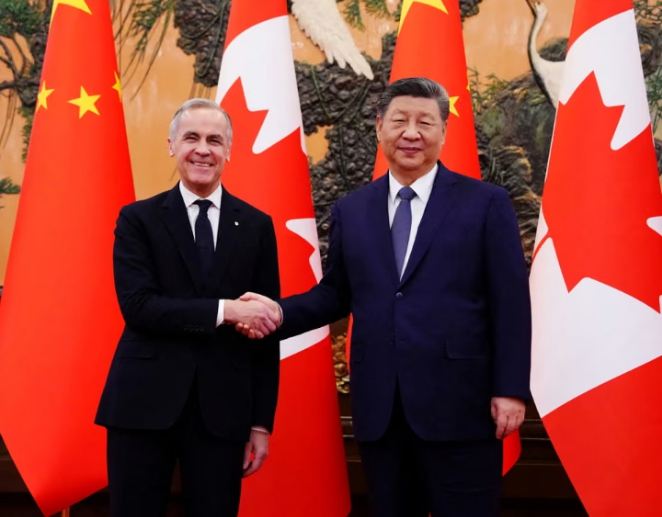
Speaking during talks with Chinese president Xi Jinping at Beijing’s Great Hall of the People, Carney said Canada and China had an opportunity to rebuild their relationship on more pragmatic and forward-looking foundations.
He stressed that cooperation and engagement would define this new phase, particularly in areas such as agriculture, energy and finance, where both countries stand to benefit in the short term.
The visit marks a significant shift in tone after years of strained relations that followed a series of retaliatory arrests, diplomatic disputes and trade restrictions.
For Carney, the renewed engagement with Beijing reflects a deliberate effort to reduce Canada’s heavy economic dependence on the United States at a time when Washington’s trade policies have become increasingly unpredictable.
Relations between Canada and China deteriorated sharply in 2018 after Canadian authorities arrested Huawei executive Meng Wanzhou on a US extradition request.
China responded by detaining two Canadian citizens on espionage charges, a move widely condemned in Ottawa and among Canada’s allies.
The episode ushered in years of mutual distrust, with both countries imposing tariffs and accusing each other of hostile political actions, including allegations of election interference.
Carney’s decision to travel to Beijing signals an attempt to move beyond that period and refocus on economic pragmatism.
Since taking office, he has repeatedly argued that Canada must adapt to a world in which global alliances are being reshaped by trade wars, geopolitical competition and protectionist policies.
Nowhere has this challenge been more evident than in Canada’s relationship with the United States under President Donald Trump.
Trump’s administration has imposed steep tariffs on key Canadian exports including steel, aluminium, vehicles and lumber, inflicting significant economic pain on one of America’s closest allies.
While Canada remains deeply integrated with the US economy, Carney has made it clear that relying so heavily on a single market is no longer sustainable in the current global climate.
During his address in Beijing, Carney said the new partnership with China should reflect “new global realities,” acknowledging that the international trading system is undergoing profound change.
He argued that Canada must diversify its export markets if it is to remain competitive and resilient, especially as protectionism becomes more entrenched in major economies.
Xi Jinping, for his part, welcomed the renewed engagement and described Canada-China relations as having reached a turning point.
He told Carney that their meeting at the Asia-Pacific Economic Cooperation summit in late 2025 had laid the groundwork for improved ties and opened a new chapter in bilateral relations.
Xi said China valued stable and constructive relations with Canada and was encouraged by recent efforts to restore cooperation.
The Chinese leader also emphasised that healthy ties between the two countries served their mutual interests, particularly at a time of global economic uncertainty.
He noted that discussions over recent months had helped rebuild trust and momentum after years of stagnation.
Behind the diplomatic language lies a clear economic calculation.
Canada’s trade relationship with the United States remains dominant, with roughly three-quarters of Canadian exports heading south of the border.
By contrast, China, while Canada’s second-largest trading partner, accounts for less than 4% of Canadian exports, highlighting the scale of the challenge Ottawa faces in diversifying its trade portfolio.
Carney has set an ambitious goal of doubling Canada’s non-US exports by 2035, a target he believes is essential to shielding the country from future trade shocks.
China, with its vast consumer market and appetite for commodities, represents a key part of that strategy, despite the political sensitivities involved.
During his visit, Carney also met China’s premier Li Qiang and is scheduled to hold discussions with business leaders aimed at boosting commercial ties.
Officials from both countries have been engaged in talks to reduce tariffs and remove barriers to trade, although no formal agreement has yet been announced.
The renewed engagement comes at a time when global perceptions of economic leadership are shifting. Surveys and economic data have suggested that Trump’s aggressive trade policies may be accelerating China’s influence rather than containing it, a reality that middle powers like Canada must navigate carefully.
Critics of closer ties with Beijing warn that economic cooperation should not come at the expense of national security or democratic values.
Concerns over human rights, political interference and strategic dependence remain prominent in Canadian political discourse.
Carney has sought to address these concerns by emphasising that engagement does not mean acquiescence, and that Canada will continue to defend its interests and values even as it expands economic cooperation.
Supporters of the new approach argue that disengagement has failed to deliver results and that constructive dialogue offers a better path forward.
They point out that Canada’s economic prosperity depends on access to global markets and that refusing to engage with the world’s second-largest economy would be self-defeating.
The shift also reflects broader changes in global trade dynamics. As traditional alliances are tested and multilateral institutions struggle to keep pace with geopolitical tensions, countries like Canada are increasingly pursuing flexible, multi-directional strategies to protect their economic interests.
Carney’s background as a former central banker has shaped his emphasis on stability, risk management and long-term planning. His approach to foreign policy mirrors this outlook, prioritising diversification and resilience over ideological rigidity.
While the United States remains Canada’s most important partner by a wide margin, Carney has been careful to signal that Ottawa is no longer willing to be overly exposed to policy decisions made in Washington.
The trade disputes of recent years have underscored the vulnerability of Canada’s export-driven economy to sudden shifts in US policy.
For China, improving relations with Canada also carries strategic value. As Beijing seeks to counter US influence and present itself as a stable trading partner, strengthening ties with Western economies like Canada helps bolster its global standing.
The success of this renewed partnership will depend on whether both sides can translate diplomatic goodwill into concrete economic outcomes. Lower tariffs, expanded market access and increased investment will be key tests of whether the reset delivers tangible benefits.
Read also: Robert Jenrick sacked after ‘secret defection plot’ as Badenoch faces calls to publish evidence
For now, Carney’s visit represents a symbolic and practical step toward redefining Canada’s place in a rapidly changing world.
By hailing a new partnership with China, the Canadian prime minister has signalled that Ottawa is prepared to rethink long-standing assumptions and adapt to the realities of a more fragmented and competitive global economy.
As trade tensions continue to reshape international relations, Canada’s effort to balance its traditional alliances with new opportunities will be closely watched by allies and rivals alike.
Whether this recalibration strengthens Canada’s economic resilience or exposes it to new risks remains to be seen, but the message from Beijing is clear: Canada is no longer content to stand still in a world that is moving fast.
About The Author