The France protests violence that erupted over rising living costs and deteriorating public services has developed into a wider confrontation between demonstrators and the authorities, with allegations of excessive police force intensifying public anger ahead of next year’s presidential election.
Smashed shop windows, looted businesses, burning public buildings and injured young demonstrators shocked the country during last month’s nationwide unrest. What began as relatively small protests over conditions in state schools in September eventually escalated into some of France’s most serious civil disturbances in years.
Government officials have blamed far-left activists and what they describe as opportunistic criminals for exploiting largely peaceful demonstrations to attack public institutions, businesses and symbols of state authority.
However, an investigation by Reuters, based on dozens of videos, court proceedings involving 26 accused individuals and interviews with more than 50 officials, police officers, lawyers, protesters and witnesses, found that the authorities’ response has also contributed to the growing resentment.
Thousands of arrests, allegations of police beatings and restrictions on demonstrations have widened the dispute, drawing more people into a movement initially driven by concerns about living costs and public services.
The unrest has attracted students, parents, teachers, trade unionists, left-wing politicians and supporters of the Yellow Vest movement, which previously challenged President Emmanuel Macron’s government over fuel prices in 2018 and 2019.
The growing coalition has continued taking to the streets, with many demonstrators accusing the government of using excessive force to suppress legitimate opposition.
Police response brings more protesters into the movement
The treatment of young demonstrators has become one of the most contentious aspects of the crisis. Some protesters have suffered life-changing injuries, including lost eyes and hands blown off during confrontations with security forces.
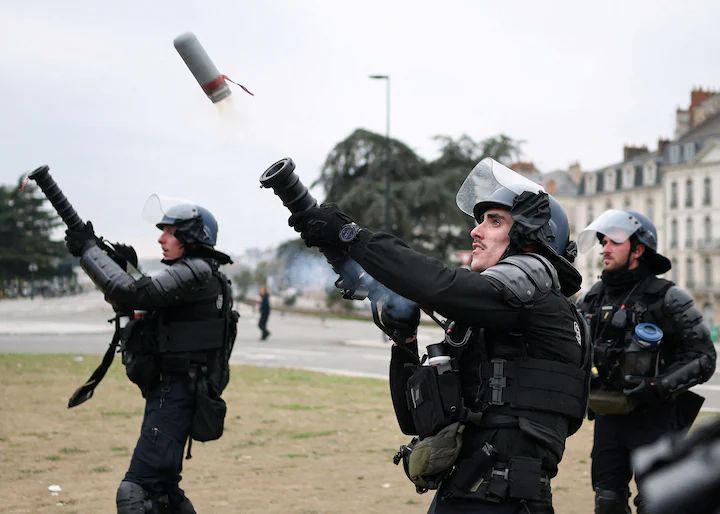
United Nations experts and other human rights specialists have also questioned the arrest of nearly 7,000 minors during sometimes-violent school blockades, describing the scale of the detentions as disproportionate.
Images showing riot police charging and beating teenagers have circulated widely, strengthening public sympathy for the students and encouraging people from different backgrounds to join subsequent demonstrations.
Emilie Berthier de Grandry, 42, has attended four protests in Paris alongside her 15-year-old son, Aaron, who wears an inflatable shark costume during the marches.
“We have rights,” she said. “We’re not going to let ourselves be pushed around.”
The demonstrations on October 17 marked a particularly significant turning point. More than half a million people reportedly took part nationwide, including approximately 110,000 in Paris, according to Interior Minister Laurent Nunez.
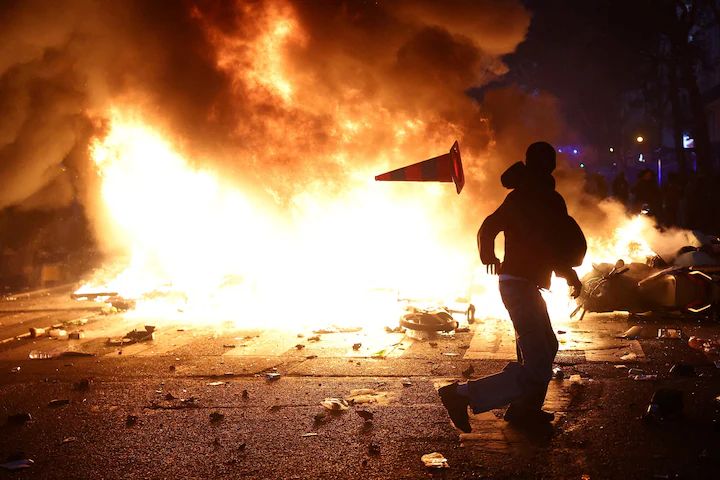
Violence spread across the country’s three largest cities: Paris, Marseille and Lyon. Police lost control of entire neighbourhoods as groups of rioters attacked businesses, erected barricades and set fires.
Around 3,000 businesses were reportedly ransacked over a 24-hour period, ranging from luxury shops to supermarkets.
Although demonstrations became calmer in the following weeks, confrontations continued when police attempted to disperse crowds at the end of marches. Officers repeatedly deployed tear gas and charged protesters who threw bottles, paving stones and mortar-style fireworks.
On October 24, far-right groups also entered the confrontation, claiming they wanted to protect businesses. Authorities said members of those groups clashed with demonstrators in several cities.
Orchestra caught in tear gas during Paris demonstration
The events of October 17 in Paris illustrated how the police response affected even participants who had no intention of engaging in violence.
Demonstrators began gathering at Place de la Republique several hours before a scheduled march at 2 p.m. Among those present was Maël Roth, a 20-year-old musician who arrived at approximately 11 a.m. to rehearse with the Orchestre du Nouveau Monde.
The 400-member classical orchestra had planned to perform in support of the demonstrators. Roth was playing the sousaphone as the musicians warmed up with the theme music from The Avengers when tear gas first drifted into the square.
He initially assumed the gas was not directed at the orchestra, so the musicians continued playing. Within about 30 minutes, however, canisters were landing close to their feet.
Reuters video footage showed riot police deploying tear gas around the same period to push back protesters attempting to march along Rue du Faubourg du Temple.
Elodie Aldila, who works at a patisserie on the street, welcomed the police intervention because businesses in the neighbourhood were later attacked and looted.
Roth, however, questioned why the orchestra had been forced to leave the square when its members were simply trying to create a positive atmosphere.
Their intention, he explained, was to “make people feel good”.
He said the experience was difficult because it made the musicians feel as though they were not legitimate participants in the demonstration.
A large crowd of mostly peaceful protesters eventually returned to the square, but the orchestra had already packed its instruments and departed.
Police overwhelmed as violence spreads across cities
Tensions increased throughout the afternoon as groups of protesters moved into surrounding streets, smashing shopfronts, constructing barricades and setting fire to cars and bicycles.
Read also: US flight shutdown exposes risks in ageing air traffic control network
At approximately 4 p.m., footage verified by Reuters showed police officers using batons to beat a man to the ground following a heated exchange near the square.
Rumours that the man had died subsequently spread across social media, further inflaming the situation. The claims were later established to be false.
The Interior Ministry confirmed that an internal police watchdog was investigating the incident.
As darkness fell, looting spread through Paris and other cities. The scale of the destruction overwhelmed security forces, with Nunez later telling lawmakers that authorities had faced an unprecedented combination of challenges.
He said thousands of ultra-left activists confronted police and attempted to organise unauthorised marches towards government institutions.
French officials use the term ultra-left to describe different political groups, including anarchists and antifascists, some of whom they accuse of accepting violence as a legitimate method of confrontation.
Nunez also said that people without any connection to those organisations joined the looting after learning about the disturbances through social media.
However, three police officers and an intelligence official familiar with investigations into the violence told Reuters they could not independently confirm that far-left groups had played the central role claimed by the minister.
They said further investigations were necessary to establish exactly how the disturbances developed.
“There is a body of circumstantial evidence but no certainty,” said Eric Moulin, a regional representative of the UNSA Police union in Marseille.
The Interior Ministry referred Reuters to Nunez’s earlier comments when asked about the allegations.
Violence reaches city halls and public institutions
The destruction was not limited to commercial properties. Public buildings and institutions also became targets during the disturbances.
In Marseille, black-clad protesters broke into the city hall and toppled a bust of Marianne, a national symbol of the French Republic.
Another group attacked police officers at the Old Port with rocks and steel bars. Approximately 45 officers were forced to retreat to their vehicles and leave the area, according to video footage verified by Reuters.
Moulin said some officers inside the police vans were so frightened that they considered drawing their service weapons.
“Some of my colleagues who were inside the police vans said they felt so threatened they reached for their service weapons,” he said.
“These are tough, hardened men, yet they confided in me that they were scared out of their minds.”
In Limoges, municipal police officers took shelter inside the city’s historic 19th-century city hall as rioters set the building on fire. The officers escaped without injuries.
The Lyon tourism office was also torched.
Prosecutors are investigating a 34-year-old carpenter on suspicion of attempted murder over his alleged involvement in starting the Limoges fire.
The city’s mayor, Guillaume Guerin, told French television that the suspect was on a security watchlist over alleged links to the far left and described him as the likely mastermind of the operation.
However, the man’s lawyers disputed the allegations, saying the evidence against their client was weak. They urged the mayor to respect the presumption of innocence.
Prosecutors did not respond to Reuters’ questions about the case.
Thousands arrested as government promises tough punishment
The government has pursued a stringent judicial response to the violence, with Justice Minister Gerald Darmanin instructing prosecutors to seek firm penalties, including pre-trial detention and expedited trials for many accused individuals.
Darmanin told French television on November 3 that more than 4,900 suspects had been taken into custody since October 17.
Of that number, approximately 2,290 had been referred for prosecution, while 404 had received prison sentences.
The minister said most of those arrested were young men between 18 and 25, although authorities have released limited information about the individual cases.
The Tribunal de Paris, the country’s largest courthouse, had to open two additional courtrooms to handle fast-track proceedings involving people accused of less serious offences.
The pressure on the courts was considerable. Reuters observed hearings being postponed because judges had not been given sufficient time to examine case files.
A union representing French judges and prosecutors expressed concern that the justice system was being “instrumentalized” by the government.
The Justice Ministry did not respond to a request for comment.
The government’s approach has also attracted criticism from human rights organisations. Amnesty International and other rights groups have warned that the restrictions and policing measures could signal a slide towards authoritarianism.
Authorities, however, maintain that their actions are necessary to uphold public order and the rule of law.
Police watchdog investigates allegations of excessive force
The Interior Ministry said internal watchdogs had opened 161 investigations into allegations of police violence against protesters since September.
Responding to Reuters, the ministry maintained that officers use force in accordance with applicable laws and regulations.
Nunez has expressed regret over injuries caused by explosive crowd-control weapons, including stun grenades, but has resisted calls to prohibit their use.
He argues that security personnel must retain the ability to defend themselves when confronted by violent crowds.
The minister has also acknowledged that authorities underestimated the scale of the October 17 disturbances.
He credited the deployment of approximately 70,000 police officers and paramilitary gendarmes with helping to maintain order during later demonstrations.
Nevertheless, he said security forces continued to face serious violence, citing a petrol-bomb attack in Paris on Halloween that injured three gendarmes.
The government has since reinforced police deployments with military personnel, imposed curfews and banned several marches in an effort to prevent another major outbreak.
Macron faces growing political pressure ahead of election
The unrest has created another major challenge for Macron, who will not be eligible to stand for re-election in April.
The president’s ability to respond to protesters’ demands is constrained by the country’s strained public finances and the weakening position of his centrist party, which no longer commands a parliamentary majority capable of passing major legislation independently.
Macron has promised to “listen to the anger” while also insisting that he will “impose respect of the Republican order.”
His government has proposed improvements to education and brought forward a planned increase in the minimum wage in an attempt to address some of the complaints.
However, student leaders and major trade unions consider the concessions inadequate and have vowed to maintain pressure on the authorities.
The political implications extend beyond the immediate protests, as the confrontation is taking place ahead of a presidential election that could be heavily influenced by public dissatisfaction with the government.
Heavy-handed policing risks prolonging confrontation
Researchers who study French social movements and policing have warned that the authorities’ approach could be contributing to the continuing cycle of violence.
Fabien Jobard, a sociologist at the French National Centre for Scientific Research who specialises in policing, said confrontations can escalate when violent groups deliberately provoke officers and security forces respond with force.
“Escalation happens when black blocs provoke with violence, and law enforcement are ordered to respond with violence,” he said.
He argued that such confrontations allow radical groups to portray the police as violent and attract wider public support.
For some young protesters, the treatment of demonstrators has become a reason to become more actively involved in the movement.
Titouan Malin, an 18-year-old medical student, began volunteering as a medic at demonstrations after witnessing how police officers treated protesters on October 17.
During a major Paris march on November 5, he wore a white helmet and carried a gas mask around his neck while monitoring the possibility of clashes.
“When you face this kind of violence—repression to such an extreme degree—you’re forced to respond with violence,” he said.
“It’s the only way to make ourselves heard.”
His comments reflect the depth of anger among some demonstrators, even as the government insists that restoring order remains its priority.
With protests continuing, the dispute has evolved beyond the original concerns about schools, living costs and public services. The government’s handling of demonstrations, the conduct of security forces and the growing distrust between protesters and authorities have become central issues.
Unless the underlying grievances are addressed and confidence in the policing of demonstrations improves, France could face further unrest in the months leading up to the presidential election.
About The Author