Donald Trump has reignited global controversy by declaring it “unacceptable” for Greenland not to be under American control, escalating tensions ahead of crucial diplomatic talks involving Denmark, Greenland and the United States, as the Trump Greenland takeover debate once again dominates international politics.
The US president made the remarks just hours before senior officials from the three parties were scheduled to meet in Washington, framing the Arctic island as vital to American national security and future defence ambitions.
Trump argued that Greenland’s strategic location was indispensable to US interests and claimed Nato would become significantly stronger if the territory were brought under Washington’s authority.
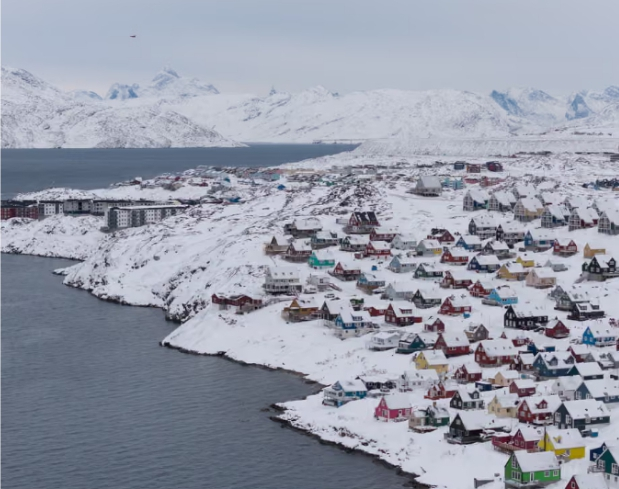
Speaking via social media, Trump insisted that American control of the island was necessary to safeguard security interests in the Arctic, particularly as global competition in the region intensifies.
He also linked Greenland’s importance to a proposed missile defence initiative, describing the territory as central to the success of the system.
The comments immediately raised alarm across Europe, coming amid weeks of mounting pressure from Washington and growing concern in Copenhagen and Nuuk over US intentions.
Trump first floated the idea of acquiring Greenland during his initial presidency in 2019, but his rhetoric has hardened considerably since returning to office, repeatedly suggesting the US could secure the island “one way or the other.”
Greenland, a semi-autonomous territory within the Kingdom of Denmark, occupies a strategically critical position in the Arctic and is rich in untapped mineral resources.
While Denmark retains responsibility for defence and foreign policy, Greenland has its own government and has consistently rejected any suggestion of being transferred to another sovereign power.
Trump’s latest remarks followed his refusal in recent weeks to rule out the use of military force, a stance that has unsettled both the European Union and Nato.
Denmark is a member of both organisations, meaning Greenland benefits indirectly from their security frameworks. Analysts say Trump’s language has raised unprecedented questions about alliance unity and the limits of American power within Nato.
Danish foreign minister Lars Løkke Rasmussen and Greenland’s foreign minister Vivian Motzfeldt travelled to Washington to engage US officials in what were initially intended to be routine diplomatic discussions.
However, the talks took on greater significance after US vice-president JD Vance and secretary of state Marco Rubio confirmed their participation, signalling the seriousness with which Washington views the issue.
Officials in Copenhagen and Nuuk have repeatedly stated that Greenland is not for sale and have accused the US of exerting unacceptable pressure on a close ally.
Danish authorities have also pointed to a long-standing defence agreement signed in 1951 that already permits the United States to maintain and expand its military presence on the island without altering its sovereignty.
European leaders swiftly rallied behind Denmark following Trump’s remarks. The president of the European Commission, Ursula von der Leyen, emphasised that Greenland belongs to its people and that their right to self-determination must be respected.
She stressed that Europe’s support for Denmark was not merely symbolic but rooted in shared democratic principles.
French president Emmanuel Macron echoed that sentiment, warning that any attempt to undermine the sovereignty of an EU member state would have far-reaching consequences. He pledged that France would act in full solidarity with Denmark should its territorial integrity be challenged.
The diplomatic stakes are high as Rasmussen and Motzfeldt seek to de-escalate tensions while addressing Washington’s security concerns.
Analysts suggest the goal of the talks is to find a compromise that could grant the US expanded operational influence in the Arctic without crossing the red line of formal ownership.
Experts caution, however, that Trump’s confrontational style leaves little room for subtle diplomacy.
Some Danish officials privately fear the talks could resemble earlier meetings between Trump and Ukraine’s president, Volodymyr Zelenskyy, which were widely viewed as humiliating for Kyiv.
In an effort to calm the situation, Denmark’s defence minister confirmed that Copenhagen is increasing its military presence in Greenland and working with allies to enhance Nato’s footprint in the Arctic.
The move is intended to reassure Washington while reaffirming Denmark’s commitment to collective security.
Greenland’s prime minister, Jens-Frederik Nielsen, has taken a firm public stance, stating that the island has no intention of leaving the Danish realm.
Speaking alongside Danish prime minister Mette Frederiksen, Nielsen said Greenland’s preference was for continued cooperation within existing alliances rather than submission to US governance.
Frederiksen described the pressure from Washington as deeply troubling, noting that international borders cannot be altered by force.
She warned that allowing powerful nations to coerce smaller ones would undermine the foundations of international order.
Public opinion in the United States appears to be at odds with Trump’s position. A recent poll found that a clear majority of Americans oppose efforts to acquire Greenland, with only a small minority supporting the use of military force.
Opposition was strong across party lines, highlighting the domestic political risks of pursuing the issue aggressively.
As diplomats gather in Washington, the outcome of the talks remains uncertain. While both sides have expressed a desire for dialogue, Trump’s uncompromising language continues to cast a shadow over negotiations.
For Denmark and Greenland, the priority remains safeguarding sovereignty while maintaining a functional relationship with their most powerful ally.
Read also: Only Trump can stop Putin from threatening Europe – Polish President warns
About The Author