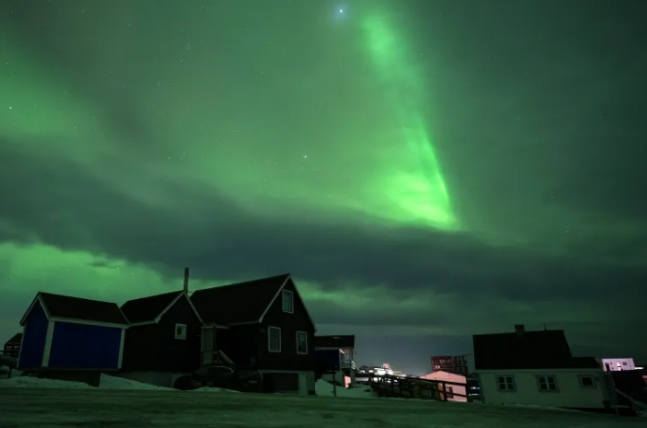
Greenland power outage has plunged the island’s capital, Nuuk, into darkness, as gusty Arctic winds triggered a hydroelectric transmission failure late Saturday night.
Residents across the city reported sudden blackouts at around 10:30pm local time, coinciding with strong winds battering the region.
Social media users quickly shared images of streets and homes shrouded in darkness, marking one of the most significant disruptions to the city’s electricity in recent years.
The semi-autonomous Danish territory, home to roughly 20,000 people, has had to confront not only the immediate impact of lost power but also concerns about water supplies, internet connectivity, and the broader geopolitical context in which Greenland now finds itself.
The Nuuk blackout affected multiple essential services, as water distribution systems rely on electrically powered pumps and communications infrastructure was disrupted.
By early Sunday morning, utility officials reported that approximately 75 percent of the city had power restored. The state-owned company managing Greenland’s electricity grid emphasized the need for citizens to use energy cautiously while repairs continued.
Emergency generators at key facilities helped sustain hospitals, municipal services, and critical communications. Despite the rapid response, residents were reminded to be prepared for potential extended disruptions, echoing recent government guidance on disaster preparedness.
The hydroelectric transmission failure occurred at the Buksefjord power plant, one of Greenland’s primary electricity sources. Officials explained that the combination of unusually strong winds and technical vulnerabilities caused a “line error” that interrupted the distribution of electricity to Nuuk.
Crews worked through the night to stabilize the grid and restore power to as many homes as possible.
While the immediate technical cause of the outage was natural in origin, its timing comes amid a period of heightened attention on Greenland, largely due to US-Greenland tensions fueled by President Donald Trump’s Arctic ambitions.
These overlapping challenges have underscored the fragility of Greenland’s infrastructure and the importance of preparedness in an environment where natural and geopolitical forces intersect.
The Greenlandic government had recently released a brochure advising citizens on how to prepare for disasters that could last up to five days. The guidance emphasized storing sufficient drinking water, non-perishable food, warm clothing, medicines, and alternative communication methods.
Officials stressed that the advice was not an indication of imminent crisis, but the timing of the Nuuk blackout reinforced the importance of these measures.
For many residents, the sudden loss of electricity highlighted the practical implications of disaster preparedness recommendations, turning abstract guidance into tangible necessity.
Citizens relied on battery-powered lights, limited heating options, and creative strategies to maintain connectivity during the outage.
Amid these local challenges, the Nuuk blackout has unfolded against a backdrop of international scrutiny over Greenland’s strategic importance. US-Greenland tensions have intensified in recent weeks, following President Trump’s statements suggesting potential territorial ambitions on the island.
During the World Economic Forum in Davos, Switzerland, Trump claimed he would not take Greenland by force and that any future arrangements would be negotiated within a framework involving NATO.
Nevertheless, details of the proposed agreements remain unclear, and Greenlandic authorities, including Prime Minister Jens-Frederik Nielsen, have voiced concerns over sovereignty.
“Sovereignty is a red line,” Nielsen stated, underscoring the limits of foreign influence on decisions about Greenland’s territory.
The geopolitical focus on Greenland is partly driven by the island’s abundant natural resources, including rare earth minerals that are critical to global technology industries.
Analysts have highlighted that Greenland could supply the world with essential minerals for more than a century, creating international interest in the territory’s mining and industrial policies.
The hydroelectric transmission failure that led to the Nuuk blackout has therefore occurred at a time when Greenland’s infrastructure is under both environmental and political pressure, demonstrating the complex interplay between natural vulnerabilities and external attention.
Residents of Nuuk experienced the blackout as both inconvenient and unsettling. Streetlights went dark, traffic signals ceased to function, and homes were plunged into silence.
Many turned to social media and community networks to check on neighbors, coordinate resources, and share information about power restoration efforts.
The utility company provided updates through Facebook and other digital channels, explaining that emergency measures were in place and that repair crews were actively working to restore full functionality.
The company’s communication emphasized careful electricity usage to avoid overloading the limited systems that remained operational during the outage.
The disaster preparedness guidance issued by the Greenlandic government included instructions to maintain at least five days of essential supplies.
While the advisory was intended as a precaution rather than a warning of imminent disaster, it highlighted Greenland’s unique vulnerabilities as an Arctic territory with limited redundancy in critical infrastructure.
For instance, water treatment relies heavily on electrically powered systems, making even short outages impactful. Internet connectivity, vital for both work and communication in a remote city, was similarly affected, showing how quickly modern urban life can be disrupted when energy systems fail.
The Nuuk blackout served as a real-world example of why such preparedness is necessary, even in the absence of extreme weather events or other crises.
The timing of the outage drew attention to the broader political situation. US-Greenland tensions have included discussions over military bases, mineral rights, and Arctic influence.
Trump’s statements about negotiating a long-term framework with NATO introduced uncertainty regarding foreign involvement in Greenlandic affairs.
The hydroelectric transmission failure, while caused by natural factors, coincided with a period of intense scrutiny and speculation over Greenland’s future.
Analysts have noted that such disruptions, even if localized and temporary, can influence public perception and governmental decision-making, particularly in a context where strategic interests are at stake.
As power was gradually restored, officials emphasized that citizens should continue to exercise caution. The utility company confirmed that by early Sunday morning, most households had regained electricity, though full restoration would take additional hours.
The outage underscored the need for continued investment in infrastructure resilience, including improvements to transmission lines and emergency generation capacity.
Community response also highlighted the role of local networks and communication channels in mitigating the effects of sudden disruptions. Neighbors shared resources, checked on vulnerable populations, and adapted to the blackout with ingenuity and resilience.
The Nuuk blackout also prompted reflection on climate and environmental conditions in Greenland. The Arctic region is increasingly experiencing extreme weather events, including strong winds, snowstorms, and fluctuating temperatures.
Such conditions can strain existing infrastructure, including hydroelectric plants and distribution networks.
The Buksefjord transmission failure illustrates how even routine operations can be disrupted by environmental forces, reinforcing the need for robust systems capable of handling both predictable and unexpected stressors.
Greenland’s semi-autonomous status adds another layer of complexity, as local authorities balance the management of natural hazards with the geopolitical implications of international attention.
Despite the challenges, the city’s response to the Greenland power outage demonstrated both preparedness and adaptability. Utility crews worked throughout the night to stabilize the system, and citizens adhered to government recommendations for conserving electricity and accessing alternative resources.
While the blackout was inconvenient, it did not escalate into a humanitarian crisis, thanks to prior planning, emergency protocols, and community coordination.
Nevertheless, the event serves as a reminder of the delicate balance in regions like Greenland, where natural, technological, and political factors intersect in ways that can quickly affect daily life.
Looking ahead, Greenland’s authorities have stressed that the government’s focus remains on infrastructure resilience, emergency preparedness, and the protection of sovereignty.
The hydroelectric transmission failure that caused the Nuuk blackout highlights the importance of redundancy in critical systems and ongoing investment in modernization.
At the same time, the geopolitical context, including US-Greenland tensions and international interest in Arctic resources, continues to influence policy decisions and public awareness.
For residents, the blackout has been both a wake-up call and a test of existing preparedness strategies, reinforcing the value of proactive planning for both natural and human-made challenges.
In conclusion, the Greenland power outage that struck Nuuk underscores the complex interplay between environmental vulnerability, infrastructure resilience, and geopolitical dynamics.
The city’s blackout was triggered by strong Arctic winds affecting the Buksefjord hydroelectric plant, temporarily disrupting power, water, and internet services.
Read also: Burnham challenges Starmer with bid for Gorton and Denton by-election
While authorities restored most electricity within hours, the incident highlighted the importance of disaster preparedness, which includes storing essential supplies and maintaining alternative communication methods.
The event occurred against the backdrop of US-Greenland tensions, adding a layer of strategic uncertainty to an already challenging situation.
Residents, authorities, and international observers alike are reminded that in Greenland, natural forces and political currents can converge in ways that demand vigilance, cooperation, and careful planning.
About The Author