Global markets rattled by Trump’s 15% tariff after President Donald Trump announced a sweeping new import duty that has thrown governments, businesses and investors into renewed uncertainty.
The decision to impose a Trump 15% global tariff under Section 122 of the 1974 Trade Act came just days after a major US Supreme Court tariff ruling struck down large parts of his earlier trade measures, creating a fresh wave of legal and economic questions across the Atlantic.
The immediate consequence has been UK and EU trade confusion, with officials in London and Brussels seeking clarity on whether existing agreements with Washington remain protected.
Business leaders in Britain warned that if the new rate replaces the current 10% arrangement, exporters could face sudden cost increases that weaken their competitiveness.
Across the European Union, policymakers stressed that previously negotiated terms should be honoured, insisting that a deal already agreed must not be unilaterally altered.
The US Supreme Court tariff ruling had initially been interpreted as a potential turning point in American trade policy, with markets briefly rallying on expectations that aggressive tariff measures would be rolled back.
However, the swift pivot to Section 122 powers has revived transatlantic trade uncertainty, as companies struggle to determine whether the new Trump 15% global tariff overrides bilateral agreements or merely supplements them.
Legal experts are also debating whether the United States can justify invoking balance-of-payments provisions when financial markets continue to absorb US debt comfortably.
Financial markets reflected this renewed transatlantic trade uncertainty. Major European indices fell as investors reassessed export prospects, while safe-haven assets such as gold gained ground.
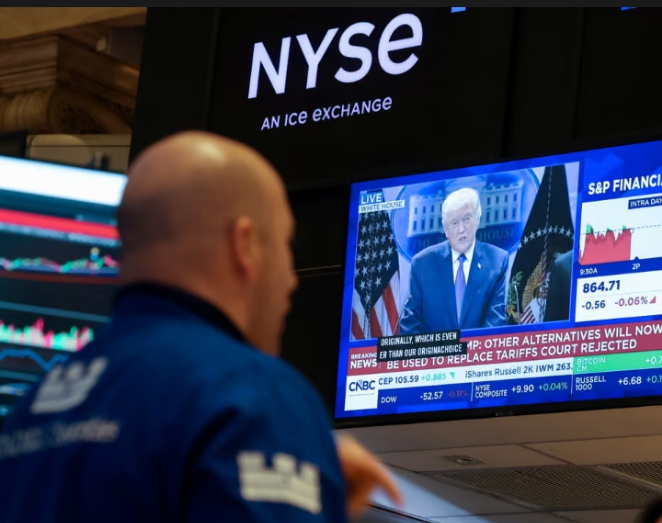
Analysts warned that even temporary tariffs can distort supply chains, delay investment decisions and dampen business confidence. Export-driven sectors including automotive, aerospace and pharmaceuticals are particularly exposed if the Trump 15% global tariff is applied broadly and without exemptions.
For the UK, the risk extends beyond direct exports. British firms embedded in complex supply chains that serve US-bound production lines could see orders disrupted, amplifying the UK and EU trade confusion already clouding the outlook.
Economists cautioned that higher US tariffs may suppress demand, intensify price competition within Europe and increase currency volatility, all of which contribute to a prolonged period of transatlantic trade uncertainty.
Policymakers on both sides of the Atlantic are now under pressure to clarify the legal and practical implications of the US Supreme Court tariff ruling and the subsequent tariff reset.
Without firm assurances from Washington, the perception that global markets rattled by Trump’s 15% tariff will remain vulnerable to abrupt policy shifts could weigh heavily on investment and growth.
Ultimately, the central issue is not only the economic impact of the Trump 15% global tariff but also the broader signal it sends about the stability of international trade rules.
As UK and EU trade confusion persists and legal debates continue in the wake of the US Supreme Court tariff ruling, businesses are preparing for a period in which transatlantic trade uncertainty may become the defining feature of the global economic landscape.
As an addendum, analysts note that global markets rattled by Trump’s 15% tariff are also being shaped by political calculations in Washington ahead of the midterm elections.
The administration’s decision to fall back on temporary legal powers has reinforced perceptions that trade policy is being used as a short-term political tool rather than a framework for long-term economic stability.
This has compounded transatlantic trade uncertainty, as businesses weigh the risk that tariff rates could shift again within months, complicating investment planning and contract negotiations across the UK and EU.
At the same time, the persistence of UK and EU trade confusion following the US Supreme Court tariff ruling risks weakening confidence in future trade talks.
Read also: US-Iran nuclear talks in Geneva confirmed as Iran cites ‘encouraging signals’ and Trump escalates military pressure
European officials fear that if existing agreements can be placed in doubt so abruptly, it may undermine trust in negotiations still under way or yet to be concluded.
For exporters and investors alike, the Trump 15% global tariff has become a symbol of a broader volatility in global trade governance, one that could linger even if the current measures are eventually scaled back or overturned.
About The Author