The US House blocks Canada tariffs in a dramatic bipartisan vote that marks one of the most significant congressional challenges to Donald Trump’s trade policy in his current term.
Lawmakers voted 219 to 211 to rescind the tariffs imposed on Canada last year, rebuking the president’s decision to declare a national emergency as justification for sweeping trade penalties against a key US ally.
The resolution, though largely symbolic at this stage, underscores growing unease within Congress about the administration’s aggressive tariff strategy.
Six Republicans joined nearly all Democrats in backing the measure, signaling cracks within the president’s party despite Trump’s explicit warnings of political consequences for dissenters.
Ahead of the vote, Trump used his Truth Social platform to caution Republican lawmakers against opposing his trade policy. He warned that any Republican who voted against the tariffs would “seriously suffer the consequences come Election time,” including potential primary challenges. The public pressure campaign highlighted the high political stakes surrounding the vote.
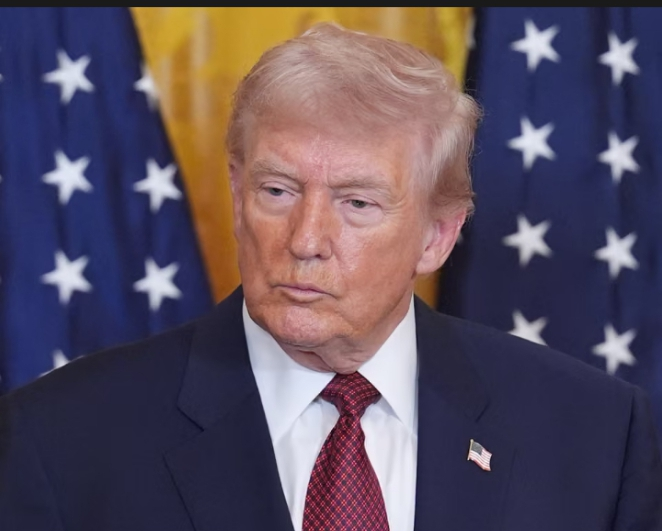
Despite that warning, a coalition of Democrats and a small but pivotal group of Republicans pushed the resolution through.
The measure seeks to terminate the national emergency Trump declared a year ago, which his administration argued was necessary to combat illicit drug flows, particularly fentanyl, entering the United States from Canada.
The administration has maintained that the alleged drug trafficking threat constituted an “unusual and extraordinary” danger, granting the president authority to impose tariffs outside the framework of the US-Mexico-Canada Agreement (USMCA).
However, critics contend that the national emergency designation stretched legal boundaries and effectively bypassed Congress’s constitutional authority over trade.
House minority leader Hakeem Jeffries framed the vote as a defense of American consumers and businesses. He argued that Trump’s tariff policy had driven up prices and injected uncertainty into the economy at a time when many families are already struggling with inflation and cost-of-living pressures. According to Jeffries, the House acted to protect the public from economic fallout.
The bipartisan rebuke of Trump is particularly striking given the president’s continued influence over the Republican Party.
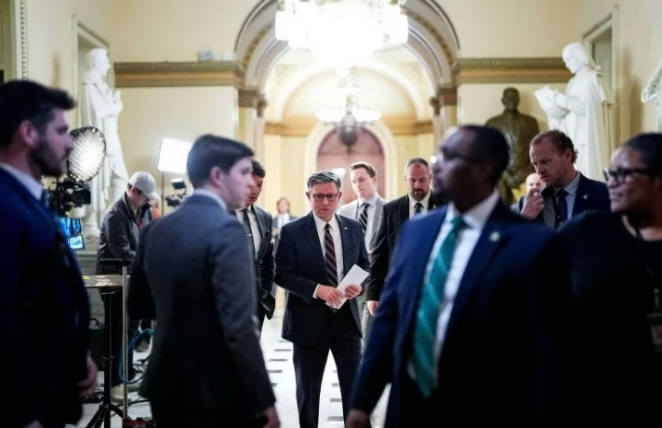
Speaker Mike Johnson attempted to block or delay the vote, urging lawmakers to wait for a pending Supreme Court decision regarding the legality of the tariffs.
Johnson even pursued a procedural maneuver designed to stall floor consideration of the resolution.
However, that strategy collapsed when several Republicans refused to back the leadership’s procedural efforts. The failed maneuver exposed internal divisions within the GOP conference, especially among members wary of surrendering congressional authority over trade policy to the executive branch.
Representative Don Bacon of Nebraska, one of the Republicans who supported the resolution, openly questioned why Congress should defer entirely to the courts.
He argued that lawmakers have an independent responsibility to assert their constitutional powers. Bacon, who is retiring rather than seeking re-election, also criticized tariffs as flawed economic policy.
Other Republicans expressed reservations but ultimately sided with the president. Some emphasized party unity, while others argued that maintaining leverage in trade negotiations justified the tariffs, at least for the time being. The debate illustrated the tension between loyalty to Trump and broader economic or institutional concerns.
The Senate has already voted to reject the tariffs in a separate but related action, reflecting broader bipartisan discomfort with the administration’s trade tactics.
Nevertheless, for the tariffs to be formally undone, both chambers must approve the rollback and send it to Trump for his signature. Given the president’s strong defense of the policy, a veto appears highly likely.
Trump has consistently argued that tariffs provide economic and national security benefits. He maintains that they pressure trading partners into fairer agreements and protect American industries.
In recent weeks, he escalated tensions by threatening a 100% tariff on Canadian goods in response to Ottawa’s proposed trade engagement with China.
That threat intensified US-Canada trade tensions and further strained relations with Prime Minister Mark Carney’s government. Canada, historically one of the United States’ closest trading partners and allies, has been caught in the crossfire of the broader Trump Canada trade dispute.
Critics of the tariffs argue that the fentanyl justification lacks proportional evidence. Experts note that most fentanyl entering the US is trafficked through the southern border, particularly from Mexico.
While some illicit substances do cross from Canada, the volume is comparatively small, raising questions about whether the national emergency declaration was warranted.
Republican Representative Brian Mast defended the administration’s stance, insisting that the fentanyl crisis constitutes a genuine national emergency. He contended that the resolution was less about tariff mechanics and more about Democrats attempting to minimize the severity of the drug epidemic.
Still, for many lawmakers, the issue extends beyond drugs or trade balances. It touches on the constitutional balance of powers between Congress and the presidency.
The US House blocks Canada tariffs in part as an assertion of legislative authority, reflecting concerns that unchecked executive action could erode institutional boundaries.
The timing of the vote also carries electoral implications. With midterm elections approaching, economic concerns remain central for voters.
Rising prices, supply chain instability, and uncertainty over trade relationships can influence public perception of leadership and governance.
For Republicans in competitive districts, aligning unconditionally with controversial tariffs may pose political risks. At the same time, defying Trump can invite backlash from the party base. The vote thus serves as a microcosm of the broader political calculations shaping Washington ahead of the next election cycle.
Although the immediate practical effect of the resolution may be limited, the symbolic weight is considerable. It signals that even within a polarized Congress, bipartisan coalitions can emerge when economic pressures and institutional principles converge.
Whether the measure ultimately results in the dismantling of the national emergency tariffs remains uncertain. Trump’s firm opposition suggests a likely veto if the resolution reaches his desk.
Overriding such a veto would require a two-thirds majority in both chambers, a threshold that appears difficult to achieve.
Nonetheless, the House’s action marks a notable moment in the ongoing debate over trade policy and executive power. The US House blocks Canada tariffs not only as a policy disagreement but also as a constitutional statement.
As US-Canada trade tensions continue to evolve, businesses, investors and consumers will be watching closely. The outcome could shape North American economic relations and redefine the boundaries between congressional oversight and presidential authority in matters of trade.
In the broader context of the Trump Canada trade dispute, this episode reinforces how tariffs remain both an economic tool and a political flashpoint.
Read also: France international appeal over Jacques Leveugle accused of raping 89 children across five continents
The coming weeks will determine whether this bipartisan rebuke translates into tangible policy change or remains primarily a symbolic assertion of congressional will.
About The Author