US-Iran nuclear talks in Geneva will enter a decisive third round on Thursday after Iran said negotiations have produced “encouraging signals,” even as the United States increases military deployments and President Donald Trump issues stark warnings over Tehran’s nuclear programme.
Iranian President Masoud Pezeshkian struck a tone of cautious optimism on Sunday, saying recent contacts with Washington involved “practical proposals” but insisting Iran is fully prepared for any outcome.
“Iran is committed to peace and stability in the region,” Pezeshkian wrote on X. “Recent negotiations involved the exchange of practical proposals and yielded encouraging signals. However, we continue to closely monitor US actions and have made all necessary preparations for any potential scenario.”
The comments come against a backdrop of rising fears of military confrontation, with Washington dramatically reinforcing its air and naval presence across the Middle East while intensifying political pressure on Tehran.
The upcoming round of US-Iran nuclear talks Geneva was formally confirmed by Oman, which has played a central mediating role in the indirect negotiations between the two adversaries.
Oman’s Foreign Minister Badr al-Busaidi announced that talks will take place in Geneva on Thursday, describing the moment as an opportunity to push negotiations toward a final agreement.
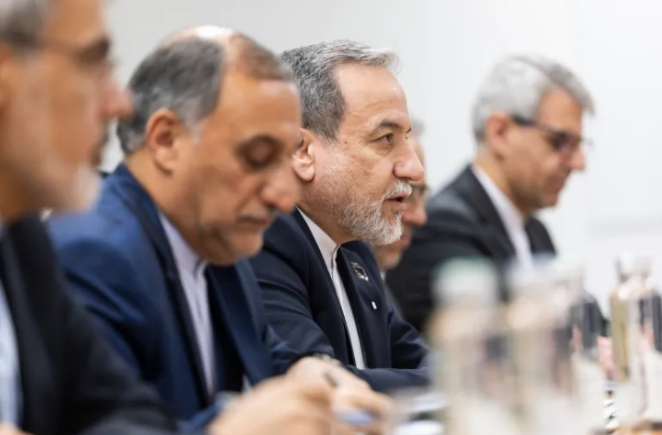
“Pleased to confirm US-Iran negotiations are now set for Geneva this Thursday, with a positive push to go the extra mile towards finalising the deal,” al-Busaidi said.
Iran and the US resumed nuclear discussions earlier this month in Muscat, before holding a second round in Geneva last week. While both sides characterised those meetings as constructive, they failed to secure a breakthrough, leaving core disputes unresolved. While diplomatic channels remain open, the White House has simultaneously escalated its pressure campaign.
US President Donald Trump warned this week that “really bad things” would happen if Iran refuses to agree to limits on its nuclear programme, a message reinforced by the scale of American military movements in the region.
According to US media reports, Washington has deployed more than 120 aircraft to the Middle East in recent days, while the USS Gerald R Ford is moving to join the USS Abraham Lincoln carrier strike group in the Arabian Sea, representing the largest concentration of US firepower near Iran since the 2003 invasion of Iraq.
Trump’s special envoy leading the talks, Steve Witkoff, suggested the president was puzzled by Iran’s resistance. “He’s curious as to why they haven’t capitulated,” Witkoff said in an interview on Fox News.
“Under this pressure — with the amount of seapower and naval power over there — why haven’t they come to us and said, ‘Here’s what we’re prepared to do’?”
Tehran responded swiftly and sharply to Witkoff’s remarks. Iran’s Foreign Minister Abbas Araghchi dismissed the idea that Iran would surrender its nuclear programme under pressure.
“Curious to know why we do not capitulate?” Araghchi wrote on X. “Because we are Iranian.” In a subsequent interview with CBS’s Face the Nation, Araghchi described Iran’s nuclear development as a matter of national dignity, forged under decades of sanctions, assassinations of scientists and military strikes on nuclear facilities.
“We have developed this technology by ourselves, by our scientists, and it is very dear to us. We’re not going to give it up. There is no legal reason to do so while everything is peaceful and safeguarded by the International Atomic Energy Agency,” he said.
As a committed member of the Non-Proliferation Treaty, which requires non-nuclear states to refrain from acquiring weapons, Iran reaffirmed its willingness to cooperate fully with the UN nuclear watchdog while emphasizing its sovereign right to peaceful nuclear enrichment.
Araghchi stressed that enrichment is a sensitive point in the negotiations, but that dialogue with Washington has clarified both sides’ positions. He indicated Iran is preparing a draft proposal that could accommodate concerns from both countries, potentially exceeding the restrictions of the 2015 nuclear deal brokered under President Barack Obama.
“There are elements that could be much better than the previous deal,” Araghchi said. “Right now, there is no need for too much detail. But we can agree on our nuclear programme to remain peaceful forever, and at the same time, for more sanctions to be lifted.”
Analysts caution that structural obstacles remain. Trita Parsi, executive vice president of the Quincy Institute, told meesmen that even an unprecedented Iranian proposal may not satisfy the US.
“Trump has been sold a narrative by the Israelis that portrays Iran far weaker than it actually is. As a result, he’s adopting maximalist capitulation positions that are unrealistic based on the actual power reality. Even if Iran presents a far-leaning proposal, Trump may still say ‘no’ because of this misperception.”
A separate point of contention arises from Israel’s ambitions, as Prime Minister Benjamin Netanyahu seeks broader dismantling of Iran’s military capabilities, while Trump remains narrowly focused on preventing nuclear weapons development.
Read also: Fugitive drug lord El Mencho killed sparks nationwide chaos across Mexico
“The Iranian nuclear programme is what’s important to Trump. Israel wants more, but Trump may not feel obliged to pursue those additional objectives,” said Mark Fitzpatrick, former director of the nonproliferation programme at the International Institute for Strategic Studies.
As negotiations resume in Geneva, both sides face a high-stakes balancing act between diplomacy and military brinkmanship, with Iran signaling openness to compromise while maintaining firm red lines and the United States pressing for maximal concessions under the shadow of a mounting military presence in the region.
About The Author