Nigeria recorded a modest easing in food prices in November 2025, offering a rare moment of relief for households that have battled months of elevated food inflation, according to the latest Selected Food Prices Watch released by the National Bureau of Statistics (NBS).
The report, published in Abuja, showed that prices of key staples such as rice, beans, garri, tomatoes and onions declined slightly compared to previous months and the same period in 2024, reflecting improving supply conditions and the early impact of government-led interventions in the agricultural value chain.
Although the price drops remain moderate and uneven across states, economists say the trend signals a potential turning point in Nigeria’s food inflation trajectory after prolonged pressure driven by insecurity, logistics disruptions, climate shocks, and currency volatility.
Food prices eased in November 2025 amid improved supply conditions
Data from the NBS indicated that the average price of one kilogramme of locally produced rice declined on both a year-on-year and month-on-month basis.
The commodity, which remains a staple in most Nigerian households, sold at an average of ₦1,861.95 per kg in November 2025, representing a 5.00 per cent decline compared to November 2024.
On a month-on-month basis, rice prices fell by 2.71 per cent, down from ₦1,913.78 recorded in October 2025. Analysts attributed the easing partly to increased harvest volumes and gradual improvements in domestic rice production, despite lingering challenges around milling costs and transportation.
Similarly, brown beans, another essential protein source, recorded one of the steepest price declines during the period.
The average price dropped by 43.14 per cent year-on-year to ₦1,547.03 per kg in November 2025. Month-on-month figures also showed a 12.13 per cent reduction from ₦1,760.53 in October.
The sharp decline in beans prices suggests improved availability in major producing regions, supported by better market access and reduced post-harvest losses compared to earlier months of the year.
Garri, tomatoes and onions follow downward trend
The easing trend extended to white garri, a widely consumed cassava-based staple. The NBS reported that the average price of one kilogramme of garri fell by 32.00 per cent year-on-year to ₦819.70 in November 2025.
On a month-on-month basis, prices declined by 3.19 per cent, down from ₦846.69 recorded in October.
Tomatoes, which have been highly volatile due to seasonal shortages and transportation bottlenecks, also recorded a price decline.
The average price of one kilogramme of tomatoes dropped by 15.57 per cent year-on-year to ₦1,243.02. Month-on-month data showed a 2.06 per cent decrease, reflecting improved supply flows from northern farming hubs to urban markets.
Onions followed a similar pattern, with prices falling by 29.03 per cent year-on-year to an average of ₦1,332.77 per kg. On a month-on-month basis, onion prices declined by 2.60 per cent, reinforcing the broader trend that food prices eased in November 2025 across several staple categories.
Palm oil bucks the trend
Despite the general easing, not all food items followed the downward trajectory. The average price of one litre of palm oil rose marginally, increasing by 1.70 per cent year-on-year to ₦2,508.73 in November 2025.
However, month-on-month data showed a slight moderation, with palm oil prices declining by 1.70 per cent from ₦2,537.90 recorded in October.
Industry watchers attribute palm oil’s relative firmness to rising processing costs, energy expenses, and export demand pressures.
While the national averages suggest moderation, the NBS data revealed significant state-by-state variations, highlighting persistent structural gaps in food distribution.
Kogi State recorded the highest average rice price at ₦2,159.99 per kg, while Bauchi posted the lowest at ₦1,237.81. Brown beans were most expensive in Imo State at ₦2,174.39, compared to ₦725 in Adamawa.
For garri, Bayelsa recorded the highest price at ₦1,164.28, while Plateau had the lowest at ₦487.31. Tomato prices peaked in Imo at ₦2,010.70, whereas Plateau again recorded the lowest at ₦684.38.
Onion prices ranged widely, with Abia posting the highest average at ₦2,300.76, compared to ₦826.56 in Kwara. Palm oil prices were highest in Enugu at ₦2,508.73, while Taraba recorded the lowest at ₦2,050.
Regional trends show uneven relief
Zonal analysis further underscored the uneven nature of the price relief. The North-Central zone recorded the highest average rice price at ₦2,019.45, while the North-East posted the lowest at ₦1,608.54.
Brown beans were most expensive in the South-East and South-South, while the North-East recorded the lowest average price at ₦982.79. Garri prices were highest in the South-East, while the North-Central zone recorded the lowest.
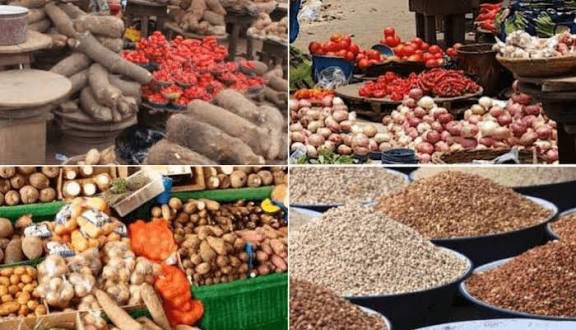
According to the NBS, tomato prices were highest in the South-East and South-South, while the North-West recorded the lowest averages, reflecting differences in proximity to production centres.
The easing of food prices comes months after President Bola Tinubu, in September 2025, directed relevant ministries and agencies to implement measures aimed at curbing food inflation, including support for farmers, improved logistics, and targeted market interventions.
Economists caution, however, that while food prices eased in November 2025, sustaining the trend will depend on security improvements in farming regions, stable energy costs, and consistent transport infrastructure.
Any reversal in these factors could quickly erase recent gains.
For now, the November data provides cautious optimism for consumers, suggesting that Nigeria may be entering a phase of gradual food price stabilisation after a prolonged period of volatility.