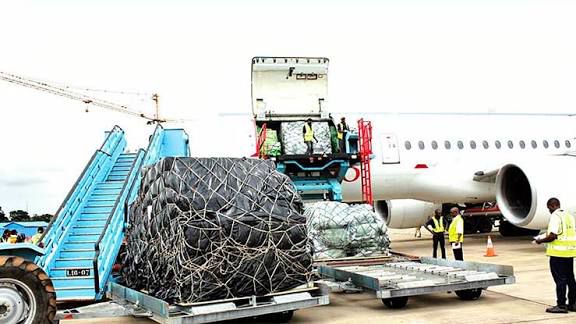
Cargo handling activities at Nigeria’s busiest aviation gateway, the Murtala Muhammed International Airport (MMIA), Lagos, were partially disrupted on Monday as airport cargo agents suspended operations in protest against a sharp increase in cargo tariffs approved by the Federal Airports Authority of Nigeria (FAAN).
The standoff has exposed growing tension between aviation regulators and private sector operators at a time when Nigeria is seeking to strengthen its logistics ecosystem, boost non-oil exports, and reduce the cost of doing business across critical infrastructure.
The protest followed FAAN’s notification to cargo handlers that a revised tariff regime would take effect from February 2, 2026, replacing the long-standing cargo processing fee of ₦7 per kilogram with a new rate of ₦25 per kilogram — a jump that industry stakeholders say is excessive, poorly communicated, and potentially damaging to trade flows.
Airport cargo agents halt operations over tariff dispute
Industry groups confirmed that members stopped cargo processing in response to what they described as an “unacceptable and sudden” tariff increase.
The National Association of Government Approved Freight Forwarders (NAGAFF) said the decision to down tools reflected a collective rejection of the new pricing structure.
According to the association, freight forwarders and cargo agents were unwilling to absorb or pass on a 257 per cent increase in handling costs to importers and exporters already grappling with high logistics expenses, exchange rate volatility, and inflationary pressures.
Deputy President of NAGAFF, Segun Musa, explained that the protest was not spontaneous but the outcome of consultations among stakeholders who felt sidelined in the decision-making process.
“Our members have resolved not to process cargo under the new tariff regime. This is a general decision because the rate is unrealistic and does not reflect current economic realities. We are not prepared to accept it,” he said.
Musa added that cargo agents were monitoring the situation while awaiting a formal engagement with FAAN, insisting that meaningful dialogue was the only path to restoring normal operations.
Conflicting claims over suspension of new tariff
While NAGAFF confirmed the suspension of cargo activities, another industry body — the Africa Association of Professional Freight Forwarders and Logistics — suggested that the tariff hike had not yet been fully enforced.
Its president, Frank Ogunnojemite, told reporters that although FAAN officials were present at the cargo terminals, the agency had not formally commenced collection under the new rates.
“For now, the new rate is suspended.
We are still operating on the ground, but there has been no official meeting with FAAN to resolve the matter. Until there is written communication, anything else remains speculation,” Ogunnojemite said.
He disclosed that cargo agents had engaged ground handling companies, including the Nigerian Aviation Handling Company Plc (NAHCO) and Skyway Aviation Handling Company Plc (SAHCO), to assess the broader implications of the tariff increase on airport operations.
The dispute escalated after cargo agents wrote formal petitions to security agencies operating at MMIA, including the Nigeria Police Force, Nigeria Customs Service, Nigeria Immigration Service, and the Department of State Services (DSS), drawing attention to the potential operational and economic consequences of the tariff hike.
According to industry sources, officials from FAAN’s Cargo Development and Services Department, accompanied by DSS personnel, were deployed to the Hajj and cargo terminals to ensure compliance with the revised tariff.
This move, stakeholders argue, further strained relations and reinforced perceptions that the new charges were being imposed without adequate stakeholder consultation.
Ogunnojemite warned that any tariff adjustment must align with existing Federal Government guidelines, which recommend that fee increases across public infrastructure should not exceed 25 per cent at a time.
“A 257 per cent increase is clearly outside the policy framework. Even if there must be a review, it should be gradual and transparent, not imposed overnight,” he said.
FAAN insists on implementing new rates
FAAN, however, dismissed claims that cargo operations were halted or that it was reconsidering the tariff increase.
Speaking on behalf of the authority, spokesperson Henry Agbebire said airport operations remained largely smooth and that the agency was proceeding with the revised charges.
“Aside from a few attempts to create a scene, cargo operations were smooth today. FAAN is not backing down on the new tariff. The agents are complying, and we are moving forward,” Agbebire stated.
He did not address concerns about the scale of the increase or whether further consultations with stakeholders were planned.
Broader implications for trade and logistics
Industry analysts warn that prolonged disruption could have ripple effects across Nigeria’s import and export value chain, especially for time-sensitive cargo such as pharmaceuticals, perishables, and manufacturing inputs.
With Lagos airports serving as critical hubs for international trade, higher cargo tariffs could translate into increased costs for businesses, reduced competitiveness for exporters, and higher consumer prices.
Aviation economists also caution that policy inconsistency and regulatory uncertainty may discourage private investment in airport logistics infrastructure, undermining Nigeria’s ambition to position itself as a regional cargo and transit hub.
They argue that while FAAN is under pressure to boost internally generated revenue amid fiscal constraints, revenue optimisation must be balanced against the broader economic impact on trade facilitation.
As of Monday night, both sides remained entrenched, with cargo agents insisting on a rollback or renegotiation of the tariff hike, and FAAN maintaining its stance.
Stakeholders across the aviation and logistics sectors are urging the Federal Government to intervene, warning that failure to resolve the dispute quickly could erode confidence in Nigeria’s aviation business environment.
For now, the situation at MMIA underscores a recurring challenge in Nigeria’s infrastructure management — how to balance revenue generation with stakeholder engagement, policy clarity, and economic sustainability.
About The Author