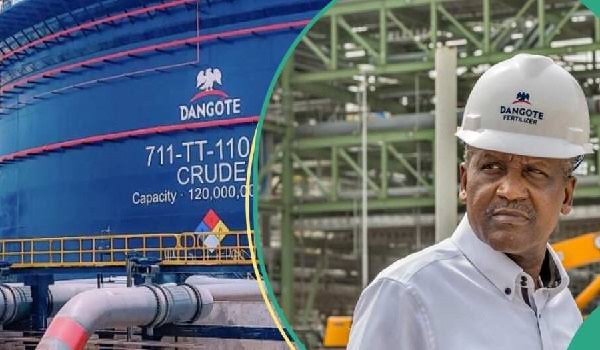

Nigeria’s industrial giant, Aliko Dangote, has unveiled ambitious plans to double the capacity of the Dangote refinery from its current 650,000 barrels per day (bpd) to a massive 1.4 million bpd — a development that would make it the largest refinery in the world.
In a recent interview with S&P Global, the President of the Dangote Group disclosed that the Dangote refinery expansion will be supported through fresh financing partnerships, including potential collaborations with Middle Eastern investors.
The move marks another major leap for Nigeria’s energy independence and industrial self-sufficiency.
Dangote refinery expansion targets world’s largest status
According to S&P Global Commodity Insights, the expansion will push the refinery’s capacity beyond India’s Jamnagar refinery, currently the largest globally with a capacity of 1.36 million bpd.
Dangote’s project, located in the Lekki Free Zone, Lagos, is already reshaping the country’s oil and gas landscape by transforming Nigeria into a net exporter of diesel and jet fuel and a growing supplier of petrol across West Africa.
Speaking on the motivation behind the refinery’s next phase, Dangote described the initiative as a “herculean task” but a necessary step toward ensuring Africa’s energy independence.
“We have to build the refinery again, either here or somewhere else. But really, somewhere else is not possible because we already have the infrastructure here,” he said.
Industry engineers at the Lekki complex confirmed that the site was designed with future expansion in mind, with additional concrete plots already allocated for new refining systems.
Experts believe the Dangote refinery expansion could involve constructing a second refinery module with identical configuration, possibly including a vacuum distillation unit to improve yield efficiency.
Financing and strategic partnerships driving the expansion
Sources familiar with the project reveal that the Dangote refinery expansion will rely heavily on new funding from Middle Eastern partners.
Dangote also hinted at a shift from his traditional ownership model, noting that the refinery business will open up equity to external investors and possibly list shares on the Nigerian Stock Exchange within a year.
“Our business concept is going to change. Instead of being 100 percent Dangote-owned, we’ll have other partners,” he said.
“We plan to list between 5 to 10 percent of shares, but we’ll keep about 65–70 percent ownership.”
He further disclosed that the Nigerian National Petroleum Company Limited (NNPCL), which currently holds a 7.2 percent stake, may be offered more shares once the next growth phase stabilizes.
This strategic financing comes just months after the company secured a critical $4 billion funding agreement in August 2025, easing previous concerns over debt repayment schedules and capital constraints.
Addressing Africa’s refining gap through Dangote refinery expansion
Dangote’s vision for the refinery expansion goes beyond business growth — it’s a bold attempt to end Africa’s dependence on imported fuel.
He warned that without large-scale private investment, the continent risks prolonged energy insecurity.
“Most African governments will not have the capacity to build a refinery,” he cautioned.
“Smaller projects like Angola’s Cabinda refinery are good but remain a drop in the ocean.”
Analysts note that the expansion is also a response to projections by S&P Global that Nigeria’s net gasoline imports could double between 2026 and 2030, driven by economic growth and rising population.
With the expanded capacity, the refinery aims to fill domestic demand gaps and become a key exporter to neighbouring markets.
Operational challenges and ongoing maintenance
Despite its achievements, the Dangote refinery recently faced minor operational setbacks. Its main petrol unit — the Residue Fluid Catalytic Cracker (RFCC) — temporarily went offline in September following a three-week maintenance turnaround in August.
Vice President for Refinery Operations, Devakumar Edwin, confirmed that the RFCC resumed operation by early October and would soon return to full capacity.
“We have resolved most of the technical issues. A short, planned turnaround is being scheduled to ensure efficiency without disrupting seasonal demand,” Edwin stated.
Dangote added that while the RFCC would undergo a month-long maintenance shutdown, other critical units, including the Crude Distillation Unit (CDU), would remain operational.
The refinery only requires a full system turnaround once every five years — a testament to its robust design and technology.
Broader economic impact of the Dangote refinery expansion
Economists and industry experts view the Dangote refinery expansion as a major boost for Nigeria’s industrial and fiscal outlook.
The refinery’s current output has already reduced the country’s dependence on imported refined products, saving billions in foreign exchange and stabilizing domestic fuel supply.
Beyond fuel production, the company is also diversifying into petrochemical projects, including linear alkylbenzene and base oil plants, and plans to raise its annual polypropylene production from one million to 1.5 million metric tonnes in the coming years.
Although the International Energy Agency (IEA) projects a global surplus of refining capacity by 2030, Dangote insists that Africa must prioritize local processing to secure its economic future.
“We cannot rely on global capacity while our continent remains energy-dependent. Africa needs large, privately led projects to ensure stability and growth,” he stressed.
The Dangote refinery expansion represents not only an industrial milestone but also a turning point in Africa’s pursuit of energy independence.
As Dangote continues to attract global partnerships and expand production capacity, Nigeria stands poised to solidify its status as a refining powerhouse, redefining its role in global energy trade.
About The Author