The Senate war powers resolution on Iran failed on Wednesday after Republicans voted down an effort to require President Donald Trump to seek congressional approval before continuing the US military campaign against Tehran.
The 47-53 vote underscored deep partisan divisions in Washington over the legality and scope of the expanding US-Israel war on Iran, with nearly all Democrats backing the measure and most Republicans opposing it.
The resolution, introduced by Democratic senator Tim Kaine of Virginia, sought to invoke the War Powers Act to compel the president to secure explicit authorization from Congress before further prosecuting hostilities against Iran.
Kaine argued that the constitution grants lawmakers the authority to declare war and that the ongoing US military campaign against Iran had already resulted in American casualties, making congressional oversight both urgent and necessary.
Only two senators broke ranks with their parties. Democratic senator John Fetterman voted against the measure, while Republican senator Rand Paul supported it. The outcome reflected a largely party-line divide, reinforcing how the Donald Trump Iran conflict has become a defining political flashpoint in Congress.
Ahead of the vote, Democratic senator Chris Murphy warned that failing to assert congressional authority risked repeating what he described as costly missteps in past Middle East interventions.
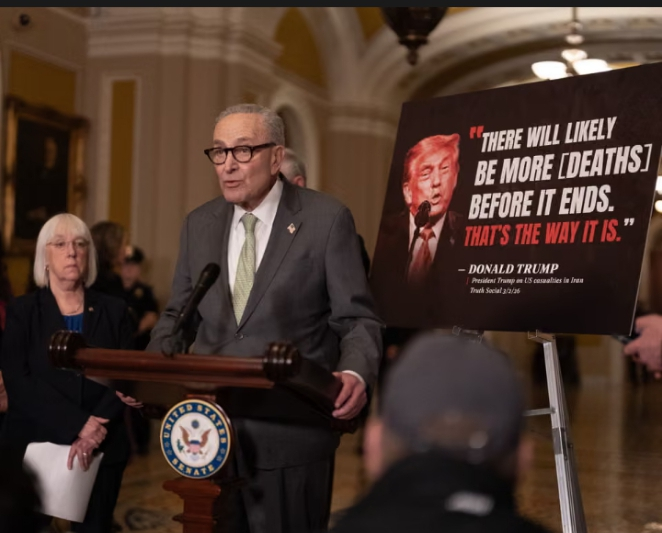
He drew comparisons to earlier US military engagements, arguing that unchecked executive power had led to prolonged conflicts in Afghanistan and Libya. Murphy framed the Congress war powers vote as a test of whether lawmakers had learned from decades of interventionist policy.
Trump initiated the current military campaign following months of stalled negotiations with Tehran over its nuclear programme. Administration officials maintain that the strikes were necessary to curb Iran’s capabilities and respond to what they describe as persistent regional aggression.
Although the president notified a select group of senior lawmakers before launching operations, critics argue that limited consultation does not satisfy constitutional requirements for sustained warfare.
Kaine, in remarks delivered on the Senate floor, stressed that the conflict had already claimed American lives and risked escalating further.
He urged colleagues to “debate and vote about matters of war,” invoking the framers’ intent that decisions of such magnitude should not rest solely with the executive branch. His argument centered on the Senate war powers resolution on Iran as a constitutional safeguard rather than a partisan maneuver.
Republican leaders rejected those claims, asserting that Trump acted within his authority as commander-in-chief. Senate minority leader Mitch McConnell defended the legality of the operation, contending that presidential powers to use military force, with or without prior congressional approval, are well established through precedent.
McConnell described the administration’s actions as consistent with past uses of force by US presidents.
Senator Lindsey Graham went further, framing the conflict in stark ideological terms and emphasizing longstanding hostilities between Washington and Iran’s clerical leadership.
He argued that diplomatic overtures had failed and that military pressure was necessary to counter what he characterized as an entrenched and uncompromising regime in Tehran.
Since the conflict began, six US service members have been killed. Estimates of Iranian casualties range from just over 1,000 to as many as 1,500 people, underscoring the human cost of the US military campaign against Iran.
The rising toll has intensified debate in Washington over the trajectory and objectives of the war, with critics warning that escalation could draw the United States into a broader regional confrontation.
Attention now shifts to the House of Representatives, where a separate bipartisan war powers resolution has been introduced by Republican representative Thomas Massie and Democratic representative Ro Khanna. However, the measure faces steep odds in a chamber where Republican leadership has signaled firm opposition.
House speaker Mike Johnson warned that abruptly curtailing presidential authority during active hostilities would be “dangerous.” He argued that stripping the commander-in-chief of operational flexibility mid-conflict could undermine US strategy and embolden adversaries.
Johnson expressed confidence that the House would defeat the resolution, mirroring the Senate’s rejection.
Even if both chambers were to approve a war powers measure, Trump retains the authority to veto it. Overriding such a veto would require two-thirds majorities in both the Senate and the House, a threshold that appears out of reach given current partisan alignments.
The president has also shown a willingness to publicly criticize lawmakers who oppose his foreign policy initiatives, particularly on matters involving military force.
Earlier this year, Trump lashed out at Republican senators who supported a separate war powers effort aimed at limiting hostilities with Venezuela.
That resolution ultimately failed after some GOP backers withdrew their support. The episode serves as a cautionary example for lawmakers contemplating rebellion on the Iran issue, illustrating the political risks of breaking with party leadership on national security.
The failure of the Senate war powers resolution on Iran leaves the administration with broad discretion to continue military operations for now. Yet the vote also highlights simmering unease within Congress about the balance of power between the legislative and executive branches.
As the Donald Trump Iran conflict unfolds, debates over constitutional authority, strategic objectives and the long-term consequences of US involvement are likely to intensify.
Read also:Russia, China voice opposition to US-Israeli attacks on Iran
For Democrats, the Congress war powers vote was about reasserting legislative responsibility in decisions of war and peace. For Republicans, it was a defense of presidential prerogative during an ongoing military campaign.
With casualties mounting and regional tensions high, the question of how far the US-Israel war on Iran will extend remains unresolved, even as Congress struggles to define its role in shaping that outcome.
About The Author