
China GDP growth Target 2026– China has set its lowest economic growth target in decades, signalling a major shift in strategy as leaders brace for mounting domestic and global pressures.
At the annual parliamentary gathering in Beijing, the government announced a gross domestic product (GDP) growth target of between 4.5% and 5% for 2026 — the first time since 1991 that the benchmark has fallen below 5%.
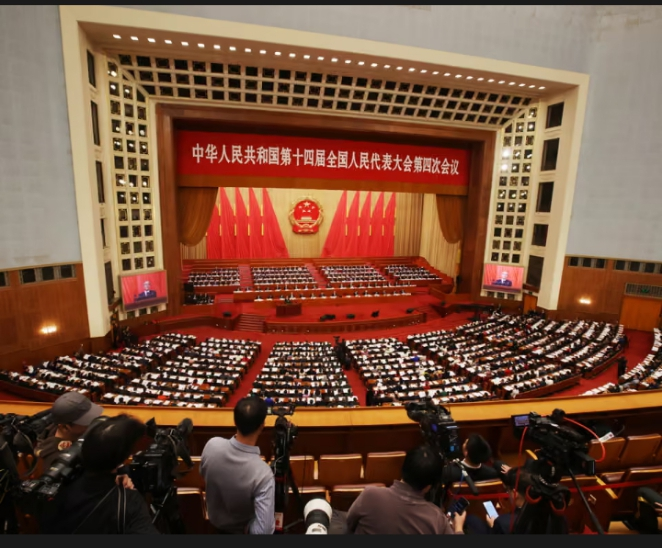
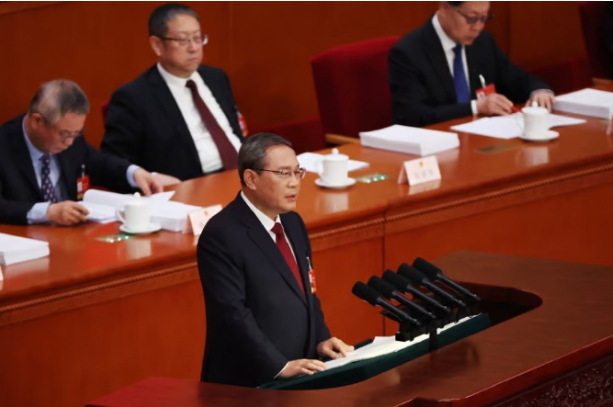
The announcement was made by Premier Li Qiang during the opening session of the National People’s Congress (NPC), part of the country’s closely watched “Two Sessions” political meetings.
Addressing nearly 3,000 delegates gathered inside Beijing’s Great Hall of the People, Li described the previous year as “truly remarkable” despite what he called “profound and complex developments both at home and abroad.”
The lower growth target underscores Beijing’s evolving economic philosophy. For decades, China’s rise was powered by exports, heavy industry and massive construction projects.
Now, policymakers are increasingly emphasising what they describe as “high-quality growth” — expansion driven by advanced manufacturing, innovation, technology and domestic consumption rather than property development and low-cost exports.
The new target reflects both structural ambition and economic reality. China is grappling with a combination of long-term and cyclical challenges: an ageing population, a struggling property sector, subdued consumer confidence and weaker global demand.
As the world’s second-largest economy matures, slower growth is widely viewed by economists as inevitable.
The leadership’s decision to publicly lower its target suggests a greater willingness to tolerate slower expansion in exchange for more sustainable development.
Alongside the GDP announcement, authorities published a draft of the country’s 15th five-year plan, covering the period from 2026 to 2030. The plan — due to be formally approved later this month — prioritises boosting domestic consumption, strengthening technological self-sufficiency and advancing structural reforms.
These objectives are designed to insulate China from external shocks and geopolitical tensions that have reshaped global trade patterns in recent years.
Economic analysts say the timing is significant.
China and the United States agreed in October to a one-year pause in their trade dispute, creating what some observers describe as a window for Beijing to recalibrate its economic model.
Although tariffs and restrictions remain in place, the temporary truce has eased immediate pressure on Chinese exports and allowed policymakers to focus on internal reforms.
The low GDP target is also a response to structural changes in the domestic economy. Experts note that China is shifting away from reliance on construction and exports, towards industries that leverage high technology and innovation.
Dan Wang, China director at Eurasia Group, said that policymakers are using the trade truce with the US to “focus on reforming the economy away from export-led growth,” while also demonstrating a “higher tolerance for unemployment.”
Premier Li announced a 5.5% target for urban unemployment and pledged to create more than 12 million new urban jobs in 2026, targets broadly consistent with previous years.
However, some economists caution that the shift toward high-tech industries could leave blue-collar workers exposed, highlighting potential social tensions as the economy modernises.
Guo Shan, partner and chief economist at Hutong Research, said the modest growth target nevertheless demonstrates confidence. He noted that achieving roughly 4.3% annual growth over the next decade would allow China to reach its stated goal of becoming a moderately developed country by 2035.
“After dealing with the US trade war and still growing by 5% in 2025, Beijing has likely become more confident in setting and delivering China’s growth target,” Guo said.
The draft five-year plan also includes ambitious environmental targets, including a proposed 17% cut in carbon intensity — the amount of CO₂ emitted per unit of economic activity — by 2030.
Li Shuo, director of China Climate Hub at the Asia Society Policy Institute, pointed out that while this marks progress, it falls short of China’s broader pledge to reduce carbon intensity by more than 65% from 2005 levels by the end of the decade.
Challenges in the first half of the 2020s, including the Covid-19 pandemic and a heavy reliance on traditional industry, meant China failed to meet the carbon reduction targets of the previous plan.
Data shows that carbon intensity fell only 12% between 2020 and 2025, below the 18% target set in the 14th five-year plan. The new 17% target signals a recalibration, acknowledging the difficulty of reaching earlier goals.
The 2026 budget, released alongside the growth target and five-year plan, also reflects shifting priorities. Defence spending will rise by 7%, a modest increase compared to previous years, while broader economic initiatives focus on encouraging domestic consumption.
Analysts note that stimulating internal demand is essential for China’s long-term stability, particularly as global demand slows and external shocks continue to affect trade.
State media commentary has emphasised a more balanced approach to consumption and production, signalling a strategic shift from heavy industry reliance to a more diversified economic base.

While the details of how consumption will be boosted remain vague, the policy framework indicates a longer-term vision of economic resilience and technological self-reliance.
Overall, China’s 2026 GDP growth target and accompanying five-year plan illustrate a cautious but deliberate pivot. Leaders are acknowledging slower growth as a structural reality while attempting to modernise the economy, address social and environmental challenges, and navigate a complex global trade landscape.
By prioritising high-quality growth, innovation and domestic demand, Beijing aims to ensure that the next phase of China’s development is more sustainable and resilient against future shocks.