Venezuela earthquake rescue 2026 teams delivered a rare moment of hope on Sunday when a man and his teenage son were pulled alive from rubble in Caraballeda, about 40km north of Caracas.
The discovery came nearly four days after back-to-back quakes of magnitude 7.2 and 7.5 struck, destroying nearly 200 buildings in the area and pushing the confirmed death toll past 1,450. Interim President Delcy Rodríguez said search operations would not be suspended while survivors were still being found.
The rescue stands against a backdrop of widespread destruction in La Guaira state, strained public services, and a surge of international support as Venezuela faces one of Latin America’s deadliest earthquake disasters in decades.
Caraballeda Earthquake Survivors Offer a Glimmer of Hope
French and American rescue teams made the breakthrough in Caraballeda, working through pancaked concrete and collapsed apartments to reach the father and son.
AFP journalists on site reported the extraction on Sunday, almost 96 hours after the twin quakes hit on Wednesday evening. The find came after the critical 72-hour window for live rescues had passed, which made the outcome even more significant for families waiting on news.
Why Caraballeda Earthquake Survivors Matter for Morale
The Caraballeda operation became a reference point for the entire response. For communities digging by hand for missing relatives, seeing live rescues after day four renewed pressure on authorities to keep teams deployed. Interim President Rodríguez captured the shift in tone: “Today we have rescued people who are still alive, and therefore these efforts will not be suspended. We always hold on to hope.” That message has been repeated across damaged towns where exhaustion is high but the will to search remains.
Rescue leaders on the ground were cautious. A Salvadoran team member said, “At this point, they are probably dead bodies. Thanks to God maybe we can find people still alive.” Even with tempered expectations, the father-son rescue proved that pockets of survival were still possible, prompting fresh sweeps in zones previously written off.
Delcy Rodríguez Rescue Efforts and the Scale of Destruction
The government’s accounting of the disaster has grown daily. National Assembly President Jorge Rodriguez said on Sunday that about 774 buildings were badly damaged by the twin quakes. The official toll stood at 1,450 dead and 3,150 injured, with authorities warning that both figures were expected to rise.
Delcy Rodríguez Rescue Efforts Focus on Access and Recovery
Interim President Delcy Rodríguez has coordinated the domestic response while thanking partner nations for support. Her office reported that 24 countries had sent 521 tons of supplies, 86 canine units trained to locate people under rubble, and more than 2,700 search-and-rescue personnel. The priority has been to keep routes open, expand airport capacity, and restore a key seaport to move relief faster into coastal areas.
Public frustration has also surfaced. In Tanaguarena, part of hard-hit La Guaira state, residents confronted soldiers, urging them to trade rifles for tools: “The country needs you. Put down your weapon,” one man shouted. The exchange reflected anger at the pace of aid in some neighborhoods, even as Rodríguez’s team insisted that rescue would continue alongside relief distribution.
La Guaira Earthquake Damage Strains Communities
La Guaira, the port city near Venezuela’s main international airport, was among the worst affected. Much of the city lies in rubble, with pharmacies and supermarkets ransacked in the days after the quakes. Residents cited slow and limited aid deliveries as a factor in the looting, while authorities moved to secure supply lines and stabilize distribution points.

Living Conditions After La Guaira Earthquake Damage
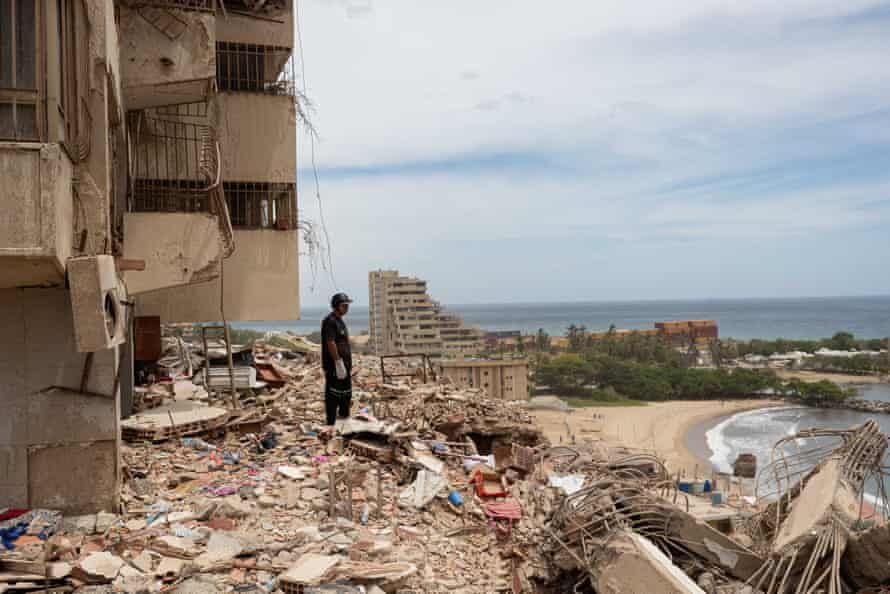
Beyond collapsed housing, basic services have been degraded. The UN migration agency estimated that up to 6.76 million people could be affected and would need shelter, water, sanitation, healthcare, and essential relief items. Images from Catia La Mar showed rescue workers surveying streets of broken masonry and twisted rebar, while families camped near damaged buildings waiting for assistance.
The economic context is severe. Venezuela’s worst earthquakes in more than a century have struck after more than a decade of economic contraction that has hollowed out hospitals and public services. The UN has put the physical repair bill at $6.7bn, about six percent of GDP, a figure that underscores the scale of reconstruction ahead.
Venezuela Earthquake International Aid Expands Operations
Foreign teams have been central to the response. The United States sent helicopters to ferry aid and deployed additional personnel to increase airport throughput and reopen the seaport. A 250-strong US disaster response team was already on site, with 230 more military personnel arriving to support logistics. Mexico and other partners also contributed search units and supplies.
Venezuela Earthquake International Aid Priorities Now
The immediate priorities are threefold: locate any remaining survivors, deliver water and medical care, and prevent secondary crises. Canine teams are sweeping new sectors in Caraballeda and La Guaira, while engineers assess which buildings can be shored up and which must be demolished. Aid convoys are being rerouted through the reopened port to reduce bottlenecks at the airport.
Diplomatic visibility has also risen. Opposition figure María Corina Machado, speaking from exile to Fox News, said she would return “very soon” to join mourning and recovery efforts: “We need to be together, to embrace, to grieve and mourn together, but also to give each other strength at this difficult time.” Her statement adds a political dimension to a disaster response that is already under intense scrutiny.
What Happens Next in Venezuela Earthquake Rescue 2026
The search is shifting from rescue to recovery, but it is not finished. Rodríguez’s pledge to keep operations active while survivors are found means teams will continue targeted probes in buildings with signs of void spaces. At the same time, humanitarian corridors are being prioritized to move food, medicine, and shelter materials into La Guaira and surrounding towns.
Read àlso: Iran US peace deal on the brink as Gulf military escalation intensifies in June 2026
Longer-Term Challenges After the Quakes
Rebuilding will test budgets and institutions already under strain. Hospitals will need equipment and staff, schools will need safe facilities, and thousands of families will need interim housing. International donors have pledged material support, but coordination and transparency will determine how quickly communities stabilize.
For now, the father and son pulled from Caraballeda rubble remain the most visible outcome of Venezuela earthquake rescue 2026. Their survival does not change the overall toll, but it changes the narrative. It says that after four days, after 1,450 confirmed deaths, after hundreds of buildings lost, there is still room for hope and for work that matters.
About The Author