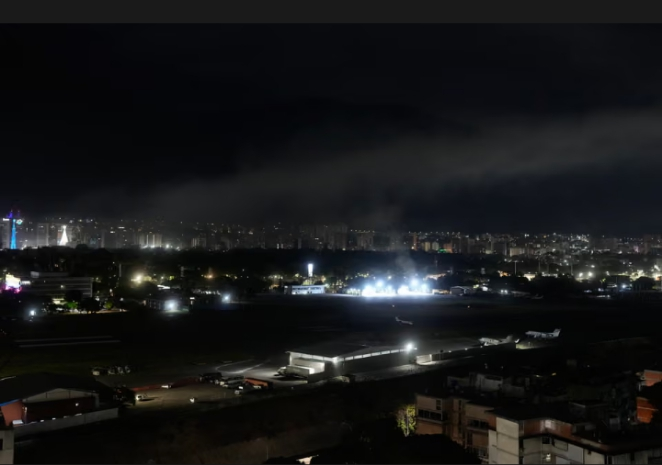
Multiple blasts rock Caracas – Explosions were reported across Venezuela’s capital, Caracas, during the early hours of Saturday, triggering widespread alarm, confusion, and rapid speculation about their cause.
Residents in several neighbourhoods said they were jolted awake by loud detonations around 2am local time, with some rushing into the streets fearing a major security incident.
Witnesses also reported low-flying aircraft circling parts of the city, intensifying anxiety among civilians already accustomed to prolonged political and economic instability.
According to the Associated Press, at least seven distinct explosions were heard across different areas, suggesting a coordinated or multi-site incident rather than an isolated accident.
Social media platforms quickly filled with videos showing flashes in the night sky, shaking buildings, and smoke rising from parts of the capital.

One of the most visible signs of disruption was a reported power outage affecting southern districts of Caracas, leaving thousands temporarily without electricity.
Images circulating online appeared to show smoke billowing near La Carlota airport, a strategically significant military and civilian facility within the city.
Authorities did not immediately confirm the location or source of the blasts, and emergency services provided no official briefing in the hours following the incident.
Venezuela’s government declined to respond to early media inquiries, maintaining silence as speculation mounted both domestically and internationally.
A Caracas resident told local radio, “The windows shook like an earthquake, and people started shouting and running outside in panic.”
Another witness described hearing aircraft engines shortly after the explosions, saying the sounds were “unusual and very low, unlike normal flights.”
The lack of immediate official explanation heightened uncertainty, with rumours ranging from industrial accidents to military activity or sabotage.
The explosions occurred amid escalating tensions between Venezuela and the United States, adding a sensitive geopolitical dimension to the unfolding situation.
In recent weeks, the US military has intensified operations targeting vessels it claims are involved in drug trafficking in Caribbean and Pacific waters.
Former US president Donald Trump has repeatedly threatened direct land operations in Venezuela as part of efforts to force President Nicolás Maduro from power.
Those efforts have included expanded economic sanctions, increased military presence in the region, and multiple strikes on suspected trafficking boats.
Although US actions have largely occurred outside Venezuelan territory, Caracas has consistently accused Washington of aggression and destabilisation.
Following the reported explosions, the Pentagon also declined to comment, offering no clarification on whether US forces were involved or aware of the incident.
Security analysts cautioned against drawing conclusions, noting Venezuela’s history of infrastructure failures and occasional military exercises within urban areas.
One regional analyst said, “Until authorities speak, it’s impossible to determine whether this was an attack, an accident, or an internal security operation.”
Hospitals in Caracas did not immediately report mass casualties, suggesting the explosions may not have struck densely populated residential zones.
However, the psychological impact was evident, with parents keeping children indoors and many residents remaining awake until daylight.
Markets and public transport were disrupted Saturday morning, as commuters weighed personal safety against economic necessity.
Opposition figures called on the government to provide transparent information, warning that silence fuels fear and misinformation.
Government supporters, meanwhile, accused foreign media of exaggeration and urged citizens to remain calm and await official statements.
Venezuela has previously experienced mysterious explosions at refineries, power stations, and military sites, often with delayed or incomplete explanations.
Such incidents have frequently been blamed on poor maintenance, sanctions-related shortages, or alleged foreign sabotage.
The developing situation placed renewed focus on the fragility of Venezuela’s infrastructure after years of economic crisis.
Energy experts noted that power outages remain common nationwide, making it difficult to determine whether Saturday’s blackout was directly linked.
International observers said the timing was significant, coming amid renewed diplomatic strain and regional security manoeuvres.
Latin American governments monitored events closely, concerned about potential spillover effects or refugee movements.
For ordinary Venezuelans, the blasts reinforced a sense of uncertainty that has defined daily life for much of the past decade.
As daylight broke over Caracas, streets gradually returned to activity, though the atmosphere remained tense and watchful.
Police presence was visibly increased near government buildings and transport hubs, suggesting heightened alert levels.
No group claimed responsibility for the explosions, and no evidence was presented linking them to any specific actor.
State media limited coverage to brief updates, reiterating calls for calm and national unity.
Independent journalists faced difficulties accessing certain areas, reporting restricted movement and limited official cooperation.
Human rights organisations urged authorities to respect press freedom and provide timely, accurate information to the public.
The incident underscored the volatile intersection of domestic hardship and international pressure confronting Venezuela.
Whether the explosions mark a turning point or remain an unexplained episode depends largely on forthcoming official disclosures.
For now, Caracas waits for answers, as residents balance resilience with lingering fear after a night of sudden violence.
About The Author