The US strikes Iran for a second consecutive day after President Donald Trump declared the interim ceasefire “over” late on Wednesday. US Central Command confirmed that American forces carried out new attacks across three locations in Iran, just hours after three cargo ships were targeted while transiting the Strait of Hormuz.
The renewed strikes mark the most significant escalation between Washington and Tehran since the memorandum of understanding was signed on 17 June, and they have already sent oil prices climbing and diplomatic hopes collapsing.
President Trump made the announcement first on Truth Social before repeating it on the sidelines of the Nato summit in Ankara. He framed the action as direct retaliation and warned Tehran that further attacks on shipping would bring an even harsher response.
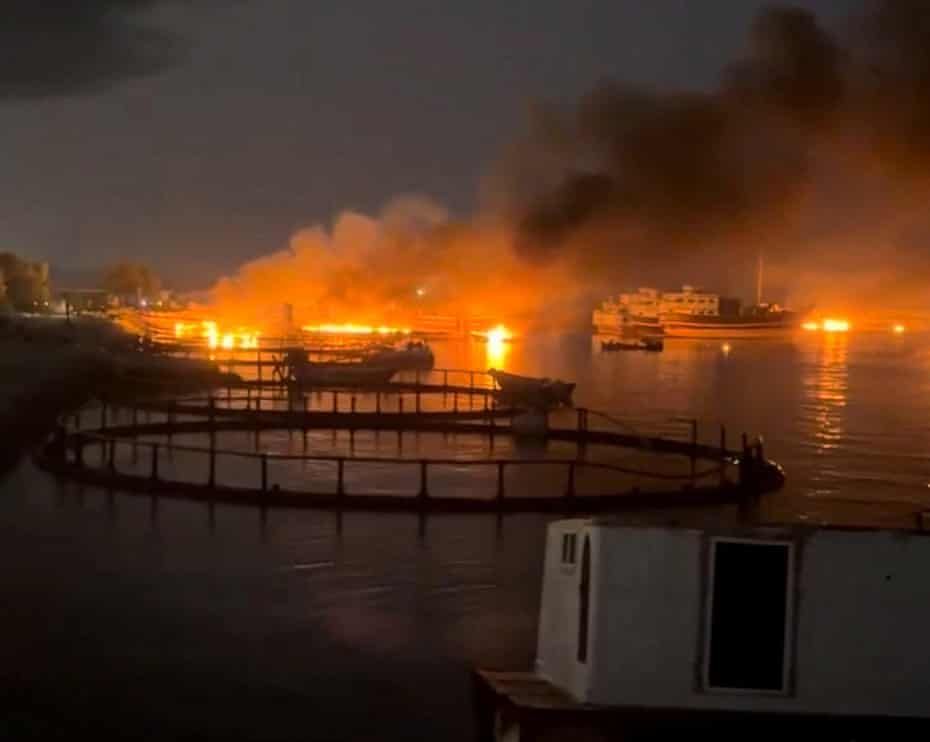
Within hours, explosions were reported in southern Iran, and US officials told reporters that the operation was designed to degrade Iran’s capacity to threaten commercial vessels in one of the world’s most critical oil chokepoints.
Trump Orders Renewed Military Action
The president did not wait for formal briefings before taking to social media to explain the rationale. In a post published late Wednesday, Trump wrote that the strikes were in response to Iranian actions at sea and that patience had run out. He said the interim deal brokered last month had failed to restrain Tehran and that the United States would no longer be bound by its terms.
Speaking to reporters at Nato, he doubled down on the message and suggested that the campaign could expand quickly if Iran continued to target merchant ships.”If It Happens Again, It Will Get Much Worse”
“If It Happens Again, It Will Get Much Worse”
“This is in retribution for yesterday’s bombing of ships by Iran,” Trump wrote. “If it happens again, it will get much worse!” At the summit, he told journalists that the United States would “probably hit hard again tonight” and that “anything that happens is going to happen very fast.” He also floated the idea that Washington might “just finish the job” but insisted that the current round of strikes was not intended to become a prolonged ground campaign.
US Central Command confirmed the operation in a statement posted on X. “At the direction of the Commander in Chief, US Central Command forces have started conducting additional strikes against Iran to further degrade their ability to threaten freedom of navigation in the Strait of Hormuz,” the command said.
Officials described the targets as military sites and port facilities linked to the launches against commercial vessels earlier in the week. An unnamed US official told Reuters that the second wave was expected to be larger than the first, reflecting what the Pentagon called a need to send a clear deterrent signal.
Explosions Reported Across Southern Iran
Iranian state media reported a series of blasts late Wednesday and into Thursday morning. The locations named included the port city of Bandar Abbas on the Strait of Hormuz, the coastal town of Sirik, and Bushehr province in the southwest, where Iran’s only operating nuclear power plant is located. State television also mentioned explosions heard on Abu Musa Island, one of three small islands in the Gulf that are disputed with the United Arab Emirates and that Iran uses to project control over the strait.
Bushehr Nuclear Site Reported Undamaged
Iran’s Mehr news agency said that the strikes in Bushehr province did not cause damage to the Bushehr nuclear power plant. There was no immediate independent confirmation, and the International Atomic Energy Agency said it was monitoring the situation closely.
Iranian officials accused the United States of deliberately targeting civilian infrastructure, a claim that Washington rejected. US officials said the aim was to hit launch sites and logistical nodes, not energy facilities, though they acknowledged the risk of collateral damage in such a densely developed coastal region.
The strikes came as Iran was observing days of national mourning for Supreme Leader Ayatollah Ali Khamenei, who was killed on the opening day of the US-Israeli campaign that triggered the current war. Millions had taken part in funeral processions across Iran and Iraq, and authorities were preparing for his burial in Mashhad. The timing added emotional weight to Tehran’s response and complicated any efforts by mediators to de-escalate.
Iran Responds With Missile And Drone Fire
Tehran did not wait to absorb the American strikes. Iranian forces fired again at US military installations in Bahrain and Kuwait on Thursday, just as they had done a day earlier. Air raid sirens sounded at least twice in Bahrain, where the US Navy’s 5th Fleet is headquartered. In Kuwait, the military said it was intercepting incoming projectiles and that there were no immediate reports of casualties or major damage.
Iranian officials have argued that the interim ceasefire gave them the right to regulate maritime traffic through the Strait of Hormuz, and they accused Washington of violating the spirit of the agreement by threatening shipping and then blaming Iran for the consequences.
Parliament speaker Mohammad Bagher Ghalibaf, who has been central to talks on a permanent end to hostilities, posted a defiant message online. “The era of bullying and extortion is over,” he wrote. “It leads nowhere. We don’t fold.”
Oil Markets And Global Diplomacy Feel The Shock
The market reaction was immediate. Brent crude, the global benchmark, rose more than 5 percent to trade close to $80 a barrel on Wednesday as traders priced in the risk of prolonged disruption to Gulf shipping.
US equity markets slipped, with energy and defense stocks moving in opposite directions. Analysts warned that any prolonged closure or harassment in the Strait of Hormuz could have outsized effects on global inflation, given that roughly a fifth of the world’s oil passes through the waterway.
Ceasefire Hopes Diminish
The escalation has effectively ended hopes of converting the 17 June memorandum into a durable peace deal. That agreement had paused direct strikes for several weeks and included a temporary US waiver allowing Iran limited oil exports.
The Treasury revoked that waiver on Tuesday after the tanker attacks, further squeezing Tehran’s finances. European diplomats who had been shuttling between Washington and Tehran said the window for negotiation had narrowed dramatically, and that both capitals now appeared to be preparing for a longer confrontation.
Domestic criticism in the United States was also swift. Senator Bernie Sanders condemned the president’s decision in sharp terms. “Restarting his reckless war with Iran won’t make America stronger,” Sanders said. “It will cost more lives and waste more taxpayer dollars.”
In a follow-up post on X, he added: “after getting the United States into a war based on lies, Trump has now declared the ceasefire with Iran ‘over’ after less than a month.” Other lawmakers called for congressional briefings and warned against mission creep, while some Republicans defended the strikes as necessary to protect American sailors and global commerce.
Strait Of Hormuz Becomes Central Flashpoint
The waterway has been at the heart of the crisis since last month, when the interim deal was meant to secure safe passage for commercial vessels. On Tuesday, three cargo ships were hit while transiting the strait, an incident that US officials blamed on Iranian-backed forces. Tehran denied direct responsibility but said it would not tolerate what it called foreign interference in regional waters.
Read also: Bedfordshire murder suspect flees to Zimbabwe after wife and daughters killed
Iran has long viewed control of the strait as a strategic lever, and the islands of Abu Musa, the Greater Tunb and the Lesser Tunb are key to that posture. The renewed focus on Abu Musa in Iranian state broadcasts suggests that Tehran wants to signal it can tighten the maritime chokepoint if pressure increases. Washington, for its part, says freedom of navigation is non-negotiable and that any attempt to close or harass traffic will meet force.
As the US strikes Iran for a second day, the conflict appears to be settling into a dangerous pattern of tit-for-tat attacks with little diplomatic space in between. Trump, speaking on his return flight from Nato, dismissed questions about security threats to Air Force One.
“I have a threat all the time. I’m number one on their list,” he said. For now, both sides are signaling resolve, and the region is bracing for what comes next as funerals, market volatility, and military operations continue in parallel.
About The Author