

US pressure on Vanuatu over ICJ climate ruling has intensified global debates about climate responsibility, highlighting growing divisions between vulnerable island nations and major powers at the United Nations.
The Pacific island nation of Vanuatu is championing a draft UN resolution to reinforce the advisory opinion delivered by the International Court of Justice climate opinion, declaring states legally obliged to act against climate change.
Vanuatu’s climate minister, Ralph Regenvanu, described the ICJ ruling as “a necessary legal and moral recognition” of threats faced by countries experiencing extreme weather and rising sea levels due to global warming.
According to reports, a US State Department cable circulated to embassies worldwide urged governments to pressure Vanuatu into withdrawing its draft UN resolution, signalling strong opposition from Washington’s administration.
The cable warned that the resolution sought to convert a non-binding advisory opinion into international obligations that could potentially expose states to claims of accountability for emissions.
Advisors in Washington expressed concerns that embracing the court’s guidance through the UN could create legal precedents, opening avenues for compensation demands or litigation against countries historically responsible for high emissions.
The ICJ opinion arose from a historic case in which judges reviewed tens of thousands of pages of written submissions and held extensive oral hearings spanning multiple weeks in The Hague.
Vanuatu initiated the case after securing support from 132 countries in the United Nations General Assembly, emphasising the urgency of global climate action and legal responsibility for states contributing to the crisis.
The case represented the largest examination of climate obligations ever undertaken by the court, culminating in a landmark advisory opinion framing climate change as an existential threat requiring immediate international attention.
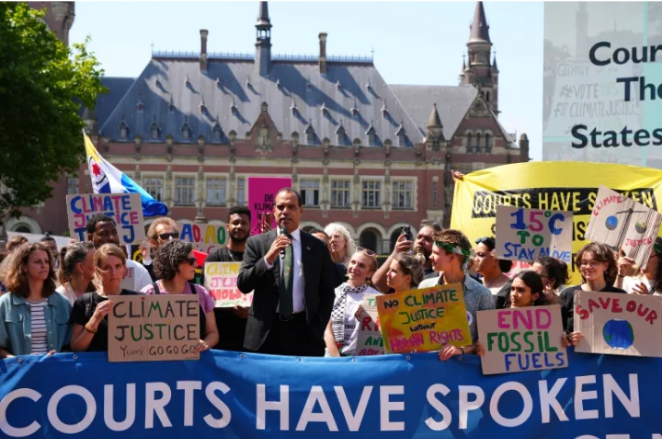
Human rights and environmental organisations have lauded Vanuatu’s leadership, calling for countries to respect both the scientific consensus and the legal guidance of the ICJ on climate responsibilities.
Louis Charbonneau, director at Human Rights Watch’s UN office, urged member states to support the draft UN climate accountability resolution, warning that ignoring climate obligations would endanger vulnerable populations worldwide.
Critics argue that the United States is attempting to undercut the influence of the court, reflecting broader patterns of US climate diplomacy backlash and skepticism toward binding international climate initiatives.
The Trump administration has consistently challenged multilateral climate frameworks, withdrawing from key UN climate bodies and opposing regulatory measures on emissions, including international agreements and shipping fuel levies.
Vanuatu’s UN ambassador, Odo Tevi, stressed that the draft resolution does not seek confrontation but aims to provide clarity, strengthen multilateral cooperation, and support global action against climate change.
Several nations, including Barbados, Kenya, the Marshall Islands, and Micronesia, have already signalled support for the resolution, recognising the urgent need to protect citizens from rising seas, stronger storms, and worsening heatwaves.
Analysts note that Vanuatu’s advocacy reflects small island nations’ increasing use of legal channels to hold larger emitters accountable and elevate global climate governance standards.
Opposition from the United States focuses on preventing the resolution from establishing legal obligations based on speculative climate models, which Washington officials describe as a potential threat to national sovereignty.
Experts argue, however, that advisory opinions from the ICJ, while non-binding, carry moral and political weight that often influences international negotiations, treaty interpretations, and future judicial decisions.
The unfolding situation highlights the tension between nations historically responsible for emissions and those most affected by climate impacts, with vulnerable countries leveraging law to amplify their voices globally.
Vanuatu’s campaign also demonstrates a strategic use of the UN as a forum for Vanuatu climate leadership, aiming to strengthen global recognition of climate risks and promote collective responsibility among states.
The diplomatic friction comes amid increasing awareness that inaction could threaten human rights, food security, economic stability, and safety for millions, particularly in low-lying and resource-poor regions.
Legal scholars argue that the ICJ opinion could serve as a precedent, influencing future litigation or negotiations regarding emissions reductions, adaptation funding, and international climate obligations.
Despite strong opposition, Vanuatu and its allies have continued to press for a vote on the draft resolution, scheduled to occur by the end of March, reinforcing its commitment to global accountability.
Washington’s approach reflects a broader pattern of resistance to multilateral climate interventions, demonstrating how political priorities may conflict with scientific consensus and international legal guidance.
The debate over the resolution also illustrates the complex interplay between international law, diplomacy, and environmental protection, showing how emerging legal norms can challenge traditional notions of state sovereignty.
Many experts view Vanuatu’s effort as a historic attempt to link moral responsibility with enforceable international action, reflecting the growing role of legal frameworks in addressing climate emergencies.
Small island nations have increasingly framed climate change as an existential threat, leveraging both the ICJ ruling and the UN system to advocate for rapid policy change from larger, more influential emitters.
The US response, meanwhile, has triggered discussions about the limitations of unilateral climate resistance and the consequences of opposing multilateral initiatives when global warming poses an urgent, collective risk.
With multiple countries backing the draft resolution, the outcome may signal whether ICJ opinions can effectively influence policy or remain primarily advisory instruments within international law.

Observers note that the dispute underscores a critical moment for global governance, where legal interpretations, scientific evidence, and geopolitical interests converge in shaping climate accountability mechanisms.
Vanuatu’s continued advocacy demonstrates that smaller nations are increasingly capable of driving global climate agendas, asserting that legal recognition of climate obligations is essential to survival and international fairness.
As negotiations unfold at the United Nations, the world watches whether US pressure on Vanuatu over ICJ climate ruling will prevail or whether international law will reinforce the legitimacy of collective climate responsibility.
The resolution’s fate could have lasting implications, defining how far advisory opinions can influence UN policymaking and whether vulnerable states can leverage legal arguments to secure stronger global protections.
Even before a vote, the controversy has prompted reflection on the intersection of law, science, and diplomacy, with Vanuatu positioned as a focal point for advancing climate justice through international mechanisms.
Ultimately, this situation demonstrates the growing relevance of international legal frameworks in shaping responses to climate change, with ICJ guidance offering both a tool and a challenge to traditional power dynamics.
Read also: High Court rules Palestine Action terror ban unlawful in landmark judgment
As the United Nations considers the draft resolution, the global community confronts a central question: can legal opinion catalyse meaningful climate action, or will political and economic interests continue to dominate decision-making?
The discourse surrounding US pressure on Vanuatu over ICJ climate ruling reveals how environmental imperatives increasingly intersect with law, diplomacy, and the pursuit of equitable, sustainable solutions for future generations.


