

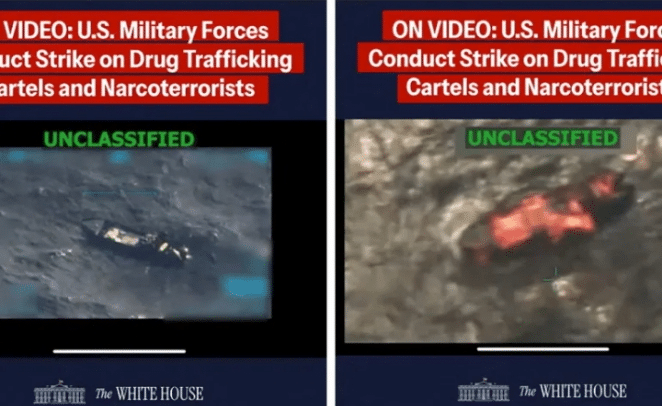
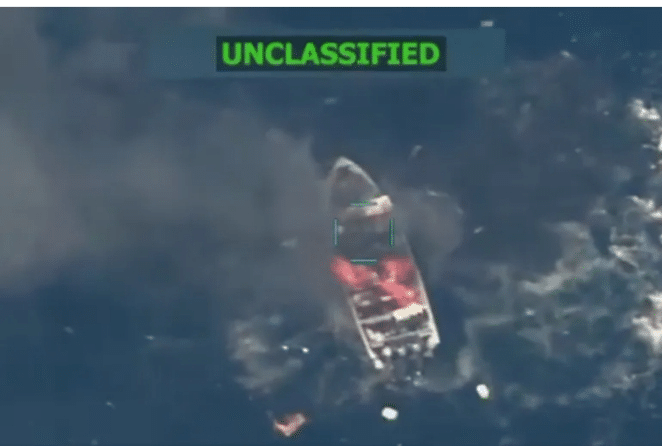
The US military has launched another strike on a vessel in the Caribbean, killing three men, according to Secretary of Defense Pete Hegseth. The operation followed intelligence reports.
Hegseth said the attack, carried out on the orders of US President Donald Trump, targeted individuals involved in illicit narcotics smuggling, which Washington has repeatedly described as “narco-terrorism.”
“All three male narco-terrorists aboard the vessel were neutralized during the strike,” Hegseth wrote on X. He added the operation took place in international waters, outside any recognized national territory.
The strike on Saturday follows a series of recent US attacks in the Caribbean, including a Wednesday strike that killed four men and multiple operations earlier this month that killed fourteen.
Since early September, the campaign has reportedly killed more than sixty-two individuals and destroyed fourteen boats and a semi-submersible vessel allegedly used for drug smuggling, according to US officials.
Critics question the legality of the strikes, calling them extrajudicial killings and a violation of international law, which limits the use of lethal force outside conflict zones.
Volker Turk, UN High Commissioner for Human Rights, condemned the US strikes in a statement on Friday, describing the escalating death toll as “unacceptable” and urging Washington to halt such operations immediately.
“The US must take all necessary measures to prevent the extrajudicial killing of people aboard these vessels, regardless of the criminal allegations against them,” Turk emphasized in the statement.
The attacks are occurring alongside a substantial US military buildup in the Caribbean, including guided-missile destroyers, F-35 fighter jets, a nuclear submarine, and thousands of deployed personnel.
The Trump administration has dispatched the Ford carrier strike group to the region, which is expected to arrive in the Caribbean in the coming weeks, raising concerns among neighboring countries.
Tensions have grown with Venezuela and Colombia, whose governments have condemned the strikes as illegal and an aggressive violation of their sovereignty, accusing the US of attempting regime change.
Venezuelan authorities, bolstered by increased security deployments nationwide, accuse Washington of targeting President Nicolas Maduro and destabilizing the country, claims that have been denied or downplayed by US officials.
Earlier this year, Washington doubled the reward for information leading to Maduro’s arrest to $50 million, citing alleged links between the Venezuelan leadership and international drug trafficking networks.
Trump has also publicly confirmed authorizing covert CIA operations in Venezuela, further signaling an aggressive stance on the region’s alleged drug trafficking activities, critics say, raising human rights concerns.
Russia’s Ministry of Foreign Affairs condemned the US military actions, labeling them as “excessive use of force” and in violation of both international law and US domestic regulations, according to spokesperson Maria Zakharova.
“Such actions undermine the national sovereignty of Venezuela,” Zakharova said, reaffirming Russia’s support for Caracas and calling on Washington to cease its military operations immediately.
Human rights organizations argue the strikes disproportionately affect civilians and low-level operatives while failing to address the broader drug trafficking networks that continue to operate unhindered.
Michael Vigil, a former DEA official, told reporters, “Targeting boats in the Caribbean has no measurable impact on the overall flow of drugs into the United States. The high-level traffickers remain untouched.”
Some analysts suggest that the US strikes serve more as a political signal than a functional counter-narcotics strategy, emphasizing show-of-force tactics over sustainable anti-drug policies.
Satellite imagery and open-source investigations indicate the vessels targeted have included both fishing boats and semi-submersibles, but independent verification of their involvement in drug trafficking remains limited.
Legal experts warn the US could face international scrutiny for violating maritime law and conventions restricting the use of lethal force in peacetime outside declared combat zones.
“These operations risk normalizing extrajudicial killings under the guise of counter-narcotics, setting dangerous precedents for other nations with global military reach,” said a maritime law analyst speaking on condition of anonymity.
Despite criticism, the Trump administration maintains the operations are justified under national security priorities, describing them as preventive measures against organized criminal networks threatening US borders.
The Pentagon has yet to release specific evidence supporting claims that the vessels were actively transporting narcotics, citing operational security and intelligence sensitivities in public statements.
Observers note that the strikes could strain US relations with Caribbean and Latin American nations, complicating broader diplomatic efforts and potentially destabilizing regional security environments.
Local populations in affected regions have expressed fear and uncertainty, with reports of boats caught in attacks leaving some communities hesitant to engage in traditional fishing or maritime trade.
“People are terrified to go out to sea,” said one Caribbean fisherman who requested anonymity. “Even if you are innocent, you could be targeted if your boat is mistaken for a drug vessel.”
Venezuelan authorities have reinforced coastal patrols and deployed additional troops, citing concerns that US military operations could escalate into a larger confrontation in international waters.
US officials argue the campaign aims to disrupt the supply of narcotics before they reach American shores, framing the strikes as a proactive defense measure against organized crime.
The debate over legality and morality continues, with international organizations calling for transparent investigations and accountability, highlighting the potential for civilian harm in high-intensity maritime operations.
Human rights groups have emphasized the urgent need for multilateral oversight, warning that unilateral military strikes without evidence risk undermining international law and fostering instability across the Caribbean.
As the US military continues its operations, diplomatic channels remain tense, with Venezuela and Colombia seeking support from allies, while the Trump administration insists the strikes are necessary to safeguard national interests.
Experts predict ongoing scrutiny from both legal and human rights organizations, noting that the number of casualties and scale of operations could influence future US foreign policy debates regarding extraterritorial military actions.
“The risk of escalation is real,” said an independent security analyst. “These strikes may not only affect US relations in Latin America but also have implications for global norms on the use of force.”
The strikes underscore the complex intersection of counter-narcotics policy, national security, and international law, raising questions about proportionality, oversight, and the long-term consequences for regional stability.
With over sixty lives reportedly lost in under two months and no public evidence presented, critics argue that the US military campaign risks becoming a protracted conflict with unclear objectives.
The Caribbean theater remains volatile, as the combination of high-profile military operations, political rhetoric, and regional alliances create an environment ripe for miscalculation and unintended escalation.
Washington has pledged continued vigilance, asserting that any future operations will target “narco-terrorists” and prioritize US security, even as international criticism mounts over the strikes’ legality and human cost.


